
You’ve read the research. You know Bluetooth headphones put a low-power radio transmitter next to your brain. You’ve seen the 2024 ACS Nano study showing earphone magnetic fields may promote nanoparticle accumulation in brain tissue. Now you want to know: what should I actually buy?
This isn’t one of those articles that lists “10 best EMF headphones” with affiliate links and zero science. We’re going to rank every headphone technology by actual EMF exposure, explain the physics behind each one, and give you enough information to make your own decision — because “EMF-safe” means different things depending on your risk tolerance.
The EMF Headphone Hierarchy: Ranked by Exposure
Here’s how headphone technologies stack up, from lowest to highest RF radiation at your head:
Tier 1: Zero RF Emission
1. Wired headphones with ferrite beads — LOWEST exposure
Standard 3.5mm wired headphones emit zero intentional RF. The audio signal travels as an electrical current through copper wire. No Bluetooth, no wireless protocol, no antenna.
However — and this is where it gets nuanced — wired headphones aren’t zero EMF. The wire can act as an antenna, conducting ambient RF from your phone up toward your head. This is real but small: a phone in your pocket with headphones produces orders of magnitude less head exposure than a phone pressed to your ear.
Adding a ferrite bead (a small clip-on cylinder) to the headphone cable near the earbuds further reduces conducted RF by absorbing high-frequency interference. Cost: $3-8 for a multipack. Effectiveness: measurable on a spectrum analyzer, though the baseline conducted RF from a wired connection is already low.
Best for: Maximum RF reduction with no compromise on audio quality. Limitation: Requires a headphone jack (increasingly rare) or a USB-C/Lightning adapter.
2. Air tube headphones — Zero RF near the ear
Air tube headphones (also called “anti-radiation earbuds”) are the gold standard in the EMF-conscious community. The concept is elegant: the last few inches of the headphone cable are replaced by hollow tubes. Sound travels from a conventional speaker driver (located partway down the cable) through the hollow tube as acoustic waves — just like a stethoscope.
No wire reaches your ear. No speaker magnet sits in your ear canal. No conducted RF travels to your head. The tradeoff: some loss of bass response and overall volume compared to conventional wired earbuds, because the air tube acts as a resonant cavity with its own frequency response.
Best for: People who want the lowest possible EMF at the ear without switching to speakerphone. Limitation: Audio quality is noticeably lower than good wired earbuds. Bass is thin. Max volume is lower.
Tier 2: Minimal RF Emission
3. Bone conduction headphones (wired) — Zero RF, different delivery
Wired bone conduction headphones bypass the ear canal entirely, vibrating your cheekbone to deliver sound directly to the cochlea. They exist but are extremely rare in the consumer market (most bone conduction headphones are Bluetooth).
If you can find them, they offer zero RF with the added benefit of keeping your ear canals open for environmental awareness.
Best for: Runners and cyclists who want EMF-free audio with situational awareness. Limitation: Very limited product selection. Sound quality is acceptable but not audiophile-grade.
4. Standard wired headphones (3.5mm or USB-C) — Near-zero RF
Any wired headphones with a direct analog or digital connection produce no intentional RF. The only EMF at your head comes from the tiny speaker magnets (static magnetic fields that drop to background levels within a few centimeters) and any conducted RF from the phone connection.
Over-ear wired headphones are slightly better than in-ear for total head exposure, simply because the drivers sit further from the brain.
Best for: Practical everyday use with minimal EMF. Limitation: Need a headphone jack or adapter. Cable management.
Tier 3: Low RF Emission
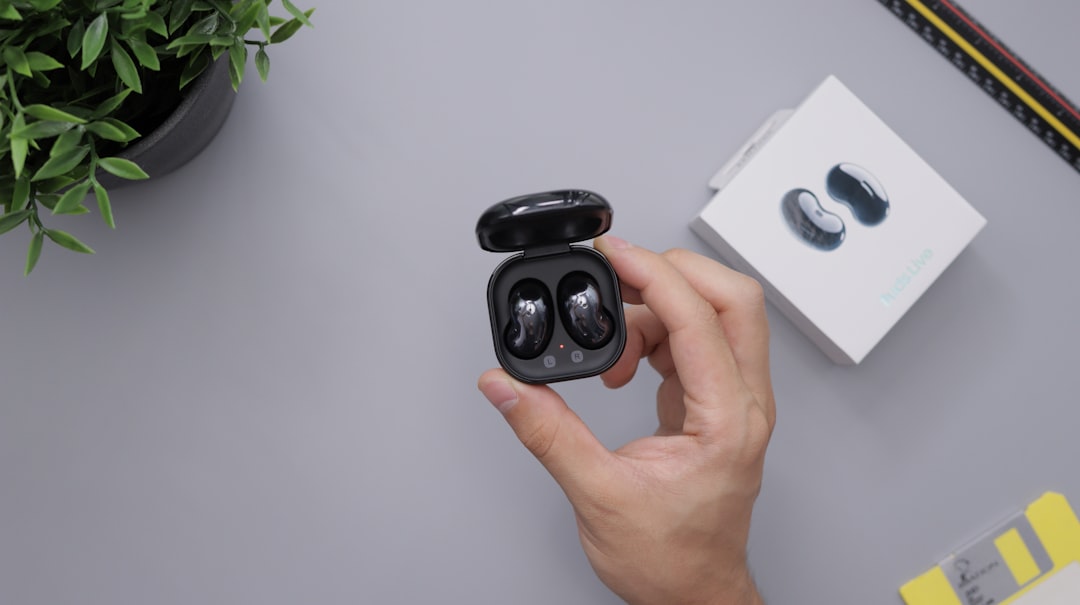
5. Bluetooth 5.0+ earbuds (low-power, Class 1)
Modern Bluetooth 5.0 and 5.2 earbuds (including AirPods, Galaxy Buds, and similar) transmit at very low power — typically 1-10 milliwatts, compared to a phone call’s 200-600 milliwatts. The FCC-measured SAR for AirPods Pro is around 0.072 W/kg for the head, compared to 1.17 W/kg for an iPhone 14 Pro pressed against the ear.
That’s roughly 16 times less RF exposure than a phone call — though the earbuds are closer to the brain and worn for longer durations (see our deep dive on whether AirPods cause cancer).
Bluetooth Low Energy (BLE) operates at 2.4 GHz with typical power output under 10 mW. The duty cycle is also lower than you might think — Bluetooth doesn’t transmit continuously. During music playback, it transmits in bursts, with pauses between packets.
Best for: People who want wireless convenience with relatively low RF. Limitation: Still a radio transmitter next to your brain. Long daily wear (8+ hours) means more cumulative exposure.
6. Bone conduction headphones (Bluetooth) — Low RF, skull pathway
Bluetooth bone conduction headphones (Shokz OpenRun, etc.) transmit RF at similar power to earbuds, but the vibration transducer sits on your cheekbone rather than in your ear canal. The Bluetooth antenna is typically in the neckband or rear section, not directly at the temple.
The net RF exposure is comparable to Bluetooth earbuds, but the delivery mechanism means the inner ear and auditory nerve are not in the near-field of the antenna.
Best for: Wireless users who want ear canal freedom and slightly different RF geometry. Limitation: Sound leaks at higher volumes. Bass is limited. Still Bluetooth.
Tier 4: Higher RF Emission
7. Active Noise Canceling (ANC) Bluetooth headphones
ANC headphones (AirPods Max, Sony WH-1000XM5, Bose 700) combine Bluetooth RF transmission with additional electronics: microphones, DSP chips, and extra batteries. Some models also support higher-power Bluetooth codecs (aptX HD, LDAC) that require more sustained transmission.
The ANC circuitry itself produces ELF magnetic fields from its electronics, though these are very weak. The primary EMF concern remains the Bluetooth RF, which is comparable to regular Bluetooth headphones.
Best for: Audio quality and noise isolation (not EMF reduction). Limitation: More electronics near your head. Sealed ear cups mean more time wearing them.
8. Wireless gaming headsets — Highest headphone RF
Many gaming headsets use proprietary 2.4 GHz or 5 GHz wireless (not Bluetooth) for lower latency. These protocols often transmit at higher power than Bluetooth and may have higher duty cycles during active gaming sessions.
Best for: Gaming performance. Limitation: Highest RF of any headphone type.
The Physics Cheat Sheet

| Technology | RF at head | Magnetic field (speaker) | Wire acts as antenna? | Overall EMF |
|---|---|---|---|---|
| Air tube (wired) | None | None at ear | Minimal | Lowest |
| Wired + ferrite | None | Tiny (in-ear driver) | Reduced | Very low |
| Standard wired | None | Tiny (in-ear driver) | Possible | Low |
| Bone conduction (wired) | None | None at ear | Minimal | Low |
| Bluetooth 5.0 earbuds | ~1-10 mW | Tiny | N/A | Moderate |
| Bone conduction (BT) | ~1-10 mW | None at ear | N/A | Moderate |
| ANC Bluetooth | ~1-10 mW | Tiny + ELF from DSP | N/A | Moderate-High |
| Gaming wireless | ~10-100 mW | Tiny | N/A | Highest |
Check your EMF exposure
See cell towers, power lines, and substations near any US address.
Search Your AddressWhat About Speaker Magnets?
Every conventional headphone — wired or wireless — has a permanent magnet in the driver that creates the magnetic field to move the diaphragm. This produces a static (DC) magnetic field, not an alternating one.
The Zhang et al. 2024 study published in ACS Nano found that earphone magnetic fields could promote accumulation of iron oxide nanoparticles in brain tissue. This mechanism involves the static magnetic field from the earphone speakers, not RF.
Key context:
- The study used iron oxide nanoparticles already present in the experimental system — the earphone field didn’t create nanoparticles, it influenced their distribution
- The magnetic field strength from consumer earbuds is in the microtesla to low millitesla range at the earbud surface, dropping off rapidly with distance
- Over-ear headphones, where the driver is further from the skull, produce weaker fields at the brain than in-ear models
This is one reason air tube headphones exist: no speaker magnet near the ear canal at all.
Practical Tips (Whatever You Own)
Even if you’re not buying new headphones, you can reduce your exposure:
1. Use speakerphone when possible
The biggest win isn’t better headphones — it’s getting the phone away from your head entirely. Speakerphone at arm’s length reduces head RF exposure by 90%+ compared to any headphone.
2. Prefer wired mode when your headphones support it
Many Bluetooth headphones (Sony, Bose, Sennheiser) include a 3.5mm cable for wired use. Plugging in disables the Bluetooth radio. Same headphones, zero RF.
3. Turn off Bluetooth when listening to stored music
If you’re listening to downloaded music (not streaming), you can put your phone in airplane mode and use wired headphones. Zero RF from both devices.
4. Take breaks
If you wear Bluetooth earbuds all day, take them out periodically. Even 10-minute breaks between calls reduce cumulative exposure. Your ears will thank you too — the link between prolonged earbud use and hearing damage is far more established than any EMF concern.
5. Keep the phone away from your body
Whether wired or wireless, keeping your phone in a bag rather than a pocket during calls reduces whole-body RF exposure. The headphone gets the audio to your ear — use that distance advantage.
6. Check your phone’s SAR rating
If you’re worried about headphone EMF, check how much your phone emits first. Our Cell Phone SAR Comparison Tool ranks 70+ phones by radiation output. The phone is almost always the bigger source.
What About “EMF Blocking” Headphones?
Some products marketed as “EMF protection headphones” claim to block or shield radiation. Be skeptical:
- Air tube headphones work as described — they physically remove the wire and speaker from your ear canal. The physics is sound.
- “Shielded” headphone cables with metallic braiding can reduce conducted RF on the wire. Marginally useful.
- “Anti-radiation” stickers or chips for headphones: no credible mechanism, no peer-reviewed evidence. See our EMF protection products review for the full breakdown.
- Faraday headphone cases: wouldn’t work while you’re wearing them. By definition, you can’t shield something while simultaneously receiving its signal.
The only EMF headphone products worth buying are those that physically change the EMF pathway (air tubes, wired connections) or reduce transmission power (Bluetooth Low Energy settings). Anything that claims to “harmonize” or “neutralize” frequencies is marketing, not physics.
Specific Product Recommendations by Category
Best air tube earbuds
Look for brands like DefenderShield, SafeSleeve, or RadiArmor. Check that the air tube section starts below the jaw (some cheap knockoffs have extremely short tubes). Sound quality is acceptable for calls and podcasts — don’t expect audiophile bass.
Best wired earbuds for low EMF
Any quality wired earbuds work. Apple EarPods (3.5mm or USB-C), Samsung wired earbuds, or enthusiast options like Etymotic ER2 or Shure SE215. Add a clip-on ferrite bead for an extra margin.
Best wired over-ear headphones
Audio-Technica ATH-M50x, Sony MDR-7506, or Beyerdynamic DT 770 Pro. Over-ear drivers sit further from the skull, and these models all have detachable cables (useful if you want to add a ferrite bead at the headphone end).
Lowest-EMF Bluetooth earbuds (if you must go wireless)
Look for Bluetooth 5.2 or newer — these protocols use lower transmission power and smarter duty cycling. Apple AirPods Pro 2 and Samsung Galaxy Buds FE both use BLE efficiently. Avoid earbuds that advertise “extended range” — that typically means higher transmit power.
The Honest Assessment
Wireless headphones are a low-power RF source worn near the brain for extended periods. The exposure per minute is far lower than a phone call, but the cumulative hours are often higher — many people wear earbuds 4-8 hours daily.
If you’re in the “any unnecessary RF exposure is worth avoiding” camp: switch to wired or air tube headphones. The science supports this as the lowest-exposure option, and the practical cost is a cable.
If you’re in the “the dose makes the poison” camp: modern Bluetooth earbuds at ~0.07 W/kg SAR are far below the FCC limit of 1.6 W/kg, and the evidence for harm at these levels remains thin. Use them with awareness.
Either way, the phone itself is almost certainly your biggest RF source. Check where the nearest cell towers are relative to where you spend your day — that ambient exposure dwarfs anything your headphones produce.
Frequently Asked Questions
Are air tube headphones actually effective?
Yes — the physics is straightforward. By replacing the last section of wire with a hollow tube, no electrical current or conducted RF reaches the ear. The tradeoff is reduced audio quality (thinner bass, lower max volume) since sound travels through air rather than being directly driven by a speaker. For calls and podcasts, most users find the quality acceptable.
Do wired headphones have zero EMF?
Not exactly zero. Wired headphones have tiny speaker magnets (producing static magnetic fields) and the wire can conduct some ambient RF from the connected phone. But the exposure is vastly lower than wireless — there’s no intentional RF transmission, and the conducted RF is negligible compared to holding a phone to your ear.
Are bone conduction headphones safer than regular earbuds?
If wired, they eliminate both the speaker magnet near the ear canal and any conducted RF. If Bluetooth (most are), the RF exposure is similar to regular Bluetooth earbuds, just delivered to a different spot on the skull. The inner ear isn’t in the antenna’s near-field, which may reduce exposure to the auditory nerve specifically.
How much EMF do AirPods actually emit?
Apple AirPods Pro 2 have an FCC-measured SAR of approximately 0.072 W/kg for the head — about 16x lower than a typical iPhone held to the ear. The Bluetooth transmitter operates at under 10 milliwatts. For detailed analysis, see our full article on AirPods and cancer risk.
Should I be worried about 5G headphones?
No consumer headphone currently uses 5G. All wireless headphones use Bluetooth (2.4 GHz) or proprietary Wi-Fi-band protocols (2.4/5 GHz). These frequencies haven’t changed with 5G cellular rollouts. If you see “5G compatible” on headphone marketing, it’s referring to phone connectivity, not the headphone’s own wireless protocol.
What’s the single best thing I can do to reduce headphone EMF?
Use speakerphone when possible. It eliminates head proximity entirely. When that’s not practical, use any wired headphone — even cheap ones. The jump from Bluetooth to wired is much larger than the jump between different wired options.
Related Reading
- EMF Blocking Phone Cases: Do They Work? — Physics breakdown of shielding cases and power compensation
- Do AirPods Cause Cancer? — Full science review of wireless earbuds
- EMF Protection Products: What Works and What’s a Scam — Our complete protection product guide
- Cell Phone SAR Comparison Tool — Compare radiation levels across 70+ phone models