Your hair dryer is probably the highest-EMF device you own. Not your phone. Not your WiFi router. Not even your microwave.
That sounds dramatic, but the measurements don’t lie. A typical hair dryer produces 50–300 milligauss (mG) of magnetic field at the nozzle — literally pressed against your head. For context, the epidemiological signal for childhood leukemia starts at just 3 mG, and the Swiss government’s precautionary limit is 10 mG (1 µT).
The good news? Not all hair dryers are equal. Some produce 10× less EMF than others, and a few simple habits can cut your exposure by 90% regardless of which dryer you use.
Why Hair Dryers Are Different from Other EMF Sources
Most EMF conversations focus on radiofrequency (RF) radiation from cell towers, WiFi, and phones. Hair dryers are a different beast entirely — they produce extremely low frequency (ELF) magnetic fields from their electric motors and heating coils.
Here’s why that matters:
The Proximity Problem
Hair dryers are used inches from your brain. A 1994 computational study modeled exactly what happens: researchers mapped the magnetic fields from a hair dryer onto a 3D anatomical head model and found that induced electric fields and current densities in brain tissue were surprisingly significant — not because the dryer is especially powerful, but because the inverse square law works both ways. At point-blank range, even moderate fields create meaningful tissue exposure.
The Duration Factor
The average person uses a hair dryer 2–5 minutes per session. Professional stylists? 6–8 hours per day. That’s a massive difference in cumulative exposure.
The Measurement Data
Here’s what researchers have actually measured at various distances from typical hair dryers:
| Distance from nozzle | Magnetic field (mG) | Context |
|---|---|---|
| At motor housing | 200–400 mG | Where your hand grips |
| 2 inches (nozzle) | 50–300 mG | Where your head is |
| 6 inches | 10–70 mG | Typical styling distance |
| 12 inches | 1–10 mG | Arm’s length |
| 24 inches | 0.1–1 mG | Background levels |
A Washington DC field study found ELF magnetic fields were elevated by a mean factor of 17 over ambient levels at 10 cm from hair dryer nozzles. That’s not subtle.
What Makes a Hair Dryer “Low EMF”?
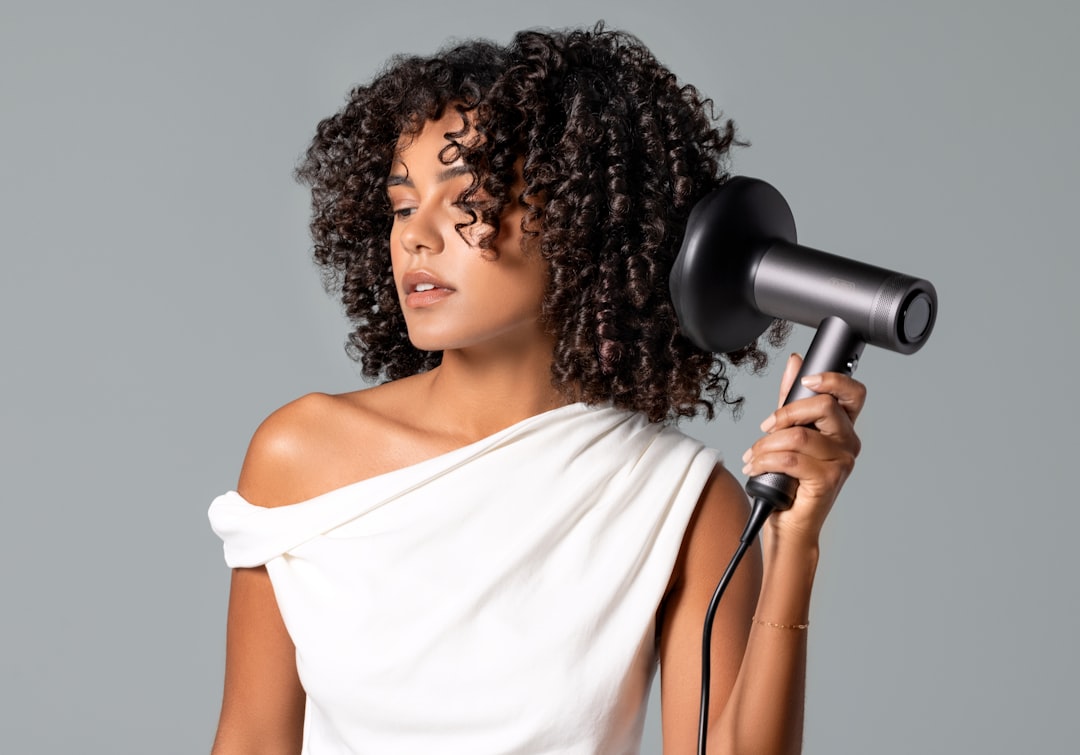
Not all hair dryers produce the same fields. The key variables:
Motor Type
- Brushless DC motors produce significantly less EMF than traditional brushed AC motors. The carbon brushes in conventional motors create electrical arcing — tiny sparks that generate broadband electromagnetic noise on top of the 60 Hz fundamental.
- Dyson’s digital motor (V9) is brushless and runs at 110,000 RPM. Higher RPM means faster drying = less total exposure time, even though instantaneous fields may be comparable.
Heating Element Design
- Ceramic heating elements tend to produce lower and more uniform magnetic fields than nichrome wire coils.
- Tourmaline/ionic dryers don’t necessarily have lower EMF — the ionic feature is about hair conditioning, not field reduction.
Motor Position
- Hair dryers with the motor in the handle (like the Dyson Supersonic) keep the strongest field source farther from your head compared to traditional barrel designs where the motor sits right behind the nozzle.
Shielding
Some premium dryers incorporate rudimentary magnetic shielding around the motor. This typically reduces fields by 20–40% at close range but isn’t a standard feature mentioned in marketing materials.
Check your EMF exposure
See cell towers, power lines, and substations near any US address.
Search Your AddressHair Dryer EMF Compared to Other Appliances
| Device | Typical magnetic field | Distance used | Daily exposure time |
|---|---|---|---|
| Hair dryer | 50–300 mG | 2–6 inches from head | 2–10 min |
| Microwave oven | 100–300 mG | 1–3 feet | 2–5 min |
| Electric shaver | 15–100 mG | Contact | 2–5 min |
| Laptop (on lap) | 2–20 mG | Contact | 1–8 hours |
| Cell phone (call) | 0.1–2 mG (ELF) | Contact | 30–120 min |
| WiFi router | 0.01–0.1 mG (ELF) | 3–30 feet | 24/7 |
| 3 mG threshold | 3 mG | — | Epidemiological signal |
The hair dryer stands out not because it’s the most powerful source, but because it combines high field strength with extreme proximity to the brain — a combination no other common appliance matches.
The Best Low-EMF Hair Dryers in 2026
Tier 1: Lowest EMF (Brushless Motor + Optimized Design)
Dyson Supersonic (~$400)
- Brushless digital motor in handle (away from head)
- Measured: ~40–80 mG at nozzle (varies by speed setting)
- Fastest drying = shortest exposure time
- Magnetic attachments add slight field at attachment point
- Best for: Maximum performance + minimum exposure
Zuvi Halo (~$350)
- Light-based drying technology (infrared)
- No traditional heating coil = dramatically lower ELF from heating element
- Measured: significantly lower than conventional dryers in independent tests
- Slower drying than hot-air dryers
- Best for: People prioritizing lowest possible EMF
Tier 2: Lower Than Average (Ceramic + Quality Construction)
GHD Helios (~$250)
- Brushless motor with advanced aerodynamics
- Ceramic heating element
- Professional-grade build quality reduces stray fields
- Measured: ~60–120 mG at nozzle
- Best for: Professional styling + reasonable EMF profile
BaBylissPRO Nano Titanium (~$90)
- Ceramic + titanium heating elements
- Good airflow efficiency (shorter drying time)
- Budget-friendly with decent construction
- Best for: Mid-range option
Tier 3: Standard (What to Avoid)
Generic drugstore dryers ($15–40) typically have:
- Brushed AC motors (more EMF + more electrical noise)
- Nichrome wire coils (higher stray fields)
- Poor motor shielding
- Slower airflow = longer drying time = more total exposure
How to Reduce Hair Dryer EMF by 90% (Any Dryer)

The biggest lever isn’t which dryer you buy — it’s how you use it:
1. Towel-Dry First (Biggest Impact — Free)
Removing 50–70% of water with a microfiber towel before blow-drying cuts drying time in half. Half the time = half the exposure.
2. Use the Cool Setting When Possible
The heating element is the largest single contributor to the magnetic field. Cool air still dries — just more slowly. Use hot for the first 60 seconds, then switch to cool.
3. Keep Distance
Moving from 2 inches to 6 inches reduces the field by roughly 75%. Use a concentrator nozzle or diffuser attachment — they naturally add a few inches of distance.
4. Use the Lowest Heat + Highest Speed Setting
More airflow and less heat = faster drying with lower EMF per second. The motor contributes less to the total field than the heating element.
5. Air-Dry When You Can
This isn’t always practical, but even partial air-drying (roots, then blow-dry the ends) reduces exposure significantly.
6. Hold at Arm’s Length for Rough Drying
For the initial rough-dry phase, you don’t need precision. Hold the dryer at arm’s length and use body heat and air movement. Switch to close-range only for styling.
For Professional Stylists: Occupational Considerations
If you use a hair dryer 6–8 hours per day, your cumulative ELF magnetic field exposure is in a completely different category than a home user. The European review of occupational EMF exposures specifically identified hairdressers as a population of interest.
Practical steps for professionals:
- Invest in a brushless-motor professional dryer (GHD Helios, Dyson)
- Hold the dryer with your non-dominant hand further from the motor housing
- Take breaks between clients to allow any potential biological effects to resolve
- Consider your total exposure picture (fluorescent lighting, other salon equipment)
- An ELF meter like the TriField TF2 can identify hot spots in your workstation
What the Science Actually Says
The honest truth: there’s no study directly linking hair dryer EMF to any specific health outcome. The concern is based on extrapolation from:
-
Childhood leukemia epidemiology — associations appear above ~3 mG chronic residential exposure (Brabant 2023 meta-analysis, multiple residential studies). Hair dryers produce 10–100× this level, but for minutes rather than 24/7.
-
Occupational ELF studies — electrical workers with chronic ELF exposure show slightly elevated risks for some cancers and neurodegenerative diseases (Swiss National Cohort: HR 1.54 for Alzheimer’s per 1 µT). Hairdressers could be in this category.
-
Biological mechanisms — ELF magnetic fields above ~1 mG can induce electrical currents in tissue. The 3D head modeling study (Gandhi et al.) confirmed meaningful induced currents from hair dryer fields.
The bottom line: hair dryer EMF is probably not a health priority for most people who use one 5 minutes a day. But if you’re already reducing EMF from other sources, or you’re a professional stylist, choosing a low-EMF model is a sensible, low-cost precaution.
How to Measure Your Hair Dryer’s EMF
Want to know exactly what your dryer produces?
- Get an ELF magnetic field meter (TriField TF2, GQ EMF-390, or even a smartphone magnetometer app like Phyphox for rough readings)
- Turn on the dryer at each speed/heat setting
- Measure at the nozzle, 6 inches, 12 inches, and 24 inches
- Record the magnetic field component (in mG or µT)
- Compare across settings — you’ll likely see 2–3× difference between low-cool and high-hot
The EMF Radar interactive map can show you the bigger picture of EMF sources around your home, and our home testing guide walks through measuring every room.
Frequently Asked Questions
Do ionic or tourmaline hair dryers have lower EMF?
No — ionic and tourmaline features affect hair conditioning (negative ions reduce static, tourmaline produces infrared heat). They have no meaningful effect on the magnetic field produced by the motor and heating element. Motor type and construction quality matter; marketing buzzwords don’t.
Can a hair dryer cause brain cancer?
There’s no evidence linking hair dryer use to brain cancer. The concern is theoretical, based on the high proximity and field strength. Population studies of hairdressers haven’t found elevated brain cancer rates, though these studies are limited.
Is it safe to blow-dry my child’s hair?
Children’s thinner skulls absorb more electromagnetic energy than adults’. For daily use on children, consider towel-drying more thoroughly and using the cool setting, or switching to a brushless-motor dryer. For occasional use (a few minutes, a few times per week), the exposure is likely negligible.
Do professional salon dryers produce more EMF?
Not necessarily — professional dryers often have better motors and more powerful airflow, meaning faster drying times. Some professional models (GHD Helios, Dyson) are among the lowest-EMF options available.
How does a hair dryer compare to living near a cell tower?
They produce completely different types of EMF. Hair dryers produce ELF (60 Hz) magnetic fields at very high levels for very short durations. Cell towers produce RF (700 MHz–3.5 GHz) fields at very low levels continuously. The biological effects and mechanisms are different. Use our interactive map to check cell tower proximity for your address.
Should pregnant women avoid hair dryers?
The Kaiser Permanente miscarriage study found elevated risk at sustained ELF exposure above 2.5 mG. A hair dryer exceeds this level during use, but for only a few minutes. The precautionary approach: towel-dry more, use cool settings, and keep the dryer at arm’s length during pregnancy. See our pregnancy EMF guide for comprehensive advice.
Related Reading
- Low-EMF Air Purifiers: The Best Options for Clean Air Without Electromagnetic Pollution
- Low-EMF Space Heaters: The Best Options for Warm Rooms Without High Radiation
- 10 Common 5G and EMF Myths Debunked by Science
Concerned about EMF in your home? Check your address on EMF Radar to see nearby cell towers and power lines, or find a certified EMF consultant for a professional home assessment.