EMF Protection During Pregnancy: A Room-by-Room Guide for Expectant Mothers
You’re growing a human. That’s already enough to worry about without adding invisible electromagnetic fields to the list. But if you’ve landed here, you probably want to know: what can I actually do to reduce my EMF exposure while pregnant?
Good news — this isn’t a scare piece. We’re not here to tell you to move off the grid or wrap your belly in aluminum foil. This is a practical, room-by-room guide based on the research that exists, the precautionary principle that major health organizations recommend, and common sense.

Why EMF and Pregnancy Deserves Attention
Let’s start with what we actually know.
The most-cited study on EMF and pregnancy comes from Kaiser Permanente (2017), where researchers gave 913 pregnant women wearable EMF monitors and tracked their pregnancy outcomes. Women with higher magnetic field exposure had a 2.72 times higher miscarriage risk compared to those with lower exposure. The study was published in Scientific Reports, a Nature journal — this isn’t fringe science. Read our complete EMF and miscarriage analysis for the full research breakdown including the 2026 uterine effects review.
The World Health Organization’s International Agency for Research on Cancer (IARC) classifies ELF magnetic fields as “possibly carcinogenic to humans” (Group 2B). Radiofrequency EMF from cell phones and towers got the same classification in 2011.
Does this mean EMF causes pregnancy complications? Not definitively. But it means there’s enough evidence to warrant caution — especially when the precautions are easy and free.
The precautionary principle is simple: when the cost of protection is low and the potential risk is real, reduce exposure where you reasonably can. You don’t need to live in fear. You just need to be smart about it.
The Two Types of EMF That Matter

Before we go room by room, a quick distinction:
Extremely Low Frequency (ELF) EMF — produced by anything plugged into the wall. Power lines, appliances, wiring. Falls off rapidly with distance. This is what the Kaiser study measured.
Radiofrequency (RF) EMF — from wireless devices. Cell phones, Wi-Fi routers, Bluetooth, cell towers. Also falls off with distance, but travels further.
Both types can be reduced with the same core strategy: distance and time. More distance from the source = less exposure. Less time near the source = less total dose.
Check your EMF exposure
See cell towers, power lines, and substations near any US address.
Search Your AddressRoom-by-Room Protection Guide
🛏️ The Bedroom — Where You Spend 8+ Hours
Your bedroom is the single most important room to optimize because you spend roughly a third of your life there — and during pregnancy, probably more.
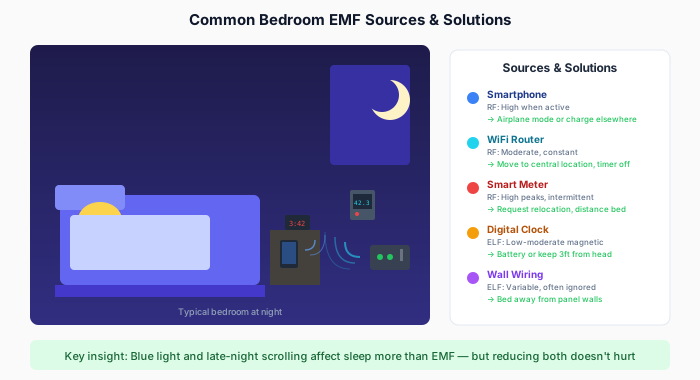
The phone on the nightstand. This is the biggest win. Your phone constantly communicates with cell towers and Wi-Fi, producing RF radiation inches from your body for 8 hours straight. Solutions:
- Put your phone in airplane mode before bed. If you need an alarm, airplane mode still allows the alarm to work. Better yet, get a $10 battery-powered alarm clock and charge your phone in another room.
- Move it across the room. Even 3-4 feet dramatically reduces exposure. The inverse square law means doubling the distance cuts exposure by 75%.
- Don’t sleep with it under your pillow. This sounds obvious, but surveys show 44% of smartphone users keep their phone in bed.
The charging cable. Any charging device produces a small magnetic field. Keep chargers at least 3 feet from your bed — not on the nightstand beside your head.
Electric blankets and heated mattress pads. These produce surprisingly strong magnetic fields because the wire runs the entire length of the blanket right against your body. If you use one, heat the bed, then unplug it before getting in. Even turning it off isn’t enough if it’s still plugged in — the wiring can still carry current.
Wi-Fi router. If your router is in the bedroom (or the room next door, against a shared wall), consider one of these:
- Move it to a central location further from bedrooms
- Use a simple outlet timer to turn it off during sleep hours (11 PM – 7 AM). You won’t miss it.
- At minimum, don’t place it within 6 feet of your bed
The baby monitor preinstalled in the nursery? We’ll get to that.
👶 The Nursery — Set It Up Right the First Time
You’re probably setting up the nursery during pregnancy, which means you have a chance to get it right before the baby arrives.

Wi-Fi baby monitors. Modern baby monitors are essentially small cell towers in your baby’s room, transmitting constantly. The RF exposure from a Wi-Fi monitor placed 3 feet from the crib is comparable to being 30 feet from a cell tower.
Better options:
- Analog (DECT) monitors produce less RF than Wi-Fi models
- Audio-only monitors produce far less than video monitors
- Wired cameras connected via Ethernet produce zero RF
- If you use a Wi-Fi monitor, place it at least 6 feet from the crib — never mounted on the crib itself
The crib location. Check what’s on the other side of the wall. Is there an electrical panel? A smart meter? A neighbor’s Wi-Fi router? Use our EMF map tool to check for nearby cell towers, and place the crib on an interior wall away from known sources.
Wiring in the walls. Older homes with unshielded wiring can produce measurable magnetic fields. You can’t see this without a meter, but a general rule: avoid placing the crib against a wall with many outlets or where you know heavy electrical runs exist (usually the kitchen/laundry wall).
🍳 The Kitchen — Appliance Distance Matters
The kitchen contains some of the highest-EMF appliances in your home — but you typically spend minutes, not hours, near them.
The microwave. Produces both ELF (from the motor and magnetron) and RF (the microwaves themselves, though shielded). The magnetic field from a microwave at 1 foot can be 40-80 milligauss — well above background levels. At 4 feet, it drops to near-zero.
→ Start the microwave and step back 4+ feet. That’s it. Simple.
The induction cooktop. Induction stoves produce strong magnetic fields because they work by creating alternating magnetic fields to heat the pan. The field drops off quickly, but pregnant women may want to:
- Stand slightly further back than usual (arm’s length)
- Use the back burners when possible
- Consider using traditional gas or radiant electric for the duration of pregnancy
The refrigerator. The compressor motor produces a constant low-level magnetic field. Not a concern unless your dining chair or a place where you sit for extended periods is right against the fridge wall. Just maintain a couple of feet of distance.
Smart home devices. Your smart speaker (Alexa, Google Home), smart displays, and any IoT devices in the kitchen produce continuous RF. They’re low-power, but the cumulative effect of 10+ smart devices in a home adds up. Consider whether you need all of them active, or if some can be unplugged during pregnancy.
💻 The Home Office / Workspace
If you’re working from home during pregnancy, this is where you accumulate significant exposure over long periods.

The laptop on your belly. This is probably the single worst EMF habit during pregnancy. A laptop produces both magnetic fields (from the processor, hard drive, and charger) and RF (from Wi-Fi and Bluetooth). Placed directly on your abdomen, your developing baby gets the full dose.
→ Always use a desk or table. If you must use it on your lap, use a thick cushion or lap desk — but a table is better. → Use an external keyboard and mouse so you can push the laptop further away. → Connect via Ethernet and disable Wi-Fi when possible. This eliminates RF from the laptop entirely.
Desktop vs. laptop. Desktop computers allow you to sit at arm’s length from the monitor and further from the CPU. If you have the choice, a desktop setup with a wired connection is lower-exposure.
Charging and power strips. A power strip under your desk, near your feet, produces a magnetic field you sit in all day. Move it to the side of your desk, or better yet, mounted on the wall behind the desk.
Trimester-Specific Considerations
First Trimester (Weeks 1-12)
This is the period of most rapid cell division and organ formation. The Kaiser Permanente study found the strongest association between EMF exposure and miscarriage in the first trimester. This is when precautions matter most.
Priority: bedroom optimization (airplane mode, move the phone), laptop-off-belly, reduce microwave proximity.
Second Trimester (Weeks 13-26)
Neural development is in full swing. The fetal brain is developing rapidly, and some animal studies suggest EMF may affect neurological development at this stage.
Priority: nursery setup (get the baby monitor and crib placement right), reduce cumulative daily exposure from work setup.
Third Trimester (Weeks 27-40)
Growth and weight gain phase. Less vulnerability to EMF disruption than the first trimester, but maintaining habits is still smart.
Priority: maintain the habits you built. Review your home’s cell tower proximity if you’re nesting and considering any room changes.
Your Quick-Start Checklist

Not everyone has time to optimize every room. Here are the five highest-impact changes you can make today, in priority order:

- Phone in airplane mode at night (or across the room) — eliminates your single longest continuous exposure
- Laptop off your belly — use a desk or table, always
- Step back from the microwave — 4 feet while it runs
- Wi-Fi timer for sleep hours — 8 hours of zero RF every night, no effort after setup
- Check your home’s surroundings — use EMF Radar to see cell towers near your address, and factor proximity into nursery placement
If you’re considering EMF shielding products like maternity belly bands or blankets, read our EMF blocking clothing guide first — it covers what actually works, what doesn’t, and how to evaluate products before you buy.
What About Cell Towers Near Your Home?
If you’re pregnant and wondering whether the cell towers in your neighborhood are a concern, that’s exactly what EMF Radar was built for.
Enter your address and you’ll see:
- Every cell tower within a configurable radius
- Distance and direction from your home
- Tower density compared to other areas
- Your city’s overall EMF score and national ranking
This data won’t tell you your exact exposure level (that requires a physical measurement), but it gives you context. A home with 2 towers within a mile is in a very different situation than one with 15.
If you’re house-hunting while pregnant, this is especially useful. Check the EMF environment of any address you’re considering — before you sign the lease or close the deal. We’ve built shareable EMF reports for exactly this purpose.
What the Research Doesn’t Say
Let’s be clear about the limits:
- No study has proven EMF causes birth defects in humans. The Kaiser study found an association with miscarriage risk, not causation, and not with birth defects specifically.
- Normal household EMF levels are well below international safety limits set by ICNIRP and the FCC.
- Distance is your best friend. Almost every EMF source drops to near-background levels within a few feet.
- Stress is also bad for pregnancy. Don’t let EMF anxiety create more harm than the EMF itself. Make reasonable changes, then relax.
The goal isn’t perfection. It’s informed reduction — making the easy changes that reduce your exposure without disrupting your life.
Further Reading
- EMF Exposure While Pregnant: What the Research Says — deeper dive into the scientific studies
- How Far Should You Live from a Cell Tower? — distance-based analysis
- Baby Monitor EMF Radiation: Should Parents Be Concerned? — detailed monitor comparison
- Reduce EMF Exposure at Home — comprehensive home guide
- EMF and Children: Parent’s Guide — continues the protection conversation after birth
- EMF and Autism: What the Science Actually Shows — honest look at the evidence for EMF-autism connections
- Check your address on EMF Radar — see cell towers near your home
Planning ahead? If you’re trying to conceive, see our EMF and female fertility guide for preconception considerations and the latest WHO research.
Related Reading
- Low-EMF Hair Dryers — pregnancy-safe hair drying tips
Concerned about EMF in your environment? Check your address on EMF Radar to see nearby cell towers and power lines, or find a certified EMF consultant for professional testing.