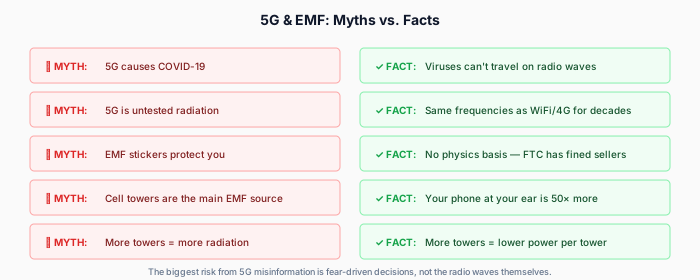
Scroll through social media and you will find no shortage of alarming claims about 5G and EMF — everything from “5G caused COVID” to “cell towers emit nuclear radiation.” Some of these myths are easily dismissed; others sound plausible enough to cause real worry.
Below, we tackle the 10 most common 5G and EMF myths one by one, explaining exactly what the published science says about each claim and why it does or does not hold up.

Myth #1: “5G Causes COVID-19”
The claim: 5G towers somehow caused or spread the COVID-19 pandemic.
The reality: This is completely false. COVID-19 is caused by the SARS-CoV-2 virus, a biological pathogen that spreads through respiratory droplets. Radio waves cannot create, carry, or transmit viruses. Countries without any 5G infrastructure experienced COVID-19 outbreaks, and the virus spread in areas with no cell towers at all.
The World Health Organization, CDC, and every major scientific body worldwide has confirmed there is zero connection between 5G and COVID-19. This myth led to real-world harm — arson attacks on cell towers in the UK and Netherlands endangered telecommunications workers and disrupted emergency services.
The bottom line: Viruses and radio waves are fundamentally different things. One is a biological organism; the other is electromagnetic energy. They don’t interact the way this myth suggests.
Myth #2: “5G Radiation Is Completely New and Untested”
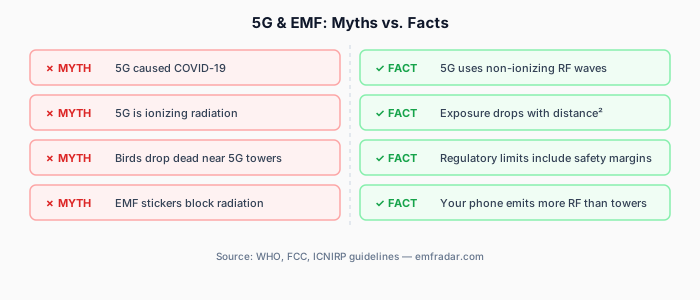
The claim: 5G uses entirely new, untested frequencies that have never been studied for safety.
The reality: Most 5G deployments in the US use frequencies that have been studied for decades. The three bands used for 5G are:
- Low-band (600-900 MHz): The same frequencies used for TV broadcasts since the 1950s and 4G LTE. Extensively studied.
- Mid-band (2.5-3.7 GHz): Similar to existing Wi-Fi (2.4 GHz and 5 GHz). Decades of research exist.
- High-band / mmWave (24-47 GHz): The newest band. While less studied than lower frequencies, millimeter waves have been used in airport body scanners, military applications, and scientific research for over 20 years.
The FCC’s exposure limits, last updated in 1996, do deserve scrutiny and modernization. But claiming 5G frequencies are “completely untested” ignores a substantial body of existing research.
The bottom line: Most 5G frequencies aren’t new. The highest-frequency mmWave band is newer to consumer deployment, but not unstudied. Legitimate concerns about updating safety standards are different from claims that the technology is wholly untested.
Check your EMF exposure
See cell towers, power lines, and substations near any US address.
Search Your AddressMyth #3: “EMF Radiation from Cell Towers Is Just Like Nuclear Radiation”
The claim: Cell tower radiation is the same type of dangerous radiation used in nuclear weapons and power plants.
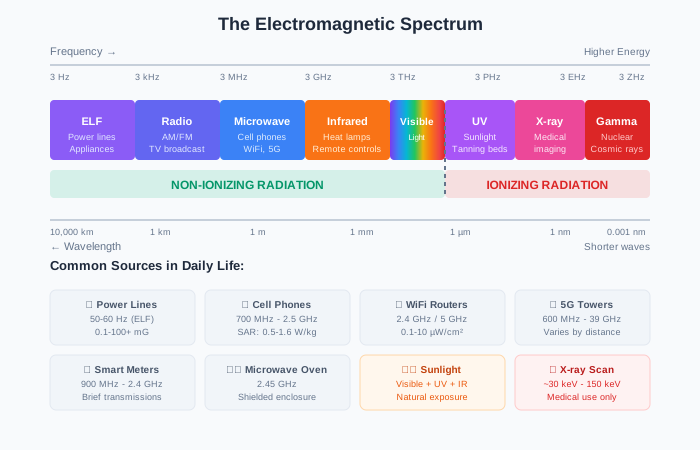
The reality: The word “radiation” covers a huge spectrum, and not all radiation is the same. There are two categories:
- Ionizing radiation: High-energy radiation (X-rays, gamma rays, ultraviolet) that can break chemical bonds in DNA. This includes nuclear radiation and is genuinely dangerous at sufficient doses.
- Non-ionizing radiation: Lower-energy radiation (radio waves, microwaves, infrared, visible light) that doesn’t have enough energy to break chemical bonds. Cell towers, Wi-Fi, Bluetooth, and 5G all emit non-ionizing radiation.
Cell tower emissions are non-ionizing — they’re in the same broad category as the light from a lamp or the heat from a campfire. The energy per photon is roughly a million times too weak to directly damage DNA the way ionizing radiation does.
This doesn’t mean non-ionizing radiation has zero biological effects (thermal effects are well-documented, and research into non-thermal effects is ongoing), but equating it to nuclear radiation is scientifically inaccurate.
The bottom line: Cell tower RF emissions are non-ionizing radiation, fundamentally different from nuclear/ionizing radiation. The word “radiation” can be misleading because it encompasses very different phenomena.
Myth #4: “Living Near a Cell Tower Guarantees You’ll Get Cancer”
The claim: If you live close to a cell tower, cancer is inevitable.
The reality: The scientific evidence on cell towers and cancer is mixed and does not support the claim that proximity guarantees cancer. Here’s what we know:
- The International Agency for Research on Cancer (IARC) classifies RF radiation as a “Group 2B possible carcinogen.” This is the same category as pickled vegetables and talcum powder — it means the evidence is limited and inconsistent, not that it’s proven to cause cancer.
- Large population studies (like the Danish cohort study of 420,000+ cell phone subscribers over 13 years) have not found increased cancer rates among heavy cell phone users.
- Some studies have found statistical associations between cell tower proximity and certain health complaints, but these often have methodological limitations (small sample sizes, no exposure measurement, recall bias).
- The NTP study (National Toxicology Program, 2018) found “clear evidence” of heart tumors in male rats exposed to very high RF levels — but at exposure levels far exceeding what any human would experience from a cell tower, and only in male rats, not female rats or mice.
The bottom line: “Possible carcinogen” is not the same as “definite carcinogen.” Living near a cell tower does not guarantee cancer. However, the science isn’t fully settled, and wanting to minimize exposure is a reasonable precaution. Check your address on EMF Radar to see exactly how many towers are near your home.
Myth #5: “Distance from a Cell Tower Doesn’t Matter”

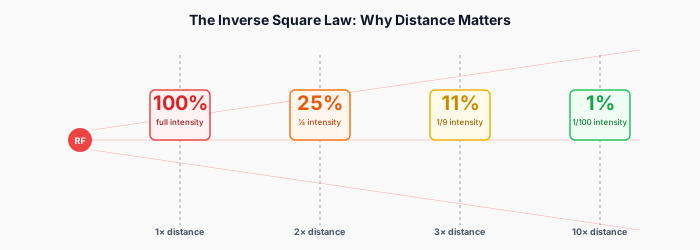
The claim: EMF exposure is the same whether you’re 100 feet or a mile from a tower.
The reality: This is absolutely false. RF power follows the inverse square law — signal strength decreases with the square of the distance. If you double your distance from a tower, your exposure drops to roughly one-quarter.
At practical distances:
- Within 200 meters: Measurably elevated RF levels, especially in the line of sight of antenna panels
- 200-500 meters: Significant reduction from peak levels
- Beyond 500 meters: RF exposure from that specific tower becomes quite low, often below measurable levels with consumer equipment
- Beyond 1 km: Negligible exposure from that particular tower
This is why distance matters, and why tools like EMF Radar exist. The difference between living 150 meters from a tower versus 500 meters is substantial in terms of RF exposure.
Use our free tool to check tower distances from your address →
The bottom line: Distance absolutely matters. The inverse square law is basic physics, and it applies to all RF emissions from cell towers.
Myth #6: “You Can Feel EMF Radiation”
The claim: Sensitive people can physically feel RF radiation from cell towers, Wi-Fi, and other sources — a condition called Electromagnetic Hypersensitivity (EHS).
The reality: This is complicated. Many people genuinely experience symptoms (headaches, fatigue, difficulty concentrating) that they attribute to EMF exposure. Their suffering is real. However, rigorous double-blind studies have consistently shown that self-described EHS sufferers cannot reliably detect the presence of EMF fields.
Key research:
- A 2005 systematic review of 31 double-blind studies found no evidence that EHS individuals could detect EMF exposure better than chance.
- The WHO acknowledges that EHS symptoms are real but states there is “no scientific basis” for linking them to EMF exposure.
- The nocebo effect (expecting to feel bad causes you to feel bad) appears to play a significant role. When people are told a device is “on,” they report symptoms regardless of whether it actually is.
This doesn’t mean these people are making up their symptoms — it means the cause likely isn’t what they think it is. Stress, anxiety, poor sleep, and environmental factors may be contributing.
The bottom line: While people genuinely experience symptoms, controlled studies haven’t confirmed that humans can detect RF fields. If you’re experiencing symptoms, see a doctor to explore all possible causes — don’t assume it’s EMF without evidence.
Myth #7: “EMF Shielding Products Block All Radiation”
The claim: Special phone cases, pendants, stickers, and “EMF harmonizers” can protect you from harmful EMF radiation.
The reality: This is a mixed bag:
Products that actually work (to varying degrees):
- EMF shielding paint (contains metallic particles that reflect RF — effectiveness is measurable and real, typically 20-40 dB reduction)
- Faraday cages and enclosures (physics-based, proven technology)
- Shielding fabrics with metallic thread (measurable attenuation)
- Window films with metallic coating (partial RF reduction)
Products that don’t work:
- “EMF harmonizer” stickers or pendants (no measurable effect on RF levels)
- Shungite, crystals, and orgonite (electrical insulators cannot block electromagnetic waves)
- Scalar energy devices (pseudoscience, no physical mechanism)
- “EMF neutralizer” chips for phones (can actually increase radiation — if they block the signal, your phone boosts power to compensate)
- Crystal-based EMF protection (no scientific basis)
The legitimate shielding products work on straightforward physics: conductive materials reflect electromagnetic waves. The scam products claim to “harmonize” or “neutralize” energy through mechanisms that don’t exist in physics.
The bottom line: Real EMF shielding uses conductive materials and is measurable with an EMF meter. If a product claims to “harmonize” or “neutralize” EMF without physically blocking it, it’s not going to do what it claims. Check out our EMF shielding paint guide for products that actually work.
Myth #8: “More Cell Towers Mean More Danger”
The claim: An area with many cell towers is more dangerous than an area with few towers.
The reality: Counterintuitively, more towers can actually mean lower individual exposure in some scenarios. Here’s why:
When towers are sparse, each tower must broadcast at higher power to cover a larger area, and your phone must also transmit at higher power to reach the distant tower. When towers are dense (like in urban areas), each tower covers a smaller area at lower power, and your phone can communicate at lower power too.
The phone in your pocket is typically a much more significant source of personal RF exposure than cell towers, because it’s pressed against your body. A phone struggling to reach a distant tower may expose you to more RF than one casually connected to a nearby tower.
That said, the cumulative RF environment in tower-dense areas is more complex, and living very close to any tower remains a valid concern regardless of the total count.
The bottom line: Tower density alone doesn’t determine your exposure. Your phone’s transmission power (which increases with distance from towers) is often a bigger factor in personal RF exposure. Check both tower count and proximity for your address on EMF Radar →
Myth #9: “The Government and Telecom Companies Are Hiding the Truth”
The claim: Governments and telecoms know 5G is dangerous but are covering it up for profit.
The reality: Conspiracy narratives about suppressed science are appealing but don’t hold up to scrutiny:
- Thousands of independent researchers across dozens of countries study EMF health effects. Suppressing all of them would require an impossible level of coordination.
- Countries with no telecom industry (or competing economic interests) have conducted their own research and generally reached similar conclusions.
- Regulatory disagreements are public. When the FCC declined to update its 1996 RF exposure limits, the case went to the DC Circuit Court of Appeals (EHT v. FCC, 2021), which ruled the FCC had inadequately explained its decision. This is the opposite of a cover-up — it’s open legal challenge.
- Legitimate criticisms exist about regulatory capture and industry influence on standards-setting. These are valid concerns about process, not evidence of a conspiracy to hide proven dangers.
The bottom line: Healthy skepticism of regulatory agencies and industry claims is warranted. But “the government is suppressing known dangers” is different from “safety standards may need updating based on newer research.” The second is a legitimate position; the first requires evidence that doesn’t exist. For context, EMF exposure limits vary by over 100x between countries — some nations have adopted far stricter standards than the US based on the same scientific evidence.
Myth #10: “There’s Nothing You Can Do About EMF Exposure”
The claim: EMF is everywhere, you can’t avoid it, so why bother?
The reality: While you can’t eliminate EMF exposure entirely in the modern world, you can significantly reduce it with informed choices:
- Know your exposure. Use EMF Radar to check cell tower proximity for your current home or a home you’re considering.
- Distance is your best friend. Even small increases in distance from sources dramatically reduce exposure (inverse square law).
- Reduce phone exposure. Use speakerphone or wired headphones, keep the phone away from your body when not in use.
- Optimize your home. Position beds away from smart meters, routers, and breaker panels. Turn off Wi-Fi at night if it’s practical.
- Choose your home wisely. If EMF is a concern, factor tower proximity into buying/renting decisions. Our guide on how to measure EMF walks you through what to check.
You don’t have to live in a Faraday cage. Simple, practical steps can meaningfully reduce your daily exposure.
The bottom line: You have more control than you think. Data + distance + simple habits go a long way. Start by checking your address — knowledge is the first step.
The Real Picture
The truth about EMF and 5G lives in the messy middle between “completely harmless” and “guaranteed cancer.” Here’s what the science actually supports:
- RF radiation from cell towers and phones is non-ionizing and doesn’t directly damage DNA.
- Current exposure levels are well below thermal thresholds for most people.
- Some studies suggest possible non-thermal biological effects, but evidence is inconsistent and mechanisms aren’t well understood.
- Regulatory standards may need updating based on post-1996 research.
- Distance dramatically reduces exposure, and informed choices can minimize your personal risk.
At EMF Radar, we don’t traffic in fear or denial. We give you the data — how many towers are near you, how far away they are, and what that means — so you can make your own informed decisions.
For the full evidence-based breakdown, read Is EMF Bad for You? What Science Actually Says.
Related Articles
- 5G Towers: Health Risks and What the Research Actually Says
- Is 5G Safe? Evidence-Based Guide to 5G Safety
- What Is EMF Radiation? The Complete Science Explained
- Cell Tower vs Phone Radiation: Which Is Greater?
- Study Spotlight: 5G at 700 MHz Shows No Brain Cell Effects — 2026 French study testing 5G on brain cells at double the safety limit
Want to check the EMF environment around your home, school, or workplace? Search any US address for free on EMF Radar →
Related Reading
- EMF and Headaches: Can Wireless Devices Cause Pain?
- EMF and Your Heart: What Electromagnetic Fields Actually Do to Your Cardiovascular System
- EMF and Human Health: What the Science Actually Says
- Are 5G Towers Dangerous? What the Research Shows (2026)
Concerned about EMF in your environment? Check your address on EMF Radar to see nearby cell towers and power lines, or find a certified EMF consultant for professional testing.