
Study Spotlight: What’s Happening to Birds, Bees, and Trees Near Cell Towers?
Part of our Study Spotlight series — breaking down new EMF research into plain English. No jargon. No agenda. Just what the science says.
The Study at a Glance
| 📄 Title | Flora and fauna: how nonhuman species interact with natural and man-made EMF at ecosystem levels and public policy recommendations |
| 📰 Journal | Frontiers in Public Health (November 2025) |
| 🏫 Researchers | B. Blake Levitt, Henry C. Lai, Albert M. Manville II, Theodora Scarato |
| 🔗 DOI | 10.3389/fpubh.2025.1693873 |
| 📊 PMID | 41358243 |
| 🔓 Access | Open Access (PMC) |
Why This Is Different
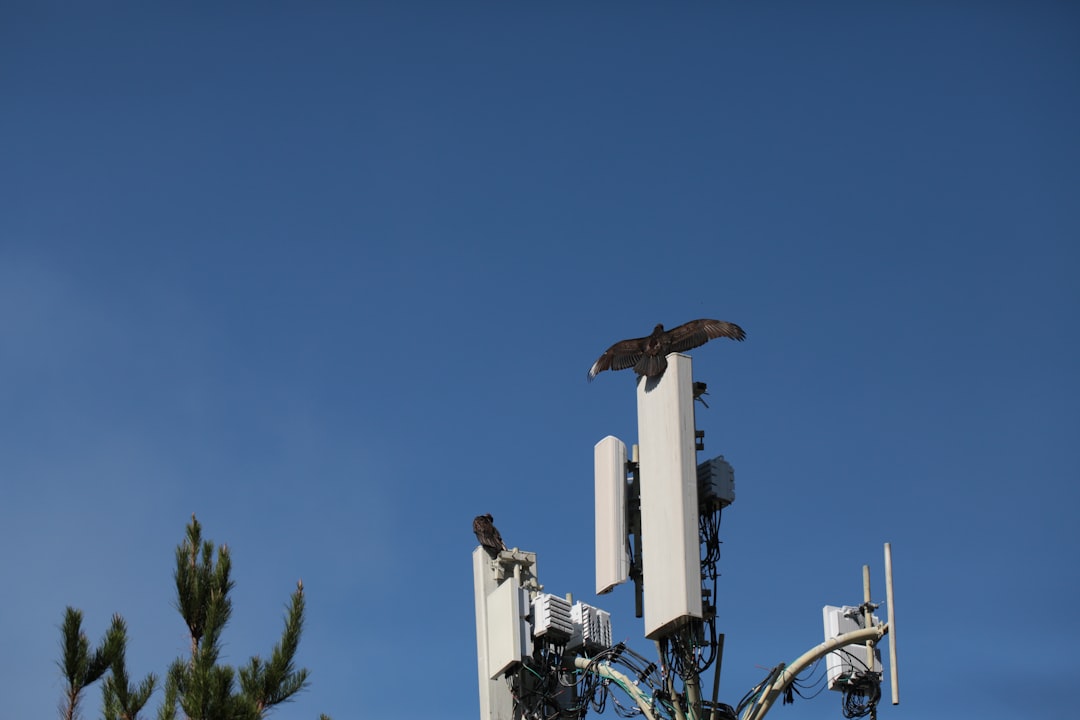
Most EMF research focuses on humans. This paper asks a much bigger question: what happens to every other living thing?
Birds, bees, bats, insects, trees, microorganisms — the entire ecosystem is bathed in RF-EMF from cell towers, radar installations, satellite constellations, and wireless networks. Unlike us, many of these species evolved exquisitely sensitive electromagnetic receptors. They use the Earth’s natural magnetic fields for navigation, migration, mating, food finding, and territorial defense.
Now their electromagnetic environment is being fundamentally altered by human technology. And unlike humans, no one asked them, and no safety limits exist for them.
Check your EMF exposure
See cell towers, power lines, and substations near any US address.
Search Your AddressThe Scale of the Problem
The authors make a startling observation right up front: nowhere on Earth today is completely RF-EMF free.
Here’s how we got here:
- AM/FM radio → layer 1 (1920s onward)
- TV broadcast → layer 2 (1940s onward)
- Radar → layer 3 (1940s onward)
- 2G/3G/4G cellular → layers 4-7 (1980s onward)
- WiFi/Bluetooth → layer 8 (2000s onward)
- 5G (sub-6 GHz and mmWave) → layer 9 (2020s)
- Low-earth orbit satellites (Starlink, etc.) → layer 10 — this one erased the rural/urban distinction
Each technology added a new layer of chronic, low-intensity exposure that didn’t exist in the environment before. The cumulative result: ambient RF-EMF levels in populated areas are now millions to billions of times higher than natural electromagnetic background levels.
What the Evidence Shows
This is a comprehensive review paper — not a single experiment. The authors synthesize decades of research across multiple species. Here are the key findings:
🐝 Insects
The most alarming evidence may be for pollinators:
- Honey bees exposed to cell tower radiation show disrupted navigation, reduced colony strength, and altered behavior. Multiple studies have found bees struggle to return to their hives when exposed to RF-EMF from nearby base stations.
- Bee colony collapse has been linked (among other factors) to electromagnetic pollution. The timing of colony collapse disorder correlates with wireless network expansion, though correlation isn’t causation.
- Insects use magnetoreception and may also sense electric fields — both are potentially disrupted by ambient RF.
- Insects’ small body sizes mean they can be resonant at higher frequencies (like those used by 5G), potentially absorbing more energy proportionally than larger animals.
🐦 Birds
Birds are among the best-studied organisms for electromagnetic sensitivity:
- Many bird species navigate using the cryptochrome protein system in their eyes, which detects the Earth’s magnetic field. Laboratory studies show this system can be disrupted by RF-EMF at levels common near cell towers.
- Migratory birds have shown disorientation in areas with high ambient RF, including near radar installations and broadcast towers.
- White storks nesting on cell towers showed lower breeding success in some studies.
- The paper discusses the concept of “airspace as habitat” — the idea that the electromagnetic characteristics of airspace should be considered part of a species’ habitat, just like physical terrain.
🦇 Bats
- Bats use echolocation (ultrasound, not RF), but they also appear sensitive to electromagnetic fields for navigation purposes.
- Studies have shown altered behavior in bats near cell tower installations.
- As insect populations decline partly due to EMF exposure, bats lose food sources — an indirect but potentially devastating impact.
🌳 Trees and Plants
- Trees near cell towers have shown asymmetric growth — growing preferentially on the side away from the tower.
- A widely-cited Bonn/Heidelberg study documented visible damage patterns in trees within line-of-sight of cell towers.
- The authors cite evidence that RF-EMF affects plant growth hormones, reactive oxygen species, and cellular processes. (For a deep dive into the plant research, including the surprising agricultural EMF enhancement studies, see our EMF and plants guide.)
- Trees in urban areas with high ambient RF show different growth patterns compared to those in lower-exposure rural areas.
🦠 Microorganisms
- Soil microorganisms — critical for nutrient cycling and plant health — have shown sensitivity to RF-EMF in laboratory studies.
- Changes in microbial communities could cascade through entire ecosystems.
The Regulatory Gap

Perhaps the most striking point in the paper: there are zero exposure limits for wildlife.
FCC, ICNIRP, and every other RF safety standard on Earth is designed exclusively to protect humans. No regulatory body has established limits for:
- Birds migrating through RF-dense airspace
- Bees foraging near cell towers
- Trees growing in direct line-of-sight to antennas
- Soil microorganisms in antenna fields
- Aquatic species near underwater cables or coastal radar
The authors argue this is a massive blind spot, especially given existing environmental laws:
- The National Environmental Policy Act (NEPA) requires environmental impact assessment for federal actions — which should include FCC spectrum licensing
- The Migratory Bird Treaty Act protects migratory birds — but electromagnetic habitat degradation isn’t addressed
- The Endangered Species Act requires consideration of all threats to listed species — but EMF isn’t routinely assessed
The 5G and Satellite Wrinkle
The paper flags two emerging concerns:
5G higher frequencies (>3.5 GHz and millimeter wave): These have never been deployed at scale before. Millimeter waves are more readily absorbed by small organisms (insects, leaves) due to size-frequency resonance effects. The biological implications are largely unstudied.
Satellite constellations: SpaceX’s Starlink alone aims for 42,000 satellites. These beam RF toward Earth in broad patterns, meaning even previously “pristine” wilderness areas now have measurable RF exposure. The authors note this has “all but erased” the distinction between urban and rural electromagnetic environments.
The Strong Points
Massive scope. This is one of the most comprehensive reviews of EMF-wildlife interactions ever published. It synthesizes research across taxonomic kingdoms — insects, birds, mammals, plants, and microorganisms.
Real ecological framing. By discussing “airspace as habitat” and ecosystem-level cascading effects, the authors move beyond single-species studies to systemic thinking.
Policy-relevant. The connection to existing environmental law (NEPA, ESA, MBTA) gives the findings actionable policy implications.
Unique angle. While human RF safety debates are well-trodden, the wildlife perspective is dramatically understudied. This review fills an important gap.
The Weak Points
Correlation concerns. Many of the cited studies show associations between RF exposure and biological effects in wildlife, but establishing causation in field conditions is extremely difficult. Other factors (habitat loss, pesticides, climate change) confound the picture.
Publication bias. Reviews tend to cite studies that found effects. Studies showing no effect in wildlife may be underrepresented in the literature and in this review.
Author positioning. B. Blake Levitt is a long-time journalist and author on EMF health effects. Henry Lai is a prominent researcher who has been advocating for tighter limits for decades. Theodora Scarato directs the Environmental Health Trust, an advocacy organization. Like the ICBE-EMF safety limits paper, these authors have clear positions. Their review may emphasize findings that align with their views.
Mechanism gaps. For many species, the exact biophysical mechanism by which low-level RF affects behavior or physiology isn’t fully established. “Animals are sensitive to EMF” and “ambient EMF harms animals” are two different claims, and the jump between them isn’t always well-supported.
Lab vs. field. Many cited studies are laboratory experiments with controlled RF exposure. How well these translate to real-world conditions — where animals are exposed to complex, variable RF environments — isn’t always clear.
What This Means for You
You might be wondering: “I care about my own EMF exposure — why should I care about birds and bees?”
Three reasons:
-
Ecosystem health = human health. If pollinators decline, food production suffers. If soil microorganisms are disrupted, agriculture changes. The human consequences of ecological disruption are real and downstream.
-
Canary in the coal mine. Wildlife with sensitive electromagnetic receptors may be the first to show effects from ambient RF levels. If birds and bees are affected at current levels, it’s a signal worth paying attention to.
-
Cumulative exposure matters. The paper’s framing of layered, escalating RF-EMF in the environment — from AM radio to Starlink — is relevant to understanding your own exposure context. You’re not just exposed to your phone; you’re immersed in a complex electromagnetic environment. Check your area’s exposure profile to see what that looks like for your specific location.
Policy Recommendations from the Authors
The paper proposes several concrete steps:
- EMF-free zones during migration and breeding seasons
- Frequency re-allocation to reduce overlap with known bioactive ranges
- Environmental impact assessments for new wireless deployments (enforcing existing NEPA requirements)
- Recognition of “airspace as habitat” in regulatory frameworks
- International coordination on wildlife EMF exposure limits
- Redesign of network architecture to minimize environmental exposure (smaller, more targeted beams vs. broad area coverage)
Study Details
| Study Type | Comprehensive narrative review |
| Species Covered | Insects, birds, bats, mammals, trees/plants, microorganisms, aquatic species |
| Key Sources | 60+ years of EMF-wildlife research |
| Exposure Types | Cell towers, radar, broadcast, WiFi, 5G, satellite |
| Published | November 19, 2025 |
| Correction | Minor erratum published February 2026 (PMID: 41769091) |
| Funding | Not specified |
| Conflicts | None declared |
| Open Access | Yes — read the full paper |
Curious about the cell tower environment near your home, your kids’ school, or your local park? Search any address on EMF Radar — and check our school, park, and city pages for pre-analyzed data.
The Study Spotlight series breaks down peer-reviewed EMF research for non-scientists. We cover studies across the spectrum — reassuring, concerning, and everything in between. Browse all Study Spotlights.
Related: Do Humans Have a Hidden Magnetic Sense? — The definitive 2026 review of magnetosensation across the animal kingdom, with direct implications for EMF-sensitive species covered in this review.
Related Reading
- Study: Can AI Predict Cell Tower Health Symptoms?
- Study Spotlight: How Much 5G Radiation Actually Reaches Your Brain? Engineers Ran the Numbers
- Study: Does RF Exposure at Work Cause Brain Cancer?
- Study: Cell Phone Use and Breast Cancer Risk (2026)
Concerned about EMF? Check your address on EMF Radar to see nearby towers and power lines, or find a certified EMF consultant for professional testing.