EMF and Headaches: Can Cell Towers, WiFi, or Phones Cause Head Pain?
Quick Answer: Many people report headaches they attribute to EMF exposure from cell towers, WiFi, or phones. However, controlled blinded studies — where participants don’t know if the EMF source is on or off — have consistently failed to show that EMF reliably triggers headaches. The most likely explanations are the nocebo effect (expecting symptoms causes them), tension from anxiety about EMF, and coincidental timing. That said, some researchers argue that individual sensitivity and specific exposure patterns deserve more investigation. If you experience headaches you believe are EMF-related, practical reduction strategies are low-cost and worth trying.
Key Facts at a Glance
| Question | Answer |
|---|---|
| Can EMF cause headaches? | No consistent evidence in controlled studies; self-reported symptoms are common but not confirmed by blinding |
| What do provocation studies show? | Participants report headaches equally whether EMF is on or off when they don’t know which condition they’re in |
| Is the nocebo effect real? | Yes — extensively documented. Expecting a headache from EMF significantly increases headache occurrence |
| Could some people be genuinely sensitive? | Possible but unproven. No biomarker or mechanism has been identified |
| What about phone-specific headaches? | Some studies show thermal effects during long calls, which could trigger headaches through heating, not EMF itself |
| Should I still reduce EMF if I get headaches? | Yes — it’s low-cost, addresses anxiety (a real headache trigger), and follows the precautionary principle |
Headaches are the single most commonly reported symptom people attribute to electromagnetic field exposure. Forum posts, news articles, and personal testimonials describe throbbing head pain triggered by cell towers, WiFi routers, smart meters, and cell phones. Some people report symptoms so severe they’ve relocated or made major life changes.
Is EMF actually causing these headaches? The answer is more nuanced than either side of the debate suggests.

What People Report

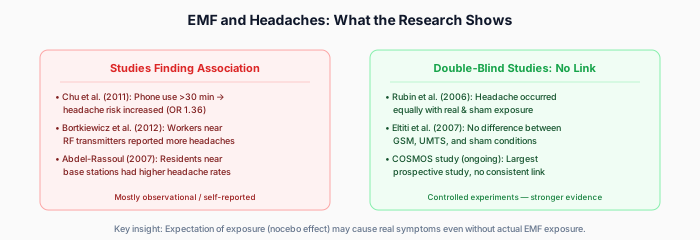
The pattern of EMF-attributed headaches is remarkably consistent across reports:
- Onset: Headaches begin or worsen after moving to a location with a new cell tower, getting a smart meter installed, or spending extended time near WiFi equipment
- Character: Usually described as pressure or tension-type headaches, sometimes migraine-like with sensitivity to light
- Timing: Often reported within minutes to hours of exposure, sometimes building over days
- Relief: Symptoms improve when leaving the area or turning off the suspected EMF source
- Recurrence: Symptoms return upon re-exposure
These reports are genuine — the people experiencing them are really suffering. The question is whether EMF is the mechanism or whether something else is at work.
Check your EMF exposure
See cell towers, power lines, and substations near any US address.
Search Your AddressWhat the Science Says
Provocation Studies: The Gold Standard
The strongest evidence comes from provocation studies — controlled experiments where participants are exposed to EMF in some trials and sham (fake) EMF in others, without knowing which is which. If EMF causes headaches, people should report more headaches during real EMF exposure than during sham exposure.
Key findings from major provocation studies:
Rubin et al. (2006, 2010) — Comprehensive Meta-Analyses
- Reviewed 46 blinded provocation studies involving people who self-identified as electrically sensitive
- Found no evidence that EMF exposure reliably triggered symptoms including headaches
- Participants reported symptoms at similar rates regardless of whether EMF was on or off
- When participants could tell (or thought they could tell) which condition was active, symptom reports aligned with their beliefs, not actual exposure
Eltiti et al. (2007) — GSM and 3G Base Station Signals
- 56 self-described sensitive participants and 120 controls
- Exposed to GSM (2G) and UMTS (3G) signals or sham conditions
- No significant difference in headache reports between real and sham exposure
- Sensitive participants reported more symptoms overall, but equally in all conditions
Wallace et al. (2012) — WiFi Signals
- Exposed participants to WiFi signals in double-blind conditions
- No difference in headache or other symptom reports between WiFi-on and WiFi-off conditions
Hillert et al. (2008) — Mobile Phone Signals
- 71 self-reported sensitive individuals
- Headache reports were predicted by participants’ beliefs about exposure, not actual exposure status
The Nocebo Effect
The nocebo effect is the negative counterpart of placebo — expecting a harmful effect causes you to experience it. It’s not imaginary; it’s a documented neurological phenomenon with measurable physiological correlates.
How it works with EMF:
- You hear that cell towers might cause headaches
- A cell tower is installed near you (or you become aware of an existing one)
- You start monitoring for headaches — something you do unconsciously
- Normal background headaches (which everyone gets periodically) are now attributed to the tower
- Anxiety about the tower adds muscle tension, stress, and sleep disruption — all genuine headache triggers
- The pattern reinforces itself: more attention → more noticed headaches → more anxiety → more headaches
This isn’t dismissive — the nocebo effect causes real suffering. Research by Benedetti et al. (2007) showed that nocebo expectations activate pain-related brain regions (the anterior cingulate cortex and prefrontal cortex) and can increase inflammatory markers. The headaches are real; the mechanism is different from what the person believes.
The “sham tower” experiments: Several studies have shown that merely telling people a cell tower has been activated (when it hasn’t) increases symptom reports. In one study, informing residents about a planned tower installation led to symptom reports before the tower was even built.
Where the Evidence Gets Complicated
The provocation study design, while rigorous, has limitations that some researchers highlight:
1. Exposure duration Most studies expose participants for 15–60 minutes. If EMF effects on headaches are cumulative over days or weeks, short exposures wouldn’t capture them.
2. Exposure characteristics Lab-controlled RF signals may differ from real-world exposure (multiple simultaneous frequencies, modulation patterns, near-field vs. far-field exposure).
3. Individual variation If only a small subset of people are genuinely sensitive, their signal gets lost in group averages. Studies would need much larger sample sizes or better pre-screening methods.
4. Biological plausibility isn’t zero Some researchers have proposed mechanisms by which RF EMF could affect neural function:
- Interference with voltage-gated calcium channels (Pall, 2013) — though this remains controversial and hasn’t been replicated independently
- Subtle effects on blood-brain barrier permeability — shown in some animal studies (Salford et al., 2003) but inconsistently
- Effects on melatonin production — potentially disrupting sleep quality, which is a major headache trigger
None of these mechanisms have been conclusively demonstrated to cause headaches at typical environmental exposure levels, but they represent areas where research is ongoing.
Phone-Specific Headaches
The case for phones is slightly different from towers and WiFi because phones are held against the head:
- Thermal effects: During long calls, phones can warm the skin by 0.1–0.5°C. This is a real, measurable effect. Some people may perceive this as headache-like discomfort, particularly during extended use.
- Postural effects: Holding a phone to your ear for extended periods causes neck tension, a well-documented headache trigger.
- Screen effects: Blue light, brightness, and the cognitive demands of phone use can trigger tension headaches and migraines independent of any EMF.
A study by Szyjkowska et al. (2014) found a correlation between heavy phone use and headaches, but couldn’t distinguish between RF effects, screen effects, postural effects, and the simple fact that people who use phones heavily tend to be more stressed and sleep-deprived.

If You Get Headaches You Believe Are EMF-Related
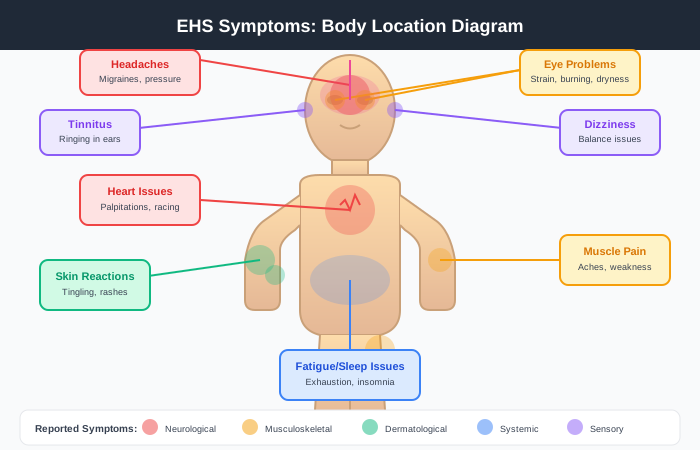
Whether EMF is the mechanism or not, there are practical steps that address multiple possible causes simultaneously:
Step 1: Document the Pattern
Before making any changes, keep a headache diary for 2–3 weeks:
- Date and time of each headache
- Severity (1–10)
- Your location and activities
- What EMF sources were nearby (if you know)
- Other potential triggers: sleep quality, stress, hydration, caffeine, weather changes, screen time
This data helps you and your doctor identify patterns. Many people discover non-EMF triggers they hadn’t considered.
Step 2: Address Known Headache Triggers First
Rule out the common causes:
- Dehydration — drink 2+ liters of water daily
- Sleep — consistent 7–9 hours, dark room, regular schedule
- Screen time — 20-20-20 rule (every 20 minutes, look at something 20 feet away for 20 seconds)
- Caffeine — both excess and withdrawal cause headaches
- Stress and tension — neck stretches, posture correction, stress management
- Eye strain — get your vision checked if you haven’t recently
Step 3: Reduce EMF Exposure (Precautionary)
If you’ve addressed other triggers and still suspect EMF:
Low-cost changes:
- Move your WiFi router away from where you spend the most time (especially the bedroom)
- Use speakerphone or wired earbuds instead of holding your phone to your head
- Turn off WiFi at night (most routers have scheduling features)
- Keep your phone at arm’s length instead of under your pillow
- Check what cell towers are near your home using EMF Radar to understand your baseline exposure
Medium-cost changes:
- Use ethernet instead of WiFi for stationary devices
- Replace DECT cordless phones with corded phones
- Move your bed away from the wall closest to a smart meter
- Get an EMF meter to measure actual levels and identify hot spots
Higher-cost changes (only if simpler steps don’t help):
- RF shielding paint for the bedroom
- Window shielding film
- EMF-blocking bed canopy
- Consultation with a building biologist
Step 4: Talk to Your Doctor
If headaches are frequent or severe, see a healthcare provider. They can rule out other causes and provide treatment. Mention your EMF concerns — a good doctor will take them seriously while also evaluating other possibilities.
The Anxiety-Headache Connection
This deserves its own section because it may be the most important practical insight:
Anxiety is one of the most well-documented headache triggers. If you’re anxious about EMF exposure — whether that anxiety is justified or not — the anxiety itself can cause headaches through:
- Increased muscle tension (especially neck and jaw)
- Disrupted sleep
- Elevated cortisol
- Hypervigilance and symptom monitoring
This creates a genuine problem: worrying about EMF headaches can cause the exact headaches you’re worried about. The solution isn’t to dismiss the concern (that increases anxiety) — it’s to:
- Take concrete action (reduce EMF exposure using the steps above) — this reduces anxiety by giving you control
- Get data — check your actual tower exposure on EMF Radar rather than imagining worst-case scenarios
- Understand perspective — environmental RF exposure from towers is typically 100–10,000x below safety limits
- Address the anxiety directly — if EMF concern is causing significant distress, a therapist experienced with health anxiety can help enormously
What We’d Like to See from Future Research
The current evidence doesn’t support a causal link between environmental EMF and headaches, but the scientific case isn’t closed. Better research would include:
- Longer exposure periods (weeks, not minutes) in controlled settings
- Larger sample sizes with better stratification for potentially sensitive individuals
- Real-world monitoring — continuous headache and EMF exposure tracking in daily life using wearable devices
- Biomarker identification — if EMF sensitivity exists, finding an objective marker would transform the field
- Dose-response studies — varying EMF intensity to look for threshold effects
Until this research exists, the honest answer is: we can’t definitively prove EMF causes headaches, and we can’t definitively prove it doesn’t for all individuals under all conditions. The practical approach is to minimize exposure where easy, address anxiety, and treat the headaches.
Summary
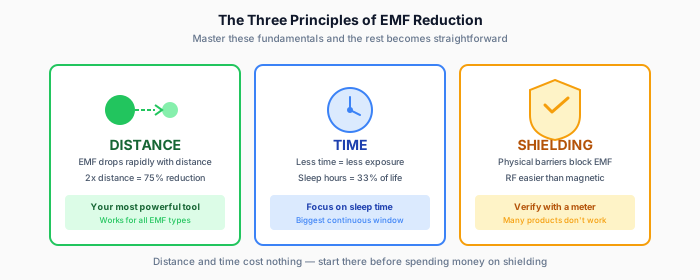
The weight of evidence from controlled studies doesn’t support EMF as a reliable headache trigger. The nocebo effect, anxiety, and coincidental timing explain most EMF-attributed headaches. But the people experiencing these headaches are genuinely suffering, and dismissing their experience isn’t helpful.
The practical path forward: reduce EMF exposure (it’s low-cost and addresses multiple possible causes), manage anxiety about EMF (a real headache trigger regardless of EMF’s direct effects), keep a headache diary to identify true triggers, and see a doctor for persistent symptoms.
Understanding your actual exposure level is a good first step — it replaces fear of the unknown with concrete data.
Want to check your exposure? Search your address on EMF Radar to see cell towers, power lines, and substations nearby. For a professional assessment, find a certified EMF consultant in your area.
Related Reading
- EMF and Migraines: Can Cell Phones, WiFi, or Cell Towers Trigger Migraines? — a deep dive into the migraine-specific mechanisms (cortical spreading depression, CGRP, trigeminal nerve), a 30-study meta-analysis, and a practical 4-week tracking experiment for migraine sufferers
- EMF and Brain Fog: Can Cell Phones and WiFi Affect Your Thinking? — cognitive effects of EMF including alpha wave disruption and BBB permeability
- EMF and Fatigue: Can Electromagnetic Fields Make You Tired All the Time? — another common symptom attributed to EMF exposure
Wondering how much EMF exposure you actually have? Search your address on EMF Radar to see nearby cell towers and estimated RF levels — real data beats speculation.