EMF and Sleep: What the Research Actually Shows
Quick Answer: Current scientific evidence suggests that EMF from WiFi, phones, and household electronics does not cause sleep disturbances at typical exposure levels. A 2024 WHO-commissioned systematic review of 41 studies found essentially zero effect on sleep symptoms. While some laboratory studies detect subtle brain wave changes during EMF exposure, these do not translate into real-world sleep problems, and people cannot detect EMF exposure at rates better than chance.
You’ve probably heard claims that WiFi routers, cell phones, and other EMF sources disrupt sleep. It’s a common concern—we spend roughly a third of our lives sleeping, and the bedroom is one of the few spaces where we might have real control over our EMF environment.
But what does the science actually show? The answer is more nuanced than either “EMF definitely destroys your sleep” or “there’s nothing to worry about.”
Key Facts at a Glance
| Question | Answer |
|---|---|
| Does EMF from WiFi and phones disrupt sleep? | No significant effect found in systematic reviews of experimental studies |
| Can people detect EMF exposure? | No, detection rates equal random chance in controlled studies |
| Do brain wave changes from EMF affect sleep quality? | Some changes detected, but no clear impact on actual sleep quality |
| Is EMF sensitivity real? | Symptoms are real, but appear to be nocebo responses rather than EMF-caused |
| Does long-term phone use cause sleep problems? | Evidence suggests behavioral factors (scrolling, blue light), not EMF itself |
| Should I reduce bedroom EMF? | Low-cost reductions are reasonable, but focus first on proven sleep factors |
The Two Questions We Need to Separate
EMF and sleep research addresses two distinct questions that require separate answers. When people ask about EMF and sleep, they’re usually asking two different questions:
- Do EMF exposures cause measurable changes in sleep physiology? (Brain waves, sleep stages, melatonin levels)
- Do people who are exposed to more EMF report worse sleep? (Subjective sleep quality, insomnia symptoms)
These questions have different answers, and conflating them leads to confusion.
Check your EMF exposure
See cell towers, power lines, and substations near any US address.
Search Your AddressWhat Experimental Studies Show
Controlled laboratory experiments represent the gold standard for studying EMF effects on sleep. The most rigorous way to study EMF effects on sleep is through controlled experiments: expose people to EMF under laboratory conditions and measure what happens. According to PubMed, several decades of such studies have produced interesting—and somewhat conflicting—findings.
Brain Wave Changes (EEG Studies)
Multiple studies have found that RF exposure during sleep can alter brain electrical activity:
- Spindle activity: Some studies show changes in sleep spindles (bursts of brain activity during Stage 2 sleep) when subjects are exposed to cell phone-like signals
- Alpha band activity: Several studies report altered alpha waves in early sleep stages during RF exposure
- REM sleep: Some research suggests changes in REM sleep architecture
However, these findings aren’t fully consistent across studies, and their practical significance is debated. The brain constantly adapts to environmental inputs—whether these specific changes translate to meaningful sleep impairment isn’t clear.
Self-Reported Symptoms
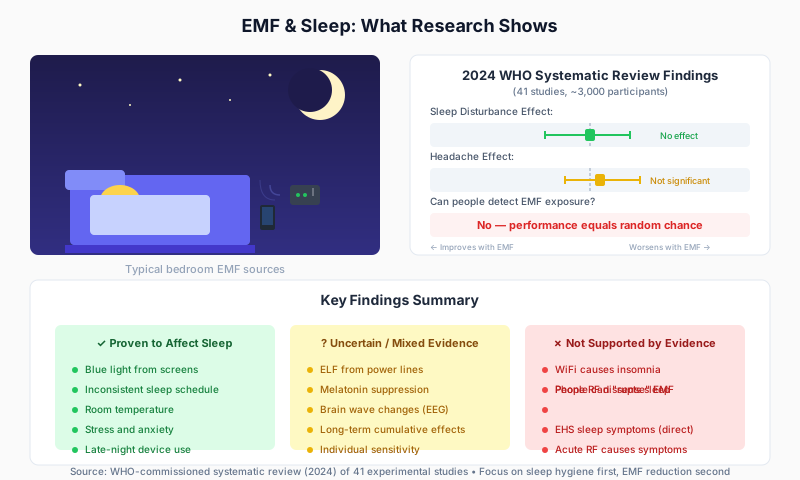
A 2024 WHO-commissioned systematic review found no evidence that RF-EMF causes sleep disturbances. In 2024, the WHO commissioned a comprehensive systematic review of experimental studies examining whether RF-EMF exposure causes self-reported symptoms. According to PubMed, this meta-analysis included 41 studies with nearly 3,000 participants and found:
- For sleeping disturbances, the effect was essentially zero (SMD 0.00, 95% CI: -0.15 to 0.15 for whole-body exposure)
- For headaches, the effect was small and not statistically significant (SMD 0.08, 95% CI: -0.07 to 0.22)
- Participants could not detect whether they were being exposed to EMF at rates better than chance
- People who self-identified as electromagnetically hypersensitive performed no better at detecting exposure than the general population
The authors concluded: “available evidence suggests that acute RF-EMF below regulatory limits does not cause symptoms.” DOI
This is important because it suggests that when people report sleep problems they attribute to EMF, the symptoms are real but may not be caused by the EMF itself—a classic nocebo effect.
What Long-Term Observational Studies Show
Long-term observational studies provide real-world data that complements laboratory experiments. Experimental studies have limitations: they typically involve short exposures in artificial settings. What about long-term, real-world exposure?
According to PubMed, the COSMOS study—a large prospective cohort following over 24,000 participants in Sweden and Finland—examined whether mobile phone use predicted sleep problems over a 4-year period. Key findings:
- Most sleep outcomes showed no association with mobile phone use
- Insomnia showed a slight association with very high call-time (>258 min/week): OR 1.24 (95% CI: 1.03-1.51)
- However, when researchers adjusted for the type of network (3G vs 2G, which have different RF exposures), the association disappeared
- The authors concluded: “findings from this study do not support the hypothesis that RF-EMF from mobile phone use has long-term effects on sleep quality” DOI
The disappearing effect after adjusting for network type suggests that if there’s an association between phone use and insomnia, it’s probably due to behavioral factors (late-night scrolling, stress, blue light) rather than RF exposure itself.
The Melatonin Question

Scientific evidence on EMF and melatonin remains inconsistent and inconclusive. One proposed mechanism for EMF-sleep effects involves melatonin, the hormone that regulates sleep-wake cycles. The theory: EMF exposure suppresses melatonin production, disrupting circadian rhythms.
Early animal studies supported this idea—some found reduced melatonin in rodents exposed to magnetic fields. But human studies have been inconsistent:
- Some found reduced melatonin metabolites in people living near power lines
- Others found no effect
- Most controlled studies haven’t replicated significant melatonin suppression
According to PubMed, a 2022 study took a different approach: instead of exposing people to EMF, they had participants sleep in beds designed to shield against EMF. After 2 months, those sleeping in shielded beds showed:
- Increased melatonin levels
- Improved cortisol/DHEA ratios (stress markers)
- Increased serotonin and oxytocin
- Reduced “biological age” markers DOI
This is intriguing but should be interpreted cautiously: the study was small (18 participants in the experimental group), lacked proper blinding (participants knew they were sleeping in “special” beds), and was partially funded by the bed manufacturer. Placebo effects on sleep can be substantial.
Putting It Together: What We Actually Know
| Question | Evidence | Confidence |
|---|---|---|
| Does RF-EMF cause measurable brain wave changes during sleep? | Some studies show effects | Moderate (inconsistent findings) |
| Does RF-EMF cause people to report worse sleep symptoms? | Evidence suggests no effect | High (large systematic review) |
| Can people detect EMF exposure? | No, performance equals chance | High |
| Does long-term phone use cause sleep problems? | Probably not due to EMF itself | Moderate-High |
| Does ELF (power line) EMF affect melatonin? | Unclear, inconsistent results | Low |
| Does EMF shielding improve sleep? | Possibly, but confounded by placebo | Low |
The honest summary: We can detect some subtle physiological effects of EMF in laboratory conditions, but these don’t clearly translate into the sleep problems people report. The strongest evidence suggests that perceived EMF effects on sleep are largely nocebo responses—real symptoms triggered by belief rather than direct physical causation.
Why People Are Still Concerned (And That’s Okay)
Concerns about EMF and sleep persist despite reassuring research for several understandable reasons. If the science is this reassuring, why do so many people feel convinced that EMF affects their sleep?
Several factors:
- Confirmation bias: If you turn off WiFi and sleep better, you attribute it to the WiFi—not to the placebo effect or other changes you made
- Correlated behaviors: Heavy phone users may also have worse sleep hygiene, more screen time before bed, and more stress
- Blue light: The most well-established screen effect on sleep is blue light suppressing melatonin—this is real and often conflated with EMF
- Real but misattributed symptoms: Sleep problems are common, and EMF provides a concrete thing to blame
This doesn’t mean concerns are irrational. Science has been wrong before. Long-term effects might exist that short-term studies miss. And even if EMF isn’t the cause, reducing bedroom EMF often correlates with other sleep-positive changes (removing devices, creating a tech-free space).
The Distance Factor
If you live near a cell tower, your nighttime RF exposure is essentially continuous for 7-8 hours — every night, for as long as you live there. This chronic, low-level exposure is what makes tower proximity a different question from phone use.
EMF exposure from a nearby cell tower depends primarily on distance:
| Tower Distance | Typical RF Power Density | Relative Exposure |
|---|---|---|
| 50 meters | 1-10 µW/m² | Very High (for ambient) |
| 200 meters | 0.1-1 µW/m² | High |
| 500 meters | 0.01-0.1 µW/m² | Moderate |
| 1+ kilometer | < 0.01 µW/m² | Low |
For context, the BioInitiative Report (which takes a precautionary stance) recommends keeping long-term RF exposure below 1 µW/m². Even researchers who disagree with that specific threshold generally agree that less is better when you can reasonably achieve it.
Check how close the nearest cell tower is to your address
Practical Recommendations
Evidence-based sleep optimization should prioritize proven factors before EMF reduction. Given the evidence, here’s a reasonable approach:
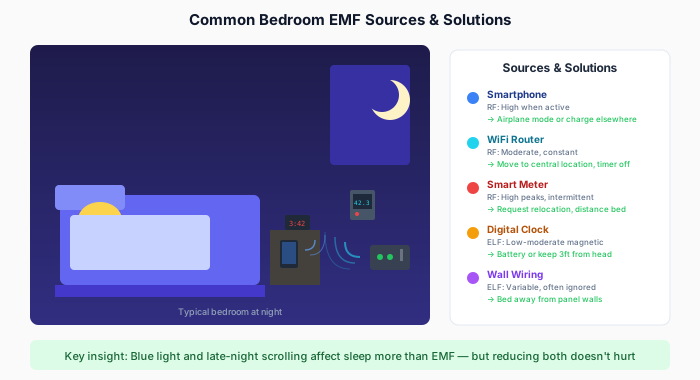
For Everyone
Focus on what definitely matters:
- Blue light: Use night mode on devices or stop screens 1-2 hours before bed
- Sleep timing: Consistent bedtime matters more than EMF levels
- Temperature: Cool rooms (65-68°F) promote better sleep
- Darkness: Light pollution affects melatonin far more demonstrably than EMF
Simple EMF reductions that don’t hurt:
- Charge phones outside the bedroom (also removes temptation to scroll)
- Put WiFi router in a central location, not next to your bed
- Don’t sleep with devices under your pillow (this should be obvious)
For the EMF-Concerned
If EMF reduction helps you sleep—whether through direct effect or placebo—there’s no harm in taking it further:
Low-cost steps:
- Turn off WiFi router at night (use a timer)
- Keep phones on airplane mode while sleeping
- Move any cordless phone bases out of the bedroom
- Unplug unnecessary electronics near the bed
Measure before assuming:
- Use a basic RF meter to check actual levels in your bedroom
- You may find levels are already low
- Check EMF Radar’s score for your address
Consider bedroom placement:
-
If possible, bedrooms should be away from:
- Smart meters (often on exterior walls)
- Electrical panels
- Neighbor’s WiFi (in apartments)
What Not To Do
- Don’t spend thousands on EMF shielding without first measuring whether you have significant exposure
- Don’t assume symptoms are EMF-caused without considering other factors (stress, sleep apnea, medications, etc.)
- Don’t worry more than necessary—anxiety about EMF may affect sleep more than EMF itself
Frequently Asked Questions
Does WiFi affect sleep quality?
Current research indicates WiFi does not significantly affect sleep quality at typical household exposure levels. A 2024 WHO-commissioned systematic review of 41 studies found the effect on sleep disturbances was essentially zero. Any sleep improvements from turning off WiFi are likely due to reduced late-night device use rather than EMF reduction.
Can EMF cause insomnia?
Scientific evidence does not support EMF as a direct cause of insomnia. The COSMOS study following 24,000 participants found no association between mobile phone EMF exposure and sleep problems. When associations appeared, they disappeared after controlling for behavioral factors like screen time.
Is electromagnetic hypersensitivity real?
The symptoms people experience are real, but controlled studies show they are not caused by EMF exposure. In blinded experiments, people who identify as electromagnetically hypersensitive cannot detect EMF at rates better than random chance. This suggests a nocebo effect where belief triggers genuine symptoms.
Should I turn off WiFi at night for better sleep?
Turning off WiFi at night is unlikely to improve sleep through EMF reduction, but it may help indirectly by removing the temptation for late-night phone use. If it helps you sleep better for any reason, there is no harm in continuing the practice.
Does airplane mode help with sleep?
Using airplane mode eliminates RF emissions from your phone, though research suggests this has no direct sleep benefit. The real advantage is removing notifications and the temptation to check your phone, both of which can genuinely disrupt sleep through behavioral mechanisms.
Are EMF-blocking products worth buying for sleep?
Most people should not invest in expensive EMF shielding products for sleep improvement. The scientific evidence does not support significant sleep benefits, and any improvements seen in studies may be due to placebo effects. Focus instead on proven sleep factors like consistent bedtime, cool temperature, and darkness.
Who Should Care Most
Some groups have more reason to be cautious about nighttime EMF exposure:
- Homes within 200 meters of a cell tower — chronic exposure at levels where some studies show effects
- Homes near high-voltage power lines — particularly 345 kV+ lines within 300 meters
- People with unexplained sleep issues — if you’ve tried everything else, reducing EMF is a reasonable experiment
- Children’s bedrooms — developing nervous systems may be more susceptible (per WHO guidance on precautionary measures for children)
- Pregnant women — some studies suggest fetal sensitivity to EMF; the precautionary approach is to minimize exposure
Check your EMF exposure score — it takes 10 seconds and tells you if tower proximity is even worth thinking about for your address.
The Bottom Line
EMF from household devices does not appear to cause sleep problems based on current scientific evidence. Based on current evidence:
- Acute RF-EMF exposure (from phones, WiFi, etc.) does not appear to cause sleep disturbances at typical environmental levels
- ELF magnetic fields (from wiring, power lines) have inconsistent evidence regarding sleep effects
- Self-reported EMF sensitivity is real in terms of symptoms but appears to be a nocebo response
- The strongest sleep disruptors from devices are behavioral (late-night use, blue light, psychological stimulation)
Should you reduce bedroom EMF? It won’t hurt, and if it improves your sleep—for whatever reason—that’s a win. But don’t let EMF anxiety itself become a sleep disruptor. Focus first on established sleep hygiene, and treat EMF reduction as one of many potential optimizations rather than a critical necessity.
Check your bedroom’s EMF environment with EMF Radar’s map, make reasonable adjustments, and then let it go. If you want a professional assessment, you can find a certified EMF consultant who can measure your bedroom with calibrated equipment. Good sleep comes from a calm mind as much as a clean electromagnetic environment.
Related Reading
- EMF and Depression: Can Electromagnetic Fields Affect Mental Health? — melatonin disruption from EMF links directly to depression risk
- The Complete Guide to a Low-EMF Bedroom — practical checklist for reducing every EMF source in your sleep environment
- How to Measure EMF in Your Home
- How to Reduce EMF Exposure at Home
- WiFi Router Safe Distance — power density data at every distance
- Electric Blanket EMF Radiation — what heated blankets actually emit
- Power Lines Near My House: Should I Be Worried?
Last updated: January 2026. This article synthesizes publicly available research from PubMed and is not medical advice. For persistent sleep problems, consult with your healthcare provider.
Sources:
- Bosch-Capblanch X, et al. (2024). “The effects of radiofrequency electromagnetic fields exposure on human self-reported symptoms.” Environment International. DOI
- Tettamanti G, et al. (2020). “Long-term effect of mobile phone use on sleep quality: Results from COSMOS.” Environment International. DOI
- Díaz-Del Cerro E, et al. (2022). “Improvement of several stress response and sleep quality hormones in men and women after sleeping in a bed that protects against electromagnetic fields.” Environmental Health. DOI
Related Reading
- EMF and Sleep Apnea: Can EMF Worsen Sleep-Disordered Breathing? — melatonin, autonomic, and sleep architecture pathways connecting EMF to apnea severity
- EMF and Hormones — melatonin suppression is the strongest evidence for EMF endocrine disruption
- How Much EMF Is Safe? — understand what your meter readings mean for sleep environments
- The Complete Guide to a Low-EMF Bedroom — practical steps for better sleep hygiene
- EMF and Weight Gain: Can Electromagnetic Fields Affect Your Metabolism? — how sleep disruption from devices drives weight gain through hormonal pathways