Electromagnetic Fields and Human Health: Navigating Uncertainty with Caution
In our hyper-connected world, we are surrounded by an invisible sea of electromagnetic fields (EMFs) that would have been unimaginable just a few decades ago. From the moment we wake up to the buzz of a smartphone alarm to the late-night scroll through social media, our bodies are continuously exposed to radiation from wireless devices, power lines, WiFi routers, and an ever-expanding constellation of electronic technology. The question that increasingly concerns scientists, public health officials, and ordinary citizens alike is straightforward yet maddeningly difficult to answer definitively: Are these fields harming us?
The honest answer, based on the current state of scientific knowledge, is that we don’t know for certain—but there are enough concerning signals in the research that exercising reasonable caution seems prudent.

Understanding EMFs: The Invisible Force Field Around Us
Electromagnetic fields exist on a spectrum, ranging from extremely low frequency (ELF) fields produced by power lines and household wiring, to radiofrequency (RF) fields emitted by mobile phones, WiFi networks, and cellular base stations. Unlike ionizing radiation such as X-rays or gamma rays, these non-ionizing EMFs don’t carry enough energy to directly damage DNA by stripping electrons from atoms. This fundamental physical fact has long been the cornerstone of reassurances about their safety.
However, biology is rarely so simple. The World Health Organization established the International EMF Project in 1996 specifically because potential health effects needed scientific clarification. As the WHO itself acknowledges, EMF exposure now occurs to varying degrees across all populations worldwide, and levels continue to increase with advancing technology. Even a small health consequence from EMF exposure could therefore have a major public health impact.
The Scientific Landscape: A Picture of Persistent Uncertainty

What strikes anyone who genuinely examines this field is not the presence of definitive answers in either direction, but rather the degree of unresolved disagreement among qualified researchers. The scientific community remains genuinely divided on this issue, and that division itself should give us pause. Major regulatory bodies like the International Commission on Non-Ionizing Radiation Protection (ICNIRP) maintain that current exposure limits adequately protect public health. Their guidelines focus on preventing acute effects: nerve and muscle stimulation for low-frequency fields, and tissue heating for radiofrequency fields.
Yet this approach has critics. Sweden’s Radiation Safety Authority, in its nineteenth annual scientific review published in 2025, noted that despite no demonstrated health risks from weak electromagnetic fields to date, further research remains important—particularly regarding long-term effects, given that virtually the entire population is now exposed. The authority specifically highlighted observations of oxidative stress in animal studies, even at levels below current safety guidelines.
This finding—biological effects occurring below supposedly safe thresholds—represents one of the most troubling threads running through the research literature.
The WHO has commissioned twelve systematic reviews on health effects of radiofrequency radiation, published between 2023 and 2025. However, these reviews themselves have become subjects of controversy, with some scientists arguing they contain methodological flaws and potential biases that undermine their conclusions. The very process of reviewing evidence, it turns out, involves judgment calls that different experts make differently.
Check your EMF exposure
See cell towers, power lines, and substations near any US address.
Search Your AddressThe Childhood Leukemia Question
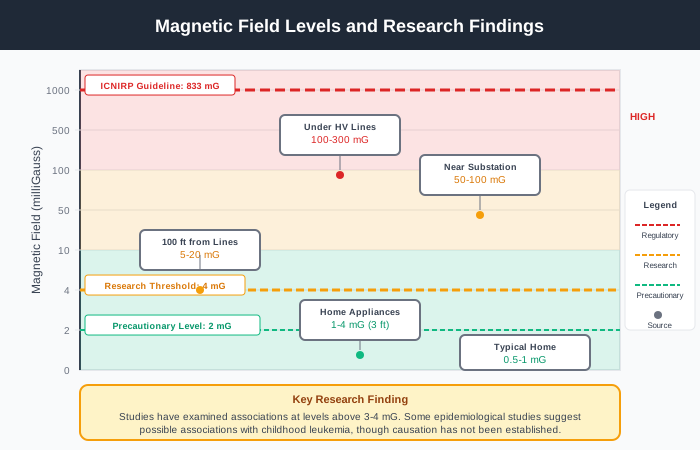
Perhaps no single issue has haunted EMF research more persistently than the apparent association between power-frequency magnetic fields and childhood leukemia. The International Agency for Research on Cancer (IARC), operating under the WHO umbrella, classified ELF magnetic fields as “possibly carcinogenic to humans” (Group 2B) back in 2002. This classification wasn’t based on speculation but on pooled analyses showing approximately twice the risk of childhood leukemia for exposures above 0.3 to 0.4 microtesla.
What makes this association particularly vexing is its durability. Decades of subsequent research have neither convincingly confirmed a causal mechanism nor successfully explained away the statistical association as mere bias or confounding. The National Cancer Institute notes that while more recent studies have had mixed findings regarding proximity to power lines, the overall epidemiological picture for ELF fields and childhood leukemia shows an increased risk at higher exposure levels.
Some researchers argue this association has been unfairly minimized. The evidence, they contend, is consistent across different continents, study types, and measurement methods. No other risk factor for childhood leukemia has been as comprehensively studied regarding possible biases and confounding factors. The exposure level showing increased risk sits far below international safety standards—standards that were designed around acute effects rather than long-term cancer risk.
Oxidative Stress: A Biological Mechanism Emerges
While the lack of an established mechanism for EMF harm has long been cited as grounds for skepticism, research into oxidative stress may be changing that picture. Multiple studies in animals and cell cultures have reported that EMF exposure increases reactive oxygen species (ROS) production and disrupts the body’s antioxidant defense systems.
Oxidative stress is not a trivial phenomenon. It’s implicated in aging, cancer development, neurodegenerative diseases, and cardiovascular problems. If EMFs genuinely trigger oxidative stress responses—even at low exposure levels—this could explain a range of reported health effects without requiring the direct DNA damage characteristic of ionizing radiation.
A 2025 paper in Frontiers in Public Health proposed a comprehensive mechanism through which EMFs might cause biological effects: the disruption of voltage-gated ion channels in cell membranes. According to this model, EMF exposure forces ions within these channels to oscillate, triggering irregular channel function that ultimately leads to oxidative stress through various cellular pathways. While this remains a hypothesis requiring further validation, it offers a plausible explanation for how non-ionizing radiation might affect living systems beyond simple heating.
The 5G Complication

The rollout of fifth-generation wireless technology has intensified public concern and scientific debate alike. 5G introduces new frequency ranges, including millimeter waves that haven’t been used extensively in consumer technology before. It also requires far more densely distributed transmission infrastructure than previous generations.
A 2021 essay by epidemiologist John Frank identified four relevant sources of scientific uncertainty: unclear boundaries around what technology 5G actually encompasses; a growing but gap-filled body of laboratory studies showing disruptive effects from RF-EMFs; an almost complete lack of high-quality epidemiological studies on 5G specifically; and persistent questions about whether telecommunications regulatory authorities base their safety policies on the latest science.
The most recent systematic reviews acknowledge this knowledge gap explicitly. Research specifically examining 5G millimeter-wave effects on human health remains extremely limited, and much of what exists comes from animal or cell studies that may not translate directly to real-world human exposures.
What the Critics of Concern Say
It would be irresponsible to present only one side of this debate. Substantial evidence also suggests that alarm over EMFs may be overblown.
A comprehensive 2024 systematic review published in Environment International examined radiofrequency EMF effects on self-reported symptoms. Across ten different exposure-outcome comparisons, the evidence suggested no significant effects of acute RF-EMF exposure on symptoms like headaches or sleep disturbances. Intriguingly, the review also found that study participants—including those who self-identified as electromagnetically hypersensitive—could not reliably detect whether they were being exposed to EMFs at rates better than chance.

This suggests that at least some reported EMF-related symptoms may stem from the perception of exposure rather than exposure itself—a nocebo effect. The psychological component of EMF concern cannot be dismissed.
Furthermore, humans have always lived within electromagnetic fields. The Earth itself generates a magnetic field, and solar radiation constantly bathes us in electromagnetic energy. Our biology evolved in this context. The question is whether anthropogenic EMFs differ qualitatively in ways that matter—a question on which expert opinion diverges sharply.
Vulnerable Populations: Children and the Elderly
The question of differential vulnerability adds another layer of complexity to the EMF debate. Children are not simply small adults—their developing nervous systems, thinner skulls, and longer expected lifetime of exposure may all influence how EMF affects them. The WHO has conducted international workshops specifically on children’s sensitivity to EMF exposure, acknowledging that while direct evidence of greater vulnerability is limited, the potential for differential effects warrants continued investigation.
Research published in early 2025 has also begun examining how aging affects sensitivity to electromagnetic fields. The body’s ability to adapt to environmental stressors declines with age, potentially making elderly individuals more susceptible to EMF effects. This remains a relatively unexplored area, but it raises important questions about protecting populations at both ends of the age spectrum.
The Regulatory Debate
A persistent criticism in EMF research involves the regulatory framework itself. Current international safety standards from organizations like ICNIRP focus primarily on acute thermal effects—preventing tissue from heating enough to cause immediate harm. Critics argue this approach fundamentally misses the point for exposures that may cause effects through other mechanisms, over longer timeframes, at lower intensities.
The International Commission on the Biological Effects of Electromagnetic Fields (ICBE-EMF), a group of independent scientists, has argued that scientific evidence invalidates the health assumptions underlying current FCC and ICNIRP exposure limits. They contend that standards last substantially updated in the 1990s fail to account for the explosion of research since then showing biological effects at sub-thermal levels.
Whether this critique is correct or represents an overly alarmist minority position depends largely on how one weighs conflicting studies—a judgment call that reasonable experts make differently.
The Precautionary Principle: Wisdom in Uncertainty
When facing scientific uncertainty about potential harms, the precautionary principle offers guidance: when human activities may lead to morally unacceptable harm that is scientifically plausible but uncertain, actions should be taken to avoid or diminish that harm.
This principle doesn’t require proof of danger before acting. It recognizes that waiting for absolute certainty—which may never come—could mean accepting preventable harm. Particularly for children, whose developing nervous systems may be more vulnerable to environmental exposures, a cautious approach seems reasonable.
Several countries have adopted precautionary measures regarding EMF exposure, particularly for children. These range from recommending that schools prefer wired internet connections over WiFi, to requiring specific absorption rate (SAR) labeling on mobile phones, to restricting mobile phone marketing to minors.
Practical Steps for Prudent Caution
For individuals who wish to reduce EMF exposure while awaiting greater scientific clarity, several reasonable steps exist that require minimal lifestyle disruption.
Increasing distance from EMF sources is perhaps the most effective strategy, as field strength decreases rapidly with distance—typically following an inverse square relationship. Keeping mobile phones away from the body when not in active use, using speakerphone or wired earbuds for calls, and positioning WiFi routers away from sleeping areas and frequently occupied spaces all follow this principle.
Reducing duration of exposure also helps. Limiting children’s screen time serves multiple purposes, EMF reduction being one potential benefit among many. Turning off WiFi routers at night eliminates exposure during sleep without significant inconvenience for most households. Some families designate device-free zones in bedrooms.
Being mindful of cumulative exposure acknowledges that we face EMFs from multiple sources simultaneously. While any single source may pose minimal individual risk, the aggregate exposure in modern environments is historically unprecedented. Smart meters, wireless baby monitors, Bluetooth devices, and the growing Internet of Things all contribute to our electromagnetic environment.
For those particularly concerned, practical options include using ethernet cables instead of WiFi for stationary devices, selecting low-SAR mobile phones, and advocating for precautionary policies in schools and workplaces. None of these measures require abandoning modern technology—merely approaching it with greater awareness.
Conclusion: Embracing Informed Uncertainty
The EMF health debate will likely continue for years, possibly decades. Definitive answers are elusive partly because the effects under investigation—if they exist—appear subtle, long-term, and difficult to isolate from the countless other factors affecting human health.
What we can say with confidence is this: the scientific case for EMF harm is not closed, despite assurances to the contrary. Credible researchers at reputable institutions continue to find biological effects at exposure levels below current safety guidelines. The childhood leukemia association persists unexplained. Animal studies showing oxidative stress accumulate. New technologies deploy before their health effects can be adequately studied.
None of this means EMFs are definitely dangerous. But it does mean that confident declarations of safety rest on incomplete evidence. In that context, treating EMF exposure with reasonable caution—particularly for children—seems not paranoid but prudent. We need not abandon our smartphones or flee to electromagnetic dead zones. But we might think twice about sleeping with devices under our pillows, or dismissing those who raise questions as mere technophobes.
History teaches that the absence of proven harm is not the same as proven safety. Tobacco, asbestos, and lead all enjoyed periods when their dangers were officially deemed unestablished. The precautionary principle exists precisely because waiting for certainty can exact terrible costs.
In navigating the invisible electromagnetic ocean we’ve created around ourselves, a measure of humility about what we don’t yet know seems the wisest course. The stakes—our health and that of our children—are simply too high for complacency.
Related Articles
- What Is EMF Radiation? The Complete Science Explained
- EMF and Cancer: A Review of Human and Animal Studies
- What Is a Safe Distance to Live From a Cell Tower?
Related Reading
- Are 5G Towers Dangerous? What the Research Shows (2026)
- Does EMF Affect Your Sleep? What 30+ Studies Found
- EMF and Fertility: What the Research Actually Shows
- Power Lines and Childhood Leukemia — What Studies Show
Related Reading
- Do Power Lines Cause Cancer? Decades of Research Reviewed — A deep dive into the childhood leukemia evidence discussed above
- Power Lines and Childhood Leukemia — The specific epidemiological studies behind the IARC classification
- 5G Towers Health Risks: What Does the Science Say? — The evidence on 5G safety, including millimeter-wave research
- Electromagnetic Hypersensitivity — The nocebo effect and EHS research in detail
- How to Reduce EMF Exposure at Home — Practical precautionary steps for your household
- EMF and Cancer Research — Human and animal study evidence reviewed
- What Is EMF Radiation? — Understanding the spectrum from ELF to RF
- Check EMF levels at your address → — See cell towers, power lines, and your estimated EMF exposure score