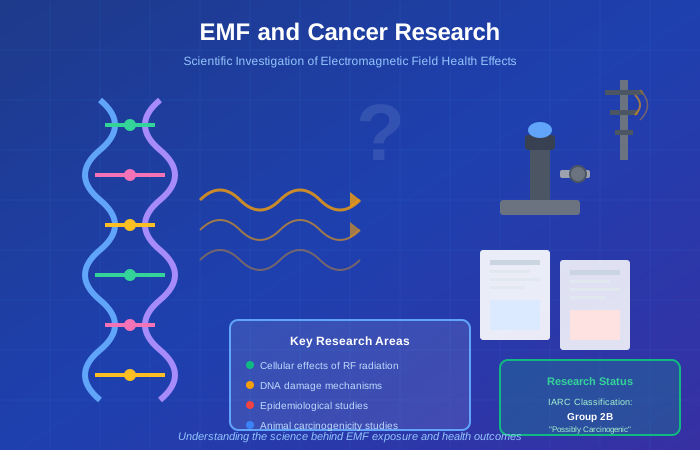
EMF and Cancer: A Review of Human and Animal Studies
Quick Answer: The International Agency for Research on Cancer (IARC) classifies radiofrequency electromagnetic fields as “possibly carcinogenic to humans” (Group 2B)—the same category as pickled vegetables and coffee. Large-scale human studies have not conclusively established a causal link between EMF exposure and cancer, though some animal studies have found increased tumor rates at high exposure levels. The evidence remains mixed, with significant methodological challenges making definitive conclusions difficult.

Key Facts at a Glance
| Factor | Details |
|---|---|
| IARC Classification | Group 2B – Possibly carcinogenic to humans (both RF and ELF) |
| Largest Human Study | INTERPHONE – 13 countries, 5,000+ participants, €19 million |
| Largest Animal Study | NTP Study – $30 million, 10+ years, found tumors in male rats |
| Primary Cancer Concerns | Glioma (brain), acoustic neuroma, childhood leukemia (ELF) |
| Current Exposure Limits | Based on thermal effects; SAR limits vary by country |
| Key Uncertainty | No established biological mechanism for non-ionizing radiation causing cancer |
Understanding the Two Types of EMF

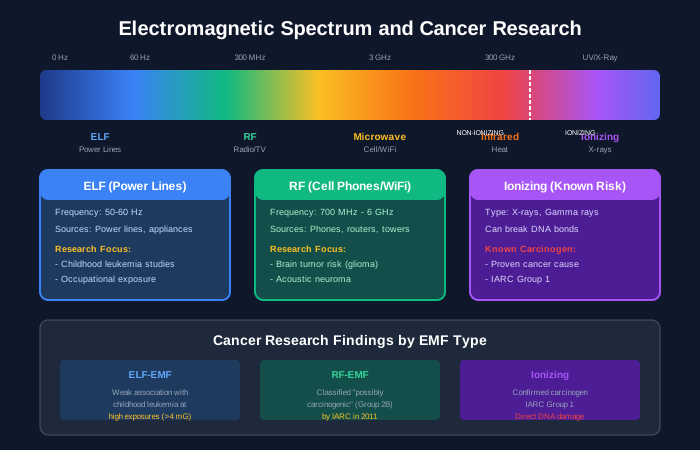
Electromagnetic fields relevant to cancer research fall into two distinct categories, each with different sources, biological interactions, and research findings.
Extremely Low Frequency (ELF) EMFs operate at frequencies up to 300 Hz. Power lines, electrical wiring, and household appliances like hair dryers and electric blankets generate these fields. Research on ELF fields has primarily focused on childhood leukemia, with epidemiological studies dating back to 1979.
Radiofrequency (RF) EMFs span from 3 kHz to 300 GHz. Cell phones, wireless devices, smart meters, and cell towers produce these fields. The biological interaction differs fundamentally from ELF: while ELF fields induce electric currents in tissue, RF exposure at sufficient intensity causes localized or whole-body heating.
Neither type produces ionizing radiation. Unlike X-rays or gamma rays, EMFs in these frequency ranges cannot directly damage DNA by stripping electrons from atoms. This fundamental distinction shapes the ongoing scientific debate about potential carcinogenic mechanisms.
Check your EMF exposure
See cell towers, power lines, and substations near any US address.
Search Your AddressThe IARC Classification: What Group 2B Actually Means
The World Health Organization’s International Agency for Research on Cancer evaluates substances and exposures for their cancer-causing potential. In 2011, a working group of 31 scientists from 14 countries reviewed the available evidence on radiofrequency electromagnetic fields.
Their conclusion placed RF-EMF in Group 2B: possibly carcinogenic to humans. This classification indicates limited evidence of carcinogenicity in humans combined with less than sufficient evidence in experimental animals.
Context matters here. Group 2B contains over 300 agents, including aloe vera extract, pickled vegetables, talc-based body powder, and gasoline exhaust. Coffee was classified as Group 2B until 2016, when the classification was downgraded based on new evidence.
The IARC working group based its RF-EMF classification primarily on epidemiological data suggesting a possible increase in glioma risk among heavy cell phone users. They noted that the evidence for acoustic neuroma (a benign tumor of the nerve connecting the ear to the brain) showed a similar pattern.
ELF magnetic fields received their Group 2B classification earlier, in 2002, based on consistent epidemiological associations with childhood leukemia. Notably, ELF electric fields were placed in Group 3 (inadequate evidence), highlighting the specificity of the magnetic field findings.
Human Epidemiological Studies
The INTERPHONE Study (2000-2010)
The INTERPHONE study represents the largest international effort to investigate cell phone use and brain tumor risk. Conducted across 13 countries with funding of approximately €19 million, the study enrolled 2,708 glioma cases and 2,409 meningioma cases along with matched controls.
The primary findings, published in 2010, did not show an overall increased risk of glioma or meningioma among regular cell phone users. The data revealed a counterintuitive protective effect at moderate use levels—a finding the researchers attributed to participation bias rather than any biological effect.
However, one subgroup analysis attracted significant attention: participants in the highest decile of cumulative call time (over 1,640 hours of lifetime use) showed an odds ratio of 1.40 for glioma. The researchers interpreted this finding cautiously, noting that recall bias and other methodological limitations provided plausible alternative explanations.
The INTERPHONE acoustic neuroma analysis, examining data from five Northern European countries, found an increased risk among users of 10 years or more—though again, the authors emphasized methodological concerns.
The Swedish Hardell Studies
Oncologist Lennart Hardell and colleagues at Orebro University Hospital conducted a series of case-control studies beginning in the late 1990s. Their findings consistently showed stronger associations between wireless phone use and brain tumors than the INTERPHONE study.
A pooled analysis of studies from 1997-2003 and 2007-2009 reported overall increased risk for glioma (OR = 1.3) with mobile phone use. Risk estimates increased substantially with longer latency periods: users of 25+ years showed an odds ratio of 3.0 for glioma. The analysis also found particularly elevated risks for individuals who began using mobile phones before age 20.
The discrepancy between Hardell’s findings and INTERPHONE has generated substantial debate. Critics point to methodological differences, potential recall bias, and the lack of replication in other independent studies. Supporters argue that the Hardell studies used more appropriate exposure metrics and were not subject to the same industry-funding concerns.
Childhood Leukemia and ELF Fields
The association between ELF magnetic field exposure and childhood leukemia remains one of the most persistent findings in EMF epidemiology. A 2021 meta-analysis combining 27 studies with over 45,000 cases found that children exposed to magnetic field levels of 0.4 microtesla (μT) or higher had 1.72 times the odds of developing leukemia compared to unexposed children.
This association has been replicated across multiple countries and study designs. Pooled analyses have consistently identified increased risk at exposures above 0.3-0.4 μT—levels experienced by approximately 1-2% of children in developed countries, typically those living very close to high-voltage power lines.
Yet the interpretation remains contested. No biological mechanism explains how such weak magnetic fields could influence cancer development. Animal studies have not reproduced the effect. And despite intensive investigation since 1979, the epidemiological evidence has neither strengthened substantially nor been definitively refuted.
Animal Studies: Laboratory Evidence

The NTP Study: $30 Million Federal Investigation
The U.S. National Toxicology Program conducted what remains the most comprehensive animal study on cell phone radiation and cancer. Spanning over 10 years with funding of approximately $30 million, the study exposed rats and mice to whole-body radiofrequency radiation at levels designed to replicate cell phone exposure patterns.
The final results, released in 2018, found “clear evidence” of carcinogenic activity in male rats. Specifically, exposed male rats developed malignant schwannomas of the heart—tumors arising from the same cell type (Schwann cells) that gives rise to acoustic neuromas in humans. The study also found “some evidence” of brain gliomas and adrenal gland tumors in male rats.
Female rats and mice of both sexes showed no clear cancer associations, a sex-specific difference that researchers could not fully explain.
The NTP findings carry significant scientific weight due to the study’s rigorous methodology, including blinded pathology review by external experts. Notably, the NTP also found increased DNA damage in the brains of exposed animals, suggesting oxidative stress as a potential mechanism linking RF exposure to tumor development. However, the exposure conditions differed substantially from human use: animals received whole-body exposure at levels near or exceeding current safety limits, for 9 hours daily, over their entire lifespan.
The Ramazzini Institute Study
Italian researchers at the Ramazzini Institute published complementary findings in 2018, examining RF exposure at much lower levels—comparable to those from cell towers rather than direct cell phone use. This study exposed 2,448 Sprague-Dawley rats from prenatal life until natural death to a 1.8 GHz signal for 19 hours daily.
At the highest exposure level (50 V/m), male rats showed a statistically significant increase in heart schwannomas. The researchers emphasized that their findings, using far-field exposure at environmental levels, reinforced the NTP results obtained with near-field exposure at higher intensities.
The consistency between studies—both finding schwannomas in male rats using different exposure paradigms—has been cited as strengthening evidence. However, regulatory bodies including ICNIRP and the German Federal Office for Radiation Protection have noted methodological concerns with both studies, including statistical analysis approaches and the lack of dose-response relationships.
The Dose-Response Question
Cancer research typically relies on dose-response relationships to establish causation. Higher exposure should correlate with higher risk. For EMF and cancer, this relationship remains inconsistent.
The NTP study did not show a clear dose-dependent increase in tumors across exposure levels. A replication study found elevated tumor rates in exposed animals but no progressive increase with higher doses. This absence of dose-response undermines confidence in causal interpretations.
Specific Absorption Rate (SAR) serves as the standard metric for quantifying RF exposure—measuring the rate at which energy is absorbed by tissue, expressed in watts per kilogram. Current safety limits incorporate substantial safety margins: international guidelines set localized SAR limits at levels designed to prevent tissue heating, with safety factors that may reach 30-fold or higher.
Whether SAR appropriately captures the biologically relevant exposure remains debated. Some researchers argue that cumulative exposure time, specific modulation patterns, or pulsed versus continuous exposure may matter more than raw energy absorption rates.
Why Results Remain Mixed

Multiple factors contribute to the inconsistent findings across EMF cancer research:
Exposure Assessment Challenges. Unlike chemical exposures where blood levels can be measured, EMF exposure must be estimated retrospectively. Self-reported cell phone use suffers from recall bias. Residential proximity to power lines provides only crude exposure estimates. The exposures that matter most—cumulative lifetime dose—cannot be accurately measured.
Long Latency Periods. Brain tumors may take decades to develop. Cell phones achieved widespread use only in the mid-1990s. Epidemiological studies may not yet have adequate follow-up time to detect effects, particularly for slow-growing tumors.
Rapidly Changing Technology. Exposure patterns have shifted dramatically. Early cell phones operated at higher power levels. Newer technologies use different frequencies and modulation schemes. A study of 2G phone users may not apply to current 4G or 5G technology.
Selection and Participation Bias. Cancer patients may overestimate past exposures when seeking explanations for their illness. Healthy controls may underestimate their use. The INTERPHONE study’s finding of apparent protective effects at moderate use levels almost certainly reflects such bias rather than any biological protection.
Publication Bias. Studies finding positive associations may be more likely to be published than null results, potentially skewing the overall literature.
Current Regulatory Positions
Regulatory agencies worldwide have generally concluded that current exposure limits adequately protect public health, while acknowledging remaining uncertainties.
The U.S. Food and Drug Administration, which nominated cell phone radiation for NTP study, maintains that the weight of evidence does not support a causal link between cell phone use and cancer in humans. The agency notes that exposure levels in positive animal studies exceeded typical human exposures.
The Federal Communications Commission sets SAR limits at 1.6 W/kg averaged over 1 gram of tissue for devices used near the body. European limits are somewhat higher at 2 W/kg averaged over 10 grams. These limits were established to prevent thermal effects and include safety margins.
Some jurisdictions have adopted precautionary measures. France banned cell phone advertising directed at children under 14. Belgium requires SAR labeling on phones. Several countries recommend limiting children’s cell phone use despite acknowledging that causal evidence remains insufficient.
Frequently Asked Questions
Do cell phones cause brain cancer?
Current evidence does not establish that cell phones cause brain cancer. The IARC classification of “possibly carcinogenic” reflects limited evidence suggesting a potential association, not proof of causation. Brain tumor incidence rates in most countries have remained stable or increased only slightly since cell phones became widespread, which would not be expected if cell phones substantially increased risk.
Why did rats develop tumors in the NTP study if cell phones are safe?
The NTP study used exposure conditions that differ significantly from human cell phone use. Rats received whole-body radiation at near-maximum exposure levels for 9 hours daily throughout their lives. These conditions were designed to maximize sensitivity for detecting any potential effect, not to replicate typical human exposure. Whether findings at such high exposures apply to normal use remains uncertain.
Should I keep my phone away from my body?
While no definitive evidence shows that typical cell phone use poses significant cancer risk, minimizing direct contact with transmitting devices reduces exposure. Using speakerphone or wired headsets, texting instead of calling, and keeping phones out of pockets during active calls are simple precautions with minimal inconvenience. Regulatory agencies generally do not recommend such measures as necessary but acknowledge them as reasonable options for those concerned.
Are 5G networks more dangerous than previous generations?
5G networks use both frequencies similar to current cell phones and new higher frequencies (millimeter waves). Higher-frequency millimeter waves penetrate tissue less deeply than lower frequencies, which may actually reduce exposure to internal organs. No evidence suggests that 5G poses greater cancer risk than previous technologies, though long-term studies specific to 5G exposure are limited.
Why is the research so contradictory?
EMF cancer research faces fundamental methodological challenges. Exposure assessment relies on imperfect estimates. Long cancer latency periods require decades of follow-up. Technology changes faster than studies can be completed. These factors contribute to inconsistent results across studies. The persistent finding of childhood leukemia association with ELF fields, despite no clear mechanism or animal model confirmation, illustrates how difficult these questions are to resolve definitively.
Are children more vulnerable to EMF exposure?
Some researchers hypothesize that children’s developing nervous systems and thinner skulls might make them more susceptible to any EMF effects. The Hardell studies found higher risk estimates for those who began phone use before age 20. However, direct evidence of increased childhood vulnerability remains limited. Precautionary recommendations to limit children’s cell phone use reflect this uncertainty rather than established risk.
The Bottom Line
After four decades of research and billions of dollars in scientific investigation, the relationship between EMF exposure and cancer remains incompletely understood. The evidence supports these conclusions:
ELF magnetic fields show a consistent epidemiological association with childhood leukemia at exposure levels above 0.3-0.4 μT. This association has not been explained by a biological mechanism or reproduced in animal studies. Whether it reflects a true causal relationship or unidentified confounding factors remains unclear.
Radiofrequency exposure from cell phones has not been conclusively linked to brain tumors in human studies. The largest epidemiological studies show no overall increased risk, though some subgroup analyses suggest possible effects in the heaviest users. Animal studies have found tumors at high exposure levels, but the relevance to typical human use is uncertain.
No established mechanism exists by which non-ionizing radiation at environmental exposure levels could cause cancer. This absence of mechanistic understanding, combined with the lack of dose-response relationships and inconsistent findings, prevents confident causal conclusions.
For individuals concerned about potential risks, practical precautions—keeping phones away from the body during calls, limiting children’s use, using wired connections when practical—involve minimal cost or inconvenience. For society, continued research monitoring remains appropriate, particularly as exposure patterns evolve with new technologies.
The honest scientific answer is that we cannot definitively rule out small cancer risks from EMF exposure, nor can we confirm them. This uncertainty is itself informative: if EMF posed substantial cancer risk, the signal would likely have emerged more clearly from decades of intensive investigation.
Related Reading
- Does EMF Cause Cancer? What 30 Years of Research Shows — our definitive guide answering the #1 question about EMF and cancer, with every major study reviewed
- Is EMF Bad for You? What Science Actually Says
- EMF and DNA Damage: Can Cell Phones Break Your DNA? — the biological mechanism that could connect EMF to cancer
- 5G Technology and Health: Separating Fact from Fiction
- How to Reduce EMF Exposure in Your Home
Sources
-
IARC Working Group. (2013). Non-ionizing Radiation, Part 2: Radiofrequency Electromagnetic Fields. IARC Monographs on the Evaluation of Carcinogenic Risks to Humans, Vol. 102. https://publications.iarc.fr/126
-
The INTERPHONE Study Group. (2010). Brain tumour risk in relation to mobile telephone use: results of the INTERPHONE international case-control study. International Journal of Epidemiology, 39(3), 675-694. DOI: 10.1093/ije/dyq079
-
National Toxicology Program. (2018). Cell Phone Radio Frequency Radiation Studies. NTP Technical Report. https://ntp.niehs.nih.gov/whatwestudy/topics/cellphones
-
Falcioni, L., Bua, L., Tibaldi, E., et al. (2018). Report of final results regarding brain and heart tumors in Sprague-Dawley rats exposed from prenatal life until natural death to mobile phone radiofrequency field. Environmental Research, 165, 496-503. DOI: 10.1016/j.envres.2018.01.037
-
Hardell, L., & Carlberg, M. (2015). Mobile phone and cordless phone use and the risk for glioma – Analysis of pooled case-control studies in Sweden, 1997–2003 and 2007–2009. Pathophysiology, 22(1), 1-13. DOI: 10.1016/j.pathophys.2014.10.001
-
Swanson, J., & Kheifets, L. (2006). Biophysical mechanisms: a component in the weight of evidence for health effects of power-frequency electric and magnetic fields. Radiation Research, 165(4), 470-478. DOI: 10.1667/RR3522.1
-
Ahlbom, A., Day, N., Feychting, M., et al. (2000). A pooled analysis of magnetic fields and childhood leukaemia. British Journal of Cancer, 83(5), 692-698. DOI: 10.1054/bjoc.2000.1376
-
Röösli, M., Lagorio, S., Schoemaker, M.J., et al. (2019). Brain and salivary gland tumors and mobile phone use: evaluating the evidence from various epidemiological study designs. Annual Review of Public Health, 40, 221-238. DOI: 10.1146/annurev-publhealth-040218-044037
-
Zhao, L., Liu, X., Wang, C., et al. (2021). Exposure to extremely low-frequency magnetic fields and childhood cancer: A systematic review and meta-analysis. PLOS ONE, 16(5), e0251628. DOI: 10.1371/journal.pone.0251628
-
Swerdlow, A.J., Feychting, M., Green, A.C., et al. (2011). Mobile phones, brain tumors, and the interphone study: where are we now? Environmental Health Perspectives, 119(11), 1534-1538. DOI: 10.1289/ehp.1103693
Related Articles
- Do Power Lines Cause Cancer? Decades of Research Reviewed
- What Is EMF Radiation? The Complete Science Explained
- EMF and Fertility: What the Research Actually Shows
Concerned about EMF near your home? Check your address on EMF Radar → to see nearby cell towers, power lines, and your estimated exposure score — free and instant.