EMF Exposure While Pregnant: What the Research Says and How to Reduce Your Risk
If you’re pregnant — or planning to be — you’ve probably wondered whether the cell towers, Wi-Fi routers, and devices around you could affect your baby. It’s a reasonable question, and one that researchers have been studying for decades.
Here’s what the science actually says, without the fear-mongering or the dismissiveness.
What Is EMF Exposure?
EMF stands for electromagnetic fields — invisible energy produced by anything electrical. There are two types that matter here:
- Radiofrequency (RF) EMF — from cell towers, Wi-Fi, Bluetooth, and your phone. This is the type most people worry about.
- Extremely low frequency (ELF) EMF — from power lines, electrical wiring, and appliances.
Both types are classified as non-ionizing radiation, meaning they don’t have enough energy to damage DNA directly the way X-rays or UV radiation can. But “non-ionizing” doesn’t automatically mean “zero biological effect” — and that’s where the research gets interesting.
What Does the Research Say?

The Precautionary Studies
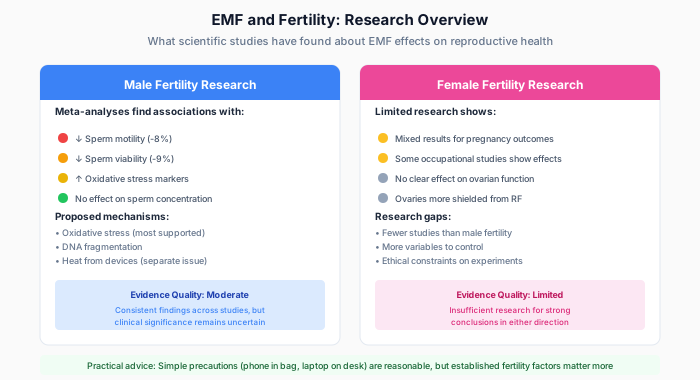
Several studies have found associations worth noting:
The Kaiser study (2017) — Researchers at Kaiser Permanente followed 913 pregnant women in the San Francisco Bay Area and measured their actual EMF exposure using monitoring devices. Women with higher magnetic field (ELF) exposure had a 2.72x higher miscarriage risk compared to those with lower exposure. This was published in Scientific Reports, a Nature journal. For a full breakdown of this landmark research and the 2026 uterine effects review, see our dedicated EMF and miscarriage guide.
The De-Kun Li research — Dr. De-Kun Li at Kaiser Permanente has published multiple studies finding associations between EMF exposure and pregnancy outcomes, including increased miscarriage risk and potential effects on fetal development.
Animal studies — Multiple animal studies have shown effects on reproductive outcomes at EMF levels comparable to or above typical environmental exposure. While animal studies don’t directly translate to humans, they raise valid biological questions.
The Reassuring Data
WHO position — The World Health Organization states that current evidence does not confirm that low-level EMF exposure causes adverse health effects, though they acknowledge that gaps exist in the research, particularly for long-term and prenatal exposure.
Regulatory limits — Cell towers and devices in the US must comply with FCC exposure limits, which include safety margins. Your actual exposure from a cell tower hundreds of feet away is typically thousands of times below these limits.
Large population studies — Several large epidemiological studies have not found consistent links between typical environmental RF exposure and birth defects or pregnancy complications.
The Honest Summary
The research is genuinely mixed. There are enough concerning findings — especially around ELF exposure and miscarriage risk — that the “precautionary principle” makes sense for pregnant women. At the same time, the absolute risk appears small, and typical environmental exposure levels are well below regulatory limits.
The bottom line: you don’t need to panic, but taking simple precautions is reasonable and free.
Check your EMF exposure
See cell towers, power lines, and substations near any US address.
Search Your AddressPractical Steps to Reduce EMF Exposure During Pregnancy
These are sorted by impact — start with the easy wins at the top.
1. Create Distance from Your Phone
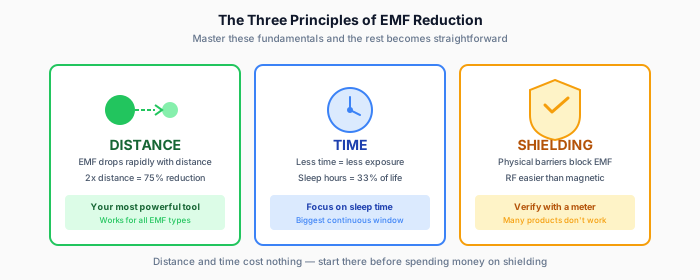
Your phone is your biggest source of personal RF exposure. The inverse-square law means that doubling the distance reduces exposure by 75%.
- Don’t carry your phone against your body. Use a bag or set it on a table.
- Use speakerphone or wired earbuds for calls instead of holding the phone to your head.
- Don’t sleep with your phone under your pillow or on the nightstand right next to your head. Across the room is fine.
- Switch to airplane mode when you don’t need connectivity — especially at night.
2. Manage Your Home Wi-Fi
Your Wi-Fi router is an always-on RF source.
- Move the router away from bedrooms — even one room away makes a significant difference.
- Turn it off at night if practical (a simple outlet timer works great).
- Use wired ethernet for stationary devices like desktops and smart TVs.
3. Reduce Appliance Exposure (ELF)
Given the Kaiser study findings on magnetic fields and miscarriage risk:
- Don’t rest a laptop on your belly. Use it on a table or desk.
- Keep distance from running appliances — hair dryers, electric heaters, and microwave ovens produce significant ELF fields while operating. A few feet of distance is plenty.
- Check your bedroom — electric blankets, heated mattress pads, and alarm clocks with transformers can produce elevated ELF fields very close to your body during sleep.
4. Check Your Neighborhood
Living very close to cell towers means higher ambient RF exposure. While still below regulatory limits, the precautionary approach suggests awareness.
- Search your address on EMF Radar to see nearby cell towers and your estimated exposure level.
- If you’re house hunting, consider EMF exposure as one factor in your decision. Browse EMF data by city to compare areas.
- Ground-floor apartments near rooftop antennas can have higher exposure than you’d expect.
5. Don’t Overthink It
- Normal daily activities are fine. Walking past a cell tower, using your phone briefly, sitting near a router — these produce exposure levels far below anything shown to cause harm.
- Stress is worse. The anxiety of obsessing over EMF is arguably more harmful to your pregnancy than the EMF itself.
- Focus on what you can control. The steps above are easy, free, and cover the biggest exposure sources.
What About EMF Shielding Products?
The market is full of “EMF protection” products marketed to pregnant women — belly bands, phone shields, pendants, and stickers. Here’s the truth:
- Most don’t work. Stickers and pendants that claim to “harmonize” or “neutralize” EMF have no scientific basis.
- Some shielding fabrics do reduce RF — but only if used correctly, and they can actually increase exposure if they reflect signals around instead of absorbing them.
- The free precautions above are more effective than most products you can buy.
If you want physical shielding, RF window film is one evidence-based option for reducing exposure from external cell towers entering your home.
The Bottom Line
EMF exposure during pregnancy is a legitimate topic with real research behind it — not just internet paranoia. While the evidence doesn’t prove harm at typical exposure levels, the precautionary principle makes sense when you’re growing a human.
The good news: the most effective steps are free, easy, and don’t require changing your life. Create distance from your phone, manage your Wi-Fi, and check what’s in your neighborhood.
Want to know your local EMF exposure? Search your address on EMF Radar to see nearby cell towers, power lines, and your estimated exposure score.
Setting up a nursery? See our Low EMF Baby Monitor Buyer’s Guide for product recommendations and setup tips that minimize your newborn’s RF exposure.
Worried about EMF and your child’s development? Read our evidence-based guide on EMF and autism — including what a 2025 brain organoid study actually shows about RF and neural development.
This article is for informational purposes only and is not medical advice. Consult your healthcare provider with specific concerns about EMF exposure during pregnancy.
Related Reading
- EMF and Female Fertility: What Every Woman Should Know — comprehensive guide covering fertility, conception, and reproductive health research
- EMF and Miscarriage: What the Research Says About Pregnancy Loss — deep dive into the Kaiser Permanente studies and 2026 uterine effects research
- EMF Protection During Pregnancy: Room-by-Room Guide — practical reduction strategies for every room
- EMF and Babies: What New Parents Need to Know — postnatal protection for infants and nursery setup
- EMF and Fertility Research — How EMF exposure may affect both male and female fertility
- EMF and Children: A Parent’s Guide — What parents need to know about EMF exposure for kids
- How to Reduce EMF Exposure at Home — Room-by-room practical tips for lowering your household exposure
- WiFi Router Safe Distance — How far is far enough? Research-backed distance recommendations
- Safe Distance from a Cell Tower — What the studies say about proximity and exposure
- EMF Proof Your Home — A comprehensive guide to home shielding options
- Check EMF near your home → — Use our free map to see cell towers and estimated exposure at your address
Sources and Further Reading
- De-Kun Li et al., “Exposure to Magnetic Field Non-Ionizing Radiation and the Risk of Miscarriage,” Scientific Reports (2017)
- WHO Fact Sheet on Electromagnetic Fields and Public Health
- ICNIRP Guidelines on Limiting Exposure to Electromagnetic Fields (2020)
- American College of Obstetricians and Gynecologists (ACOG) — Committee opinions on environmental exposures during pregnancy