Low EMF Infrared Sauna Guide: How to Choose One That Won’t Fry You
Quick answer: Many infrared saunas marketed as “low EMF” still produce 8–50 milligauss (mG) of magnetic field radiation at seating distance — far above the 2–3 mG threshold recommended by environmental health guidelines. Truly low-EMF saunas use carbon fiber heating panels with proper shielding and produce less than 3 mG at body level. Before buying, look for third-party EMF testing data (not just manufacturer claims), and consider testing any sauna yourself with a basic gaussmeter.
You bought an infrared sauna to improve your health. The last thing you want is to sit in a wooden box marinating in electromagnetic fields for 30 minutes a day.
But here’s the uncomfortable truth: most infrared saunas are EMF hotspots. The heating elements, wiring, power supplies, and control panels are inches from your body — much closer than any cell tower, WiFi router, or power line you’d normally encounter.
This guide covers everything you need to know: what causes high EMF in saunas, what “low EMF” actually means (spoiler: marketing claims are unreliable), how to test your existing sauna, and what to look for if you’re shopping for a new one.
 Infrared saunas surround your body with heating elements at close range — making EMF shielding quality a critical health factor.
Why EMF Matters More in Saunas Than Almost Anywhere Else
EMF exposure follows the inverse square law: double your distance, quarter your exposure. That’s why a cell tower 300 meters away produces far less body-level exposure than a device in your hand.
In an infrared sauna, you’ve eliminated distance entirely. The heating panels are typically 2–12 inches from your body. You’re enclosed in a small space. And you’re sitting there for 20–40 minutes, often daily.
Here’s how sauna EMF exposure compares to other common sources:
| Source | Typical Distance | Magnetic Field |
|---|---|---|
| Cell tower | 100–500m | 0.01–0.1 mG |
| WiFi router | 3–10 ft | 0.1–1 mG |
| Laptop on lap | 0 inches | 2–20 mG |
| Hair dryer (in use) | 6 inches | 1–70 mG |
| Cheap infrared sauna | 2–12 inches | 10–100 mG |
| Low-EMF infrared sauna | 2–12 inches | 0.5–3 mG |
The difference between a poorly shielded sauna and a properly designed one can be 20–50x in EMF exposure at body level.
Want to know what’s near your home? Use EMF Radar’s free map tool to check cell tower density and RF exposure estimates at any address.
The Two Types of EMF in Infrared Saunas
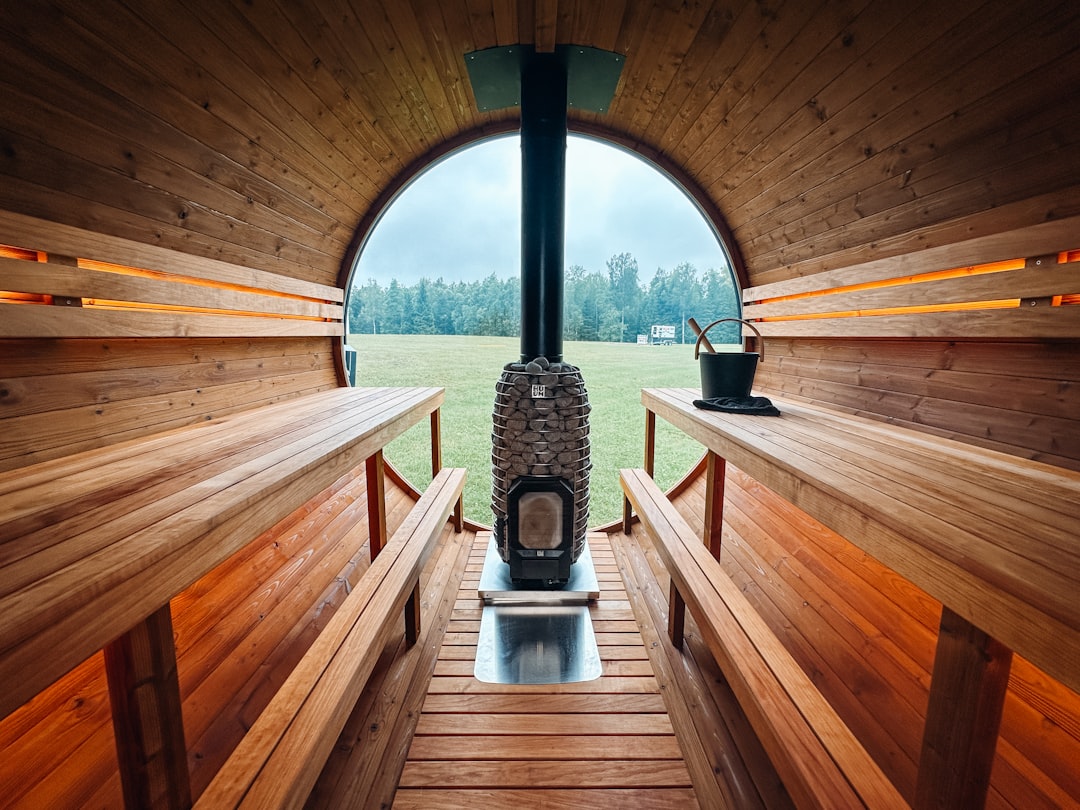
Not all EMF is created equal, and saunas produce two distinct types. Understanding the difference matters because most “low EMF” marketing only addresses one.
ELF (Extremely Low Frequency) — Magnetic Fields
This is the big one. ELF magnetic fields come from:
- Heating element wiring (the primary source)
- Power supply transformers
- Control panel electronics
- Internal wiring runs
ELF magnetic fields are measured in milligauss (mG). The Swedish safety standard (MPR-II) recommends staying under 2.5 mG for prolonged exposure. The EPA suggests 3 mG as a prudent avoidance threshold.
Most conventional infrared saunas produce 10–50 mG at the seated position. Some budget models exceed 100 mG near heater panels.
ELF Electric Fields
Electric fields exist whenever a wire carries voltage, even when no current flows. They’re measured in volts per meter (V/m). While generally considered less biologically significant than magnetic fields, some researchers (particularly those studying “dirty electricity”) consider chronic electric field exposure a concern.
Well-shielded saunas use grounded wiring and carbon panels that minimize electric fields. Unshielded models can produce 50–200+ V/m at seating distance.
 The wellness benefits of infrared saunas are well-documented — but they shouldn’t come with unnecessary EMF exposure.
Check your EMF exposure
See cell towers, power lines, and substations near any US address.
Search Your AddressWhat Makes a Sauna “Low EMF” (And What Doesn’t)
The term “low EMF” has no regulatory definition for saunas. Any manufacturer can slap it on the box. Here’s how to separate real low-EMF engineering from marketing fluff.
✅ Legitimate Low-EMF Features
Carbon fiber heating panels — Carbon panels distribute heat over a larger surface area than ceramic rods, requiring less current per square inch. Less current = lower magnetic fields. Quality carbon panels with proper wiring can achieve under 2 mG at seating distance.
Twisted-pair or counter-wound wiring — When two wires carrying current in opposite directions are twisted together or run in parallel, their magnetic fields partially cancel out. This is the single most effective EMF reduction technique and the hallmark of genuinely low-EMF saunas.
Shielded power supplies — External or well-shielded transformers placed far from the seating area reduce both magnetic and electric field exposure at body level.
Grounded enclosure design — Proper grounding of the sauna’s frame and wiring reduces electric field exposure significantly.
Third-party testing — Legitimate low-EMF claims are backed by independent lab measurements at multiple positions inside the sauna at operating temperature. Look for measurements taken at seating level, not just “at the panel surface” (which is meaningless for your actual exposure).
🚩 Red Flags
“Zero EMF” claims — Physically impossible. Any device using electricity produces some EMF. This is pure marketing.
Measurements only at panel surface — Some manufacturers test EMF right at the heater panel, where cancellation techniques work best, but not at seating distance where your body actually is. Always ask for body-level measurements.
No independent testing — If the only EMF data comes from the manufacturer with no third-party verification, treat it with healthy skepticism.
Ceramic rod heaters — Ceramic heating rods concentrate current in small areas, producing higher localized magnetic fields. They’re common in budget saunas and nearly impossible to make truly low-EMF.
Bluetooth/WiFi built in — Many modern saunas include Bluetooth speakers or WiFi-connected controls. These add RF radiation to your ELF exposure. If you want low EMF, choose models without wireless features (or at least ones where you can disable them).
Far Infrared vs. Near Infrared vs. Full Spectrum: EMF Differences
The type of infrared heating affects both the therapeutic benefit and the EMF profile:
Far Infrared (FIR)
- Wavelength: 5.6–1000 μm
- Penetration: Deepest — reaches muscles and joints
- EMF profile: Lowest when using quality carbon panels with counter-wound wiring
- Best for: Detoxification, pain relief, cardiovascular benefits
- Most common type in home saunas, and the easiest to make low-EMF
Near Infrared (NIR)
- Wavelength: 0.7–1.4 μm
- Penetration: Surface-level — skin and shallow tissue
- EMF profile: Can be very low when using LED emitters (LEDs produce minimal magnetic fields)
- Best for: Skin health, wound healing, mitochondrial stimulation
- Less common as a standalone; often combined in “full spectrum” models
Full Spectrum
- Wavelength: Combines near, mid, and far infrared
- EMF profile: Varies widely — depends on how each wavelength is generated
- Concern: More heating technologies in one box = more potential EMF sources. Full-spectrum saunas need extra scrutiny
- Some “full spectrum” models use halogen bulbs for near-IR, which can produce significant EMF
Bottom line: Far infrared with carbon panels is the sweet spot for low EMF exposure. If you want full spectrum, make sure the manufacturer provides EMF data for each heating technology at seating distance.
 The quality of materials and construction — especially the heating panels behind these benches — determines your EMF exposure during every session.
How to Test Your Sauna’s EMF Levels at Home

Already own a sauna? You don’t have to guess about EMF levels. A basic measurement takes 10 minutes with an inexpensive meter.
What You Need
A gaussmeter (also called a magnetometer or ELF meter) that measures AC magnetic fields in milligauss. Good options:
- Trifield TF2 (~$170) — Measures magnetic, electric, and RF fields. The standard recommendation for home EMF testing.
- GQ EMF-390 (~$90) — Good budget option for magnetic field measurements.
- Latnex MG-300 (~$50) — Basic but adequate for gaussmeter readings.
You can also use the meters we cover in our complete EMF meter guide.
Testing Protocol
-
Baseline first — Turn the sauna OFF. Measure the ambient magnetic field at the seating position. In most homes, this is 0.2–1.0 mG.
-
Heat it up — Turn the sauna ON to its normal operating temperature. Wait until the heaters are fully engaged (usually 10–15 minutes).
-
Measure at seating level — Hold the meter at the position where your torso would be while seated. This is the measurement that matters.
-
Test multiple spots — Measure near each wall/panel, at head height, and at foot level. EMF varies significantly by position.
-
Record the numbers:
- Under 2 mG — Excellent. Your sauna meets strict low-EMF standards.
- 2–5 mG — Acceptable. Below the threshold most environmental health researchers consider concerning.
- 5–10 mG — Moderate. Consider limiting session length or increasing distance from the hottest panels.
- Over 10 mG — High. Your sauna is not low-EMF regardless of marketing claims.
-
Check electric fields too — If your meter measures electric fields (V/m), levels under 10 V/m at seating distance are good. Over 50 V/m warrants concern.
Common Findings
People are often surprised to find that one wall of their sauna is dramatically higher than others. This typically happens because:
- The control panel and power supply are behind that wall
- Wiring runs concentrate behind certain panels
- One heater element has different shielding than others
Quick mitigation: If one wall is high, simply sit facing away from it and maintain maximum distance from the hot panel.
What to Look For When Buying
If you’re in the market for a low-EMF infrared sauna, here’s a practical checklist:
Non-Negotiables
- Carbon fiber panels (not ceramic rods)
- Third-party EMF testing data showing measurements at body/seating level
- Under 3 mG magnetic field at all seating positions
- Under 10 V/m electric field at seating positions
- Counter-wound or twisted-pair wiring in heater panels
- External or shielded power supply (not inside the cabin)
Nice to Have
- Low-VOC wood and adhesives (Canadian hemlock, basswood, or cedar preferred)
- No Bluetooth/WiFi (or the ability to disable wireless)
- Chromotherapy (LED color therapy) with separate low-EMF certification
- UL or ETL safety certification
- Full spectrum with per-technology EMF data
Questions to Ask the Manufacturer
- “Can you provide third-party EMF test results measured at seating distance, not at the panel surface?”
- “What type of wiring do you use in the heater panels — is it counter-wound?”
- “Where is the power supply located relative to the seating area?”
- “If this is full-spectrum, what are the EMF readings for each infrared technology separately?”
- “Can I return it if my own EMF measurements don’t match your specs?”
If a manufacturer can’t or won’t answer these questions, that tells you everything you need to know.
Reducing EMF Exposure in Any Sauna
Even if your sauna isn’t perfectly low-EMF, you can reduce your exposure:
Positioning
- Sit in the center — maximum distance from all panels
- Don’t lean against heater walls — even 6 inches of additional distance cuts magnetic field exposure significantly
- Face away from the control panel — this is usually the highest-EMF area
Timing
- Preheat fully before entering — many saunas cycle their heaters less aggressively once at temperature, reducing EMF during your session
- Shorter sessions at higher temp vs. longer sessions at lower temp can reduce total exposure time while maintaining benefits
Electrical
- Use a dedicated circuit — sharing a circuit with other appliances can increase dirty electricity
- Grounding rod — some EMF-conscious users add supplemental grounding to their sauna’s frame
- Kill wireless — if your sauna has Bluetooth speakers, turn off Bluetooth on any paired device. Use wired speakers instead
The Nuclear Option
- External heater saunas — some designs place the heating element outside the cabin entirely, circulating heated air through vents. This virtually eliminates body-level EMF but sacrifices the direct infrared radiation that provides the deepest therapeutic benefits
The Bigger EMF Picture
Your sauna is one piece of your total EMF exposure. While it deserves attention — especially given the close proximity and daily use — it’s worth understanding your full exposure environment.
Cell towers, power lines, WiFi routers, and smart devices all contribute to your ambient EMF baseline. If you’re EMF-conscious enough to research low-EMF saunas, you should also know what’s in your neighborhood.
Search your address on EMF Radar to see:
- How many cell towers are within 1 mile of your home
- RF frequency bands being broadcast near you
- Your neighborhood’s EMF exposure score compared to the national average
- Nearby schools, parks, and landmarks with their own tower proximity data
Your sauna might produce 3 mG for 30 minutes a day. But if there are 15 cell towers within half a mile of your home, that’s a 24/7 ambient exposure worth understanding too.
 True wellness means understanding all your exposure sources — not just the ones you choose, but the ones you can’t see.
Frequently Asked Questions
Are infrared saunas safe in terms of EMF radiation?
Well-designed infrared saunas with proper EMF shielding (under 3 mG at seating level) are considered safe by most environmental health standards. The concern is with poorly shielded models that can produce 10–100+ mG at body level. Always verify with your own measurements rather than trusting marketing claims alone.
What’s the difference between “low EMF” and “zero EMF” saunas?
“Zero EMF” is physically impossible — any electrical device produces some electromagnetic field. “Low EMF” typically means the manufacturer has taken steps to reduce EMF levels, but without standardized definitions, the actual levels vary enormously. Look for specific numbers (under 3 mG at seating distance) backed by third-party testing, not vague labels.
Can I reduce EMF in my existing sauna without buying a new one?
Yes. Sitting in the center of the cabin (away from heater panels), preheating fully before entering, and turning off any Bluetooth/WiFi features all help. You can also identify which wall has the highest EMF (usually where the control panel is) and sit as far from it as possible. However, if your sauna measures over 20 mG at seating level, positioning alone won’t bring it into safe ranges — you’d need better shielding or a different sauna.
Do carbon panel saunas produce less EMF than ceramic rod saunas?
Generally, yes. Carbon fiber panels distribute heating current over a larger surface area, producing lower-intensity magnetic fields per square inch. Ceramic rods concentrate current in small areas, creating stronger localized fields. However, the wiring design matters more than the panel type — a carbon panel sauna with poor wiring can still be high-EMF.
How often should I test my sauna’s EMF levels?
Test when you first set it up, then annually or whenever you notice changes in heating performance. Heater elements and wiring can degrade over time, potentially increasing EMF output. If you move your sauna to a different circuit or location, test again — the electrical environment affects readings.
Bottom Line
Infrared saunas offer real, research-backed health benefits — from cardiovascular improvements to chronic pain relief to detoxification support. But you shouldn’t have to choose between those benefits and unnecessary EMF exposure.
The market is full of saunas claiming to be “low EMF” when they’re anything but. Your best defense is knowledge: understand what creates EMF in a sauna, know what numbers to look for, and verify with your own measurements.
If you’re buying new, insist on third-party testing data showing under 3 mG at seating distance, carbon fiber panels with counter-wound wiring, and shielded power supplies. If you already own a sauna, spend $50–$170 on a gaussmeter and test it yourself. The 10 minutes of testing could save you thousands of hours of unnecessary exposure.
And while you’re optimizing your home environment, check what’s outside it too — because the EMF sources you can control are only part of the picture.
Claudia Kaye is the growth lead at EMF Radar, where she covers EMF science, safety, and practical guidance for health-conscious homeowners. Have questions? Reach out at claudia@emfradar.com.
Don’t have room for a sauna cabin? Sauna blankets offer similar infrared benefits in a portable package — but EMF varies wildly, so apply the same scrutiny: look for third-party testing at body level and verify with your own gaussmeter.
Related Reading
- Grounding Mats and EMF: Do They Actually Work? Science vs. Marketing
- Low EMF Baby Monitors: The Best Options for EMF-Conscious Parents in 2026
- EMF and Human Health: What the Science Actually Says
- Are 5G Towers Dangerous? What the Research Shows (2026)
Concerned about EMF in your home? Check your address on EMF Radar to see nearby cell towers and power lines, or find a certified EMF consultant for a professional home assessment.