5G Towers: Health Risks and What the Research Actually Says
Quick Answer: Current scientific evidence does not support claims that 5G towers pose significant health risks. Most 5G networks operate on frequencies similar to 4G, and even the newer millimeter wave frequencies are non-ionizing radiation that cannot damage DNA. While long-term studies on mmWave are still emerging, regulatory exposure limits include safety margins, and your phone remains a far larger source of RF exposure than any nearby tower.
Key Facts at a Glance
| Question | Answer |
|---|---|
| Is 5G radiation dangerous? | No proven health risks exist at current exposure levels. 5G uses non-ionizing radiation that cannot break DNA bonds. |
| How is 5G different from 4G? | Most 5G uses similar frequencies to 4G. Only mmWave (24-47 GHz) is significantly different, and it has very limited deployment. |
| What is a safe distance from a 5G tower? | At 50+ feet from small cells, exposure is minimal. mmWave signals weaken significantly within 20-30 feet. |
| Does 5G cause cancer? | No. A 2022 WHO review of 63 studies found no consistent evidence linking RF-EMF to cancer. |
| Is mmWave 5G safe? | mmWave is non-ionizing with superficial absorption. Long-term population data is limited, but no harm has been documented. |
| What is my biggest RF exposure source? | Your phone. Tower and small cell exposure is typically much lower than phone-to-body contact during calls. |
5G has sparked more public concern than any previous cellular generation. The rapid rollout of new antennas, unfamiliar small cell installations, and viral misinformation have left many people genuinely confused about what 5G is and whether it poses health risks.
This article cuts through the noise with a straightforward look at the technology, the research, and what you actually need to know.

What Is 5G, Really?

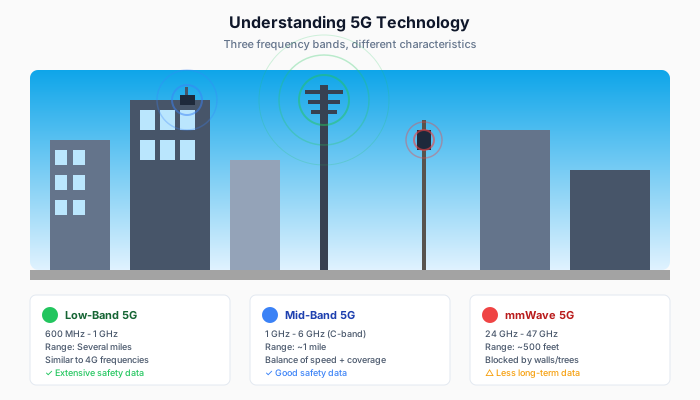
5G is a collection of wireless technologies operating across three distinct frequency bands, not a single new type of radiation. Understanding these bands is essential because most public concern focuses on the least-deployed variant.
Low-Band 5G (600 MHz - 1 GHz)
- Similar frequencies to 4G LTE
- Long range, good building penetration
- Modest speed improvements over 4G
- This is what most people experience as “5G” today
Mid-Band 5G (1 GHz - 6 GHz)
- The “sweet spot” balancing speed and coverage
- C-band (3.7-4.2 GHz) is the primary focus in the US
- Faster than low-band, still reasonable range
- Requires more antennas than 4G for equivalent coverage
High-Band 5G / mmWave (24 GHz - 47 GHz)
- The controversial millimeter wave frequencies
- Extremely fast but very short range (often < 500 feet)
- Blocked by walls, trees, even rain
- Currently limited to dense urban areas and stadiums
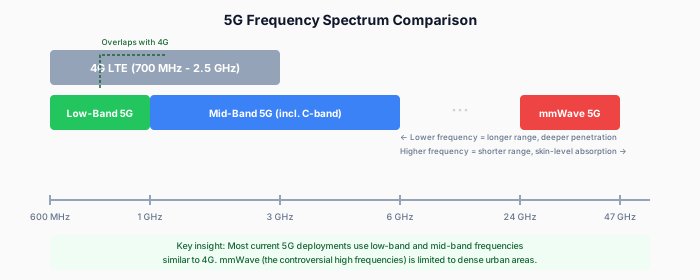
Here’s the key point: most 5G deployments use frequencies similar to or only slightly higher than 4G. The dramatic “millimeter wave” frequencies get the headlines but represent a small fraction of actual 5G infrastructure.
Check your EMF exposure
See cell towers, power lines, and substations near any US address.
Search Your AddressWhy 5G Sparked More Concern Than 4G
Public anxiety about 5G stems from increased infrastructure visibility, unfamiliar terminology, and timing rather than evidence of harm. Several factors combined to make 5G uniquely controversial:
More visible infrastructure. 5G requires denser antenna networks — small cells on poles, sides of buildings, and streetlights. People who never noticed 4G antennas suddenly see 5G equipment everywhere. Not sure what they look like? You’re not alone.
Higher frequencies sound scarier. “Millimeter waves” and “24 GHz” sound more dangerous than “700 MHz,” even though all are non-ionizing radiation far below frequencies that can damage DNA.
Timing. 5G rolled out during a period of declining institutional trust and rising health anxiety, amplified by social media algorithms that reward alarming content.
Real gaps in research. While lower 5G frequencies have decades of study (they’re the same as 4G), mmWave frequencies have less long-term human exposure data—a legitimate scientific gap, though not evidence of harm.
Common Conspiracy Theories: A Reality Check
We address this because ignoring them leaves a vacuum. Here’s a quick reality check:
“5G caused COVID-19” — No. Viruses are biological agents that spread through respiratory droplets. Radio waves cannot create, carry, or spread viruses. Countries without 5G deployment also had COVID outbreaks. This theory has no scientific basis whatsoever.
“5G is a mind-control technology” — No. 5G signals don’t penetrate the skull in any meaningful way (especially mmWave, which barely penetrates skin). You can verify 5G signal characteristics with a $30 RF meter.
“Birds are dying from 5G” — No evidence supports this. The widely-shared claims traced back to a 2018 incident in The Hague where birds died near a telecom mast — but the mast wasn’t a 5G antenna, and an investigation attributed the deaths to a yew tree in the area.
“They’re hiding the real studies” — All major studies (NTP, Ramazzini, INTERPHONE, COSMOS) are publicly available. Researchers who find concerning results are regularly published and cited. The scientific debate is happening in the open.
What IS worth questioning:
- Whether safety standards are updated frequently enough
- Whether industry-funded studies show different results than independent studies (meta-analyses suggest a modest “funding effect”)
- Whether the 30-minute averaging in SAR testing reflects real-world use patterns
- Whether children should have the same exposure limits as adults
These are legitimate policy questions, not conspiracies. EMF Radar exists to give you the data to make your own informed decisions.
What the Research Actually Shows
The majority of peer-reviewed studies find no significant adverse health effects from RF-EMF exposure at levels below current safety guidelines. Here is what the scientific literature demonstrates.
Studies on 5G-Specific Frequencies
According to PubMed, research specifically on 5G mmWave frequencies is still emerging. Key findings:
2023 Systematic Review: A comprehensive review examined 107 experimental studies on radiofrequency EMF including frequencies up to 6 GHz. The authors found that “the majority of studies did not find significant adverse health effects” at exposure levels below current guidelines. However, they noted “methodological limitations” in many studies and called for more research on newer frequencies. DOI
2022 WHO-Commissioned Review: This meta-analysis of 63 studies found no consistent evidence that RF-EMF exposure causes cancer in humans. The review included frequencies relevant to 5G and concluded that “evidence does not support a causal relationship between RF-EMF exposure and cancer.” DOI
Skin Heating Studies: Because mmWave frequencies are absorbed primarily by the skin surface (they don’t penetrate deeply like lower frequencies), thermal effects are the primary concern. Studies show that at typical exposure levels from 5G small cells, skin heating is negligible—far below what you’d experience in direct sunlight.

What About the NTP Rat Study?
The National Toxicology Program rat study does not apply to 5G because it tested different frequencies at exposure levels far exceeding real-world conditions. Important context:
- The study used 2G frequencies (900 MHz), not 5G
- Rats were exposed to whole-body radiation at levels far exceeding human exposure
- Exposed rats actually lived longer than control rats (confounding the cancer findings)
- The study could not be replicated in mice
- ICNIRP and other bodies concluded the findings don’t apply to real-world human exposure
This study is often cited as proof of 5G dangers, but it studied different frequencies at unrealistic exposure levels.
The mmWave Knowledge Gap
Long-term epidemiological data on millimeter wave frequencies is limited because widespread consumer exposure only began recently. Here’s what’s genuinely uncertain:
What we know:
- mmWave is non-ionizing (can’t break DNA bonds)
- Absorption is superficial (skin/eye surface only)
- Power levels from small cells are very low
- Military and scientific applications have used mmWave for decades without documented health effects
What we don’t know:
- Long-term effects of widespread population exposure
- Whether there are non-thermal biological effects at low levels
- Potential effects on sensitive tissues like eyes
This uncertainty isn’t evidence of harm—it’s a gap that ongoing research is addressing.
How 5G Exposure Compares to 4G
5G does not significantly increase RF exposure for most people, and may actually reduce it in some scenarios due to more efficient transmission protocols.
| Factor | 4G | 5G (Low/Mid-Band) | 5G (mmWave) |
|---|---|---|---|
| Typical frequencies | 700 MHz - 2.5 GHz | 600 MHz - 6 GHz | 24-47 GHz |
| Antenna distance | Towers 1-3 miles apart | Small cells every few blocks | Every 500 feet (limited areas) |
| Power per antenna | High | Lower per antenna | Very low |
| Phone transmission power | Moderate | Often lower (better signal) | Lower |
| Body penetration | Deep (whole body) | Similar to 4G | Skin surface only |
Counterintuitively, 5G may reduce your RF exposure in some scenarios because:
- Better signal means your phone transmits at lower power
- More efficient protocols reduce transmission time
- Small cells are low-power compared to macro towers
Your phone is almost always your largest RF exposure source—not towers or small cells.
Practical Assessment: Should You Be Concerned?
Current evidence suggests most people have no scientific reason to worry about 5G exposure from towers and small cells. Based on current evidence, here’s a reasonable framework:
Low Concern
- Living near 5G small cells: These are low-power devices. At typical distances (50+ feet), exposure is minimal.
- Using 5G phones: Your phone’s transmission power is similar to or lower than 4G.
- Low-band and mid-band 5G: These frequencies have extensive safety data from 4G era.

Moderate Concern (Uncertainty, Not Evidence of Harm)
- Living very close to mmWave antennas (< 20 feet): Exposure will be higher, though still within guidelines. Limited long-term data.
- Occupational exposure: Workers installing/maintaining 5G equipment should follow RF safety protocols.
Who’s Setting the Safety Standards?
Multiple independent bodies worldwide set RF exposure limits:
ICNIRP (International): Sets guidelines used by most of the world (including the EU, UK, Australia, Japan). Their limits include safety margins — typically 50x below the level where heating effects are observed. Updated in 2020 to specifically address 5G frequencies up to 300 GHz.
FCC (United States): Last comprehensively updated in 1996 (based on 1986 standards). In 2021, a federal court ordered the FCC to review whether their standards adequately protect children, but as of 2026, the limits remain unchanged.
Countries with stricter limits:
- Switzerland: 10x stricter than ICNIRP for “sensitive locations” (homes, schools, hospitals)
- Italy: ~100x stricter than ICNIRP
- India: 10x stricter since 2012
- China, Russia, Poland: Various limits stricter than ICNIRP
The existence of stricter limits in some countries doesn’t necessarily mean ICNIRP limits are unsafe — it often reflects a precautionary policy approach. But it does show that the “correct” limit is a policy judgment, not a settled scientific fact.
How to Check Your Local 5G Exposure
Measuring your actual RF exposure is straightforward and provides concrete data rather than speculation. Follow these steps:
Step 1: Identify Nearby Infrastructure
Use EMF Radar to check for cell towers and antennas near your address. Our RF score incorporates FCC antenna registration data including 5G deployments.
Step 2: Understand What You’re Seeing
- Macro towers (tall structures): Usually 4G/LTE, sometimes low-band 5G
- Small cells on poles/buildings: Often mid-band 5G
- Very small units every block: Likely mmWave (currently rare outside cities)
Step 3: Measure If Concerned
An RF meter can show actual exposure levels. See our guide on How to Measure EMF in Your Home for equipment recommendations.
Step 4: Put Numbers in Context
Compare your readings to Building Biology guidelines:
- < 10 uW/m2: No concern
- 10-1,000 uW/m2: Slight to moderate concern
-
1,000 uW/m2: Investigate sources, consider distance
Reducing 5G Exposure (If Desired)
Distance is the most effective way to reduce RF exposure, and simple behavioral changes provide more protection than any commercial product. If you prefer to minimize exposure despite the lack of proven harm:
Distance is effective:
- Small cells: 50+ feet provides significant reduction
- mmWave: Even 20-30 feet dramatically reduces exposure (these signals don’t travel far)
- Low-E windows significantly attenuate RF
- Brick and concrete provide some shielding
- RF shielding film can add 20–30 dB of reduction
Phone habits:
- Use speakerphone or wired headset for calls
- Don’t sleep with phone under pillow (see EMF and sleep)
- Airplane mode when not needed
- More reduction strategies for your whole home
What doesn’t work:
- “5G blocking” stickers, pendants, or devices (these are scams — see our EMF protection products review)
- Most “EMF protection” products have no scientific basis
Frequently Asked Questions
Is 5G radiation harmful to humans?
No harmful effects from 5G radiation have been proven in humans at normal exposure levels. 5G uses non-ionizing radiation, which lacks the energy to damage DNA or cells directly. Current exposure limits include substantial safety margins, and the majority of peer-reviewed studies find no significant health effects below these limits.
Does 5G cause cancer?
Scientific evidence does not support a link between 5G and cancer. A 2022 WHO-commissioned meta-analysis of 63 studies concluded that evidence does not support a causal relationship between RF-EMF exposure and cancer. The WHO classifies all RF-EMF as “possibly carcinogenic” (Group 2B), the same category that included coffee until 2016.
How far should I live from a 5G tower?
There is no scientifically established minimum safe distance because 5G small cells operate at low power levels. At 50 feet or more from small cells, exposure is minimal. For mmWave antennas, even 20-30 feet provides significant reduction since these signals weaken rapidly with distance and cannot penetrate walls.
Is 5G more dangerous than 4G?
5G is not inherently more dangerous than 4G. Most 5G networks use frequencies similar to 4G (600 MHz to 6 GHz). Even mmWave 5G, while using higher frequencies, operates at lower power levels and penetrates only the skin surface rather than the whole body. Some experts suggest 5G may actually reduce exposure due to more efficient transmission.
What is the difference between 5G and mmWave?
5G is the overall technology standard; mmWave is one of three frequency bands 5G can use. Low-band 5G (600 MHz - 1 GHz) and mid-band 5G (1-6 GHz) are similar to 4G frequencies. mmWave (24-47 GHz) offers faster speeds but very short range and is currently deployed only in limited urban areas.
Are 5G blocking products effective?
No. Products marketed as “5G blocking” stickers, pendants, or devices have no scientific basis and do not reduce RF exposure. Effective RF reduction comes from distance, building materials like Low-E glass and concrete, and modifying phone usage habits such as using speakerphone or wired headsets.
The Bottom Line
5G technology does not pose proven health risks based on current scientific evidence, though research on millimeter wave frequencies continues.
Based on current scientific evidence:
- 5G is not fundamentally different from 4G in terms of health risk. Most 5G uses similar frequencies.
- mmWave is new but not proven dangerous. The frequencies are non-ionizing and exposure levels are low.
- Real gaps exist in long-term mmWave research, but this is uncertainty, not evidence of harm.
- Your phone remains your primary RF source. Tower/small cell exposure is typically much lower.
- Regulatory limits have safety margins. Whether these margins are sufficient is debated, but exposures are far below thermal damage thresholds.
The precautionary approach: maintain reasonable distance from antennas when practical, reduce phone-to-body contact during calls, and focus your concern on exposures you can actually control. But there’s no scientific basis for panic about 5G specifically.
Check your address with EMF Radar to understand your local RF environment. If you want to measure actual levels, see our tested EMF meter picks starting at $45. For a professional assessment, find a certified EMF consultant in your area.
Related Reading
- What Is a Safe Distance From a Cell Tower?
- How to Measure EMF in Your Home
- EMF and Sleep: What the Research Shows
- 5G at 700 MHz Shows No Effect on Brain Cells — 2026 French study on neurons and astrocytes
- 26 GHz 5G Shows No Stress Biomarkers — millimeter-wave 5G human exposure study
Last updated: January 2026. This article synthesizes publicly available research and is not medical advice. 5G technology and research are evolving; check sources for the most current information.
Sources:
- Karipidis K, et al. (2023). “Systematic review of radiofrequency electromagnetic field exposure studies.” Environment International. DOI
- Roosli M, et al. (2022). “Systematic review of cancer risk and radiofrequency electromagnetic field exposure.” Environment International. DOI
- ICNIRP (2020). “Guidelines for Limiting Exposure to Electromagnetic Fields.” Health Physics.