Cell Tower Stealth Sites: Disguised Towers Hiding in Plain Sight
Quick answer: There are over 150,000 disguised or concealed cell towers across the United States — camouflaged as pine trees, palm trees, church steeples, flagpoles, water tanks, chimneys, and even cacti. They emit the same RF radiation as any standard tower. The disguise is cosmetic only, driven by local zoning laws. You can find hidden towers near you using the FCC Antenna Structure Registration database or EMF Radar’s interactive map.
That pine tree at the edge of the parking lot? It might be broadcasting LTE and 5G signals to 50,000 phones.
The telecommunications industry spends billions annually on stealth sites — cell towers designed to blend into their surroundings so seamlessly that most people walk past them every day without noticing. It’s one of the largest infrastructure concealment efforts in history, and it’s happening in your neighborhood right now.
This guide covers the major types of disguised cell towers, why they exist, how to identify them, and what they mean for your EMF exposure.
 A “monopine” — one of the most common stealth tower designs. The fake branches hide antenna arrays that function identically to standard tower equipment.
Why Cell Towers Get Disguised
The short answer: nobody wants to look at a 150-foot steel lattice tower.
When carriers need to build new cell sites, they face opposition from residents, neighborhood associations, and local planning boards. Property values, aesthetics, and health concerns dominate public hearings. The Telecommunications Act of 1996 limits how much local governments can restrict tower placement — but it doesn’t prevent them from requiring concealment.
The result is a multi-billion-dollar concealment industry where specialized companies design, manufacture, and install towers that look like anything except a cell tower.
The Economics
Stealth towers typically cost 2–5× more than standard monopoles:
- Standard monopole: $150,000–$300,000
- Monopine (fake tree): $400,000–$800,000
- Church steeple integration: $250,000–$500,000
- Water tank concealment: $500,000–$1.2 million
Carriers pay the premium because the alternative — years of zoning battles and public hearings — costs more in delayed revenue. A single cell site generates $30,000–$100,000+ per month in carrier lease payments.
 Churches are among the most common locations for concealed cell equipment. Antennas hide inside steeples, bell towers, and crosses — often funding the church through lease payments of $1,000–$5,000 per month.
The 10 Most Common Disguised Tower Types
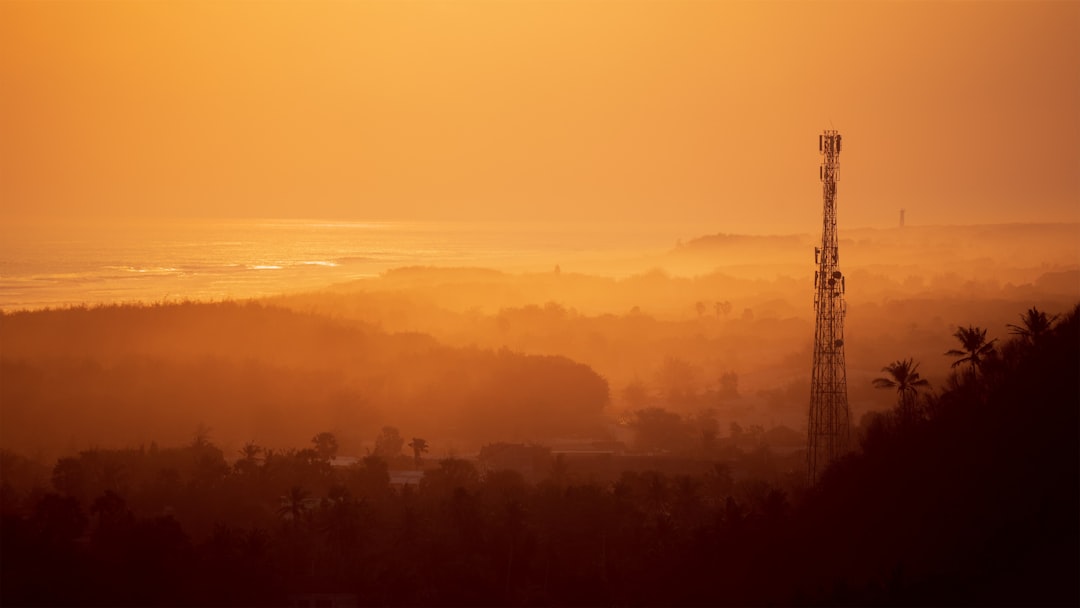
1. Monopines and Monopalms (Fake Trees)
The most recognizable stealth design. A steel monopole is wrapped in textured bark material and fitted with synthetic branches that conceal antenna panels.
How to spot them:
- Branches don’t move naturally in wind (they’re rigid fiberglass)
- The “tree” is taller than all surrounding real trees
- Bark texture is too uniform — no knots, moss, or weathering
- Equipment cabinets visible at the base behind a fence
- In winter, a “pine” that never loses needles while surrounded by deciduous trees
Varieties: Pine (“monopine”), palm (“monopalm”), eucalyptus, elm, and even saguaro cactus (“monocactus”) in the Southwest. There are an estimated 10,000+ fake-tree towers in the US.
2. Church Steeples and Bell Towers
Houses of worship are prime real estate for cell equipment. The steeple or bell tower provides height, the building provides power, and the lease payments provide income to the congregation.
How to spot them:
- Steeple appears unusually thick or has visible panel seams
- New cross or architectural element added to an older church
- Equipment conduit running along the building exterior
- HVAC equipment on the roof that seems out of place (actually cooling the radio equipment)
- Church has a ground-level equipment shelter or concrete pad nearby
An estimated 5,000+ churches in the US host concealed cell equipment.
3. Flagpoles
Oversized flagpoles in commercial areas, car dealerships, government buildings, and even residential communities frequently conceal omni-directional antennas inside the pole itself.
How to spot them:
- Pole is significantly taller than necessary (80–120 feet for a flagpole is suspicious)
- Pole diameter is unusually wide (12–18 inches vs. standard 4–6 inches)
- Located in a commercial area with no obvious reason for a monumental flagpole
- Equipment cabinet at the base, often disguised as a landscaping feature
- Multiple coaxial cables running down the pole interior (visible through access panels)
 Not every tall flagpole is a cell tower — but the 100-foot flagpole at your local car dealership? Worth a closer look. Concealed flagpole towers are among the hardest stealth sites to identify.
4. Water Tanks and Water Towers
Municipal water towers provide ideal height and are already industrial infrastructure, making cell concealment easy to justify.
How to spot them:
- Water tower has a newer-looking panel or section that doesn’t match the rest
- Antenna elements visible at the top rim, painted to match
- Equipment shelters at the base of the tower
- Coaxial cables running up the tower legs
- The “water tower” is in an area that seems unusual for water infrastructure
 Water towers are prime stealth site locations. The height is already there, and antenna panels can be painted to match the tank surface.
5. Rooftop Installations (Screened)
In urban areas, cell equipment is frequently installed on rooftops behind purpose-built screens, fake walls, or parapet extensions that match the building’s architecture.
How to spot them:
- Building has a rooftop “penthouse” addition that doesn’t have windows
- Parapet walls that are taller on one side than the other
- Fiberglass panels on the roof edge painted to look like the building facade
- Cable trays visible on the roof or running down the building exterior
- Equipment shelters or HVAC-looking cabinets on the roof
6. Silos and Barns (Rural)
In agricultural areas, carriers disguise equipment inside functional-looking silos, barns, and agricultural buildings.
How to spot them:
- A “silo” with no associated farming operation
- Structure has unusual height or antenna-like elements at the top
- Equipment fencing around what should be a simple farm building
- Warning signs (RF hazard, authorized personnel only)
7. Chimneys (Residential)
In dense suburban areas, carriers build oversized fake chimneys on commercial buildings or even install equipment in existing industrial chimneys.
How to spot them:
- Chimney is disproportionately large for the building
- No visible smoke or exhaust from a supposedly functional chimney
- RF hazard signage near the building
- Equipment conduit running along the building wall to the chimney
8. Light Poles and Utility Poles
The rise of 5G small cells has made utility poles and decorative light poles into the newest wave of stealth sites. These are often city-approved designs that blend with existing street furniture.
How to spot them:
- Light pole has a bulge or canister at the top (the small cell radio unit)
- Multiple cables running down what should be a simple street light
- Pole is thicker than neighboring identical poles
- Small equipment boxes mounted to the pole, painted to match
9. Signs and Billboards
Commercial signs and billboards provide both height and a large concealment surface.
How to spot them:
- Billboard seems unusually thick or deep
- Sign structure has equipment shelters at its base
- Rooftop signs with excess structural bulk
- The sign is in a location where the billboard would have low advertising value (it exists for the tower, not the ad)
10. Custom Architectural Features
Some stealth sites are one-of-a-kind custom designs: fake clock towers, decorative columns, rock outcroppings, artificial trees unique to local species, and purpose-built architectural follies.
How to spot them:
- Architectural element seems purposeless or out of context
- Structure appeared recently without an obvious function
- Fencing, access restrictions, or RF warning signs near the feature
Check your EMF exposure
See cell towers, power lines, and substations near any US address.
Search Your AddressThe EMF Reality: Disguised ≠ Reduced
Here’s what matters most: a disguised cell tower emits exactly the same RF radiation as an undisguised one.
The concealment materials — fiberglass branches, synthetic bark, architectural screens — are specifically chosen to be RF-transparent. They don’t attenuate the signal at all. That’s the whole point. A monopine is just a monopole in a costume.
This means:
- Your exposure is identical whether you live near a monopine or a bare lattice tower
- The FCC power limits are the same regardless of concealment
- The antennas inside are standard equipment — the same Ericsson, Nokia, or Samsung radios used on any tower
- Multiple carriers often share stealth sites, which can mean MORE antennas than a standard single-carrier tower
If anything, stealth sites can be more concerning from an exposure standpoint because:
- People don’t know they’re there. You can’t evaluate your proximity to a tower you don’t know exists
- They’re placed closer to people. Stealth designs exist specifically to get towers approved in dense residential areas where standard towers would be rejected
- Small cells are proliferating. 5G small cells on utility poles are 20–40 feet from the ground — much closer than a standard 150-foot tower
 A standard monopole tower — visible and identifiable. With stealth sites, the same equipment is concealed behind cosmetic materials that don’t reduce RF emissions at all.
How to Find Hidden Cell Towers Near You
1. EMF Radar’s Interactive Map
The fastest way: search your address on EMF Radar. Our database includes over 260,000 registered cell tower structures from the FCC Antenna Structure Registration (ASR) database, plotted with exact coordinates. Every tower shows up — disguised or not — because the FCC registration doesn’t care about cosmetics.
2. FCC Antenna Structure Registration (ASR) Database
The FCC requires registration of most antenna structures over 200 feet, or those near airports regardless of height. Search at the FCC ASR database. Note: many stealth sites and small cells fall below the registration threshold.
3. AntennaSearch.com
A commercial database that aggregates FCC data with additional sources. Useful for finding smaller installations that might not appear in ASR searches.
4. Physical Identification
Train your eye with these universal giveaways:
- RF warning signs: Required by OSHA near active antenna sites. Yellow signs with the RF hazard symbol are a dead giveaway
- Equipment shelters: Ground-level cabinets (typically gray or beige, about the size of a garden shed) near any suspicious structure
- Coaxial cables: Thick cables running up or along structures where they don’t belong architecturally
- Security fencing: Chain-link or ornamental fencing around the base of structures that wouldn’t normally need security
- Compound footprint: A concrete pad with equipment, often partially hidden behind landscaping
- Generator: A backup diesel generator nearby indicates critical infrastructure
 Once you know what to look for, stealth towers become surprisingly easy to spot. The equipment at the base is usually the biggest giveaway.
5. Your Phone’s Signal Strength
Walk near a suspected stealth site and check your phone’s signal bars. A sudden jump to full signal in an area that’s otherwise moderate coverage suggests nearby active antennas. On iPhone, dial *3001#12345#* for Field Test mode to see exact signal strength in dBm.
The Zoning Battle Behind Every Stealth Tower
The Telecommunications Act of 1996 (Section 704) created a complex legal framework:
What local governments CAN do:
- Require concealment and aesthetic standards
- Set height limits and setback requirements
- Require environmental and visual impact studies
- Negotiate lease terms for public land
What local governments CANNOT do:
- Ban cell towers outright
- Deny applications based on RF health concerns (as long as FCC limits are met)
- Create unreasonable delays in the approval process
- Discriminate between carriers
This legal framework is why stealth towers exist. Communities can’t say “no towers,” but they can say “make it look like a tree.” The result is an arms race between increasingly creative concealment and increasingly skeptical planning boards.
The 2018 Small Cell Order
The FCC’s 2018 order further limited local authority over small cell deployments on utility poles and public rights-of-way. Cities now have compressed timelines to review applications (60–90 days), limited fees they can charge, and restricted aesthetic requirements for small cells.
This has accelerated the deployment of small cells in residential neighborhoods — often without the level of community input that larger tower proposals receive.
What You Can Do
If You’re Concerned About a Nearby Stealth Site
- Identify it properly. Use EMF Radar, FCC databases, or the visual identification tips above to confirm it’s actually a cell site
- Measure your exposure. Use an RF meter (like the Trifield TF2 or Cornet ED88T) to measure actual RF levels at your location. Our EMF meters guide has recommendations
- Check the distance. Most stealth towers follow the same exposure-distance relationship as standard towers. Beyond 300 meters, exposure drops to background levels in most cases. Check our guide to cell tower health effects by distance for research details
- Review public records. Tower applications, zoning variances, and lease agreements are often public record through your local planning department
- Engage with local government. If a new stealth site is proposed, you have the right to participate in the public review process — just know that health-based objections alone are legally insufficient under the 1996 Act
If You’re House Hunting
Search any address on EMF Radar before making an offer. We’ll show you every registered tower within a configurable radius, calculate an EMF exposure score, and compare it to national and state averages. A disguised tower next door is still a tower next door — and our data sees through the disguise.
FAQs
Do disguised cell towers emit less radiation than regular towers?
No. Concealment materials like fiberglass branches and synthetic bark are specifically chosen to be RF-transparent — they don’t reduce signal strength or RF emissions at all. A monopine emits the same radiation as a bare monopole with identical equipment.
How many disguised cell towers are there in the US?
Exact numbers aren’t publicly tracked, but industry estimates suggest 150,000 or more concealed installations, including monopines, steeple mounts, flagpoles, rooftop screens, and small cells on utility infrastructure. This number is growing rapidly with 5G small cell deployment.
Is it legal to disguise a cell tower?
Yes — in fact, it’s often legally required. Local zoning ordinances frequently mandate concealment or stealth design as a condition of tower approval. The concealment industry exists because of the tension between federal mandates to allow tower construction and local desires to control aesthetics.
Can I find out if a specific structure is a cell tower?
Yes. Search the FCC Antenna Structure Registration database, use EMF Radar’s map tool to check your area, or look for physical indicators: RF warning signs, equipment cabinets at the base, coaxial cables, and security fencing around the structure.
Do stealth towers affect property values?
Research on cell tower impact on property values (1–9% decrease within 0.25 miles, according to a Journal of Real Estate Finance and Economics study) applies equally to stealth towers — if buyers know they’re there. The disguise may reduce the visual impact, but doesn’t change the infrastructure’s presence in public records and disclosure requirements. Read more in our article on cell towers and property values.