Do Cell Towers Affect Property Values? What the Research Shows

You found the perfect house. Three beds, updated kitchen, great school district. Then you drove past on a Tuesday afternoon and noticed the 150-foot steel lattice tower two blocks over that somehow didn’t make it into the listing photos.
Now you’re here. Let’s talk about what that tower actually costs you — in dollars, not anxiety.
The Number: 2-9% Discount, Depending
We’re not going to bury the lede. Multiple peer-reviewed studies across three continents put the property value impact of a nearby, visible cell tower at 2-9% below comparable homes.
That’s $10,000-$45,000 on a $500K house.
But that range is huge, and the details matter more than the headline. Here’s what actually drives the number up or down.
Five Studies, Five Countries, Similar Conclusions
This isn’t one study that got picked up by health blogs and ran wild. There’s a consistent body of academic work here:
Sandy Bond — New Zealand & US (2005-2017)
The most-cited researcher in this space. Across multiple studies at the University of Cincinnati:
- 2-3% average reduction within 300 meters
- 94% of surveyed buyers said towers negatively impact value
- Even buyers who personally didn’t care acknowledged resale risk
- The kicker: the effect was almost entirely driven by visibility, not measured RF levels
Bond, S. (2017). “Cell Towers and Residential Property Values.” The Appraisal Journal, 85(4), 301-318.
Acharya, Basu & Hanink — Las Vegas, US (2022)
Used spatial hedonic regression on actual home sales from 2014-2017. This is the gold standard methodology for isolating the tower effect from neighborhood effects:
- Statistically significant negative relationship between proximity and sale price
- Effect was distance-dependent — closer = bigger discount
- Controlled for schools, crime, amenities, lot size, everything
Cheruiyot et al. — Johannesburg, South Africa (2024)
The most recent major study. Published in the International Journal of Housing Markets and Analysis:
- Measurable price impacts near tower base stations
- Effect varied by local context — health-conscious markets showed stronger impacts
- Confirmed the pattern holds across different property types
Marona, Gaca & Głuszak — Warsaw, Poland (2024)
The interesting outlier. This study found no statistically significant effect — including after 5G rollout:
- 1,825 apartment transactions analyzed (2016-2021)
- Dense urban area where towers blend into the skyline
- Supports the visibility thesis: when towers aren’t conspicuous, the stigma disappears
Mdleleni & Ijasan — Johannesburg (2023)
Used GIS tools to map exact distances between cell towers and properties. Found the relationship between proximity and price was consistent with Bond’s earlier work.
Check your EMF exposure
See cell towers, power lines, and substations near any US address.
Search Your AddressThe Three Variables That Explain Everything
After reading through the literature, virtually all the variance comes down to three things:
1. Can You See It?
This is the single biggest factor. A tower you can see from your kitchen window is a 5-9% problem. A tower hidden behind a hill or disguised as a pine tree? Maybe 1%, maybe nothing.
The Warsaw study makes this crystal clear — in dense urban areas where towers are part of the visual noise, the effect vanishes. In suburban areas where a tower sticks out like a sore thumb against the tree line? That’s where the discount lives.
What to do: Walk the property. Look out every window. Stand in the backyard. If you can’t see a tower, you probably don’t have a value problem.
2. How Far Away Is It?
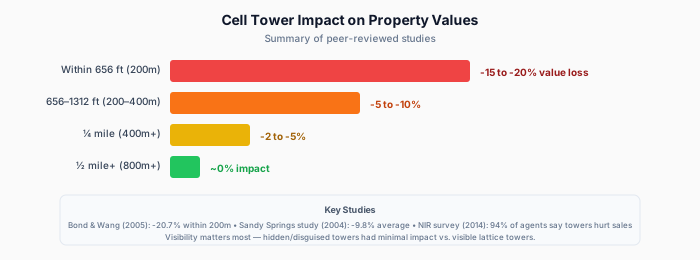
The distance gradient is predictable:
| Distance | Typical Impact | Why |
|---|---|---|
| Under 200m | 5-9% | Tower is impossible to miss, dominates the view |
| 200-400m | 2-5% | Visible but not looming |
| 400-800m | 0-2% | Most buyers won’t notice |
| 800m+ | ~0% | Statistically undetectable in all studies |
RF exposure follows the inverse square law and property values roughly mirror the pattern. Not because buyers are calculating power density — because a closer tower is an uglier tower.
Check exact tower distances for any address →
3. What Kind of Market Are You In?
The stigma isn’t universal:
- Suburban single-family homes: Largest impact. Buyers have choices and towers are conspicuous.
- Urban apartments: Minimal impact. The Warsaw study confirmed this. Towers are visual background noise.
- Health-conscious communities (Boulder, Sedona, Marin County): Amplified stigma. These buyers are specifically filtering for this.
- Underserved rural areas: Potentially positive effect — a nearby tower means better coverage, and coverage is a selling point.

If You’re Buying: The Negotiation Playbook
Here’s how to turn a tower into leverage:
Step 1: Quantify the problem. Search the address on EMF Radar — screenshot the results showing tower count and distances. This is your data.
Step 2: Pull the research. Print the Bond or Cheruiyot study abstracts. “Peer-reviewed research shows 2-9% impact” hits different than “I Googled it and I’m worried.”
Step 3: Comp it out. Find 2-3 comparable properties without visible towers. If they sold for more, you have a direct price argument. Your agent can pull these from MLS data.
Step 4: Propose a specific number. Don’t say “I want a discount.” Say “The research supports a 3-5% adjustment for tower proximity. On a $475K list price, that’s $14,250-$23,750. I’d like to come in at $455K.”
Step 5: Address the inspection. If an EMF meter reading shows elevated RF levels inside the home, that’s additional ammunition. If it doesn’t, you still have the visibility/resale argument.
The counterintuitive move: A home near a tower that’s already priced 5% below comparables might be one of the better investments on the block. You’re buying at a discount that could narrow as towers become ubiquitous and the stigma fades.
If You’re Selling: Damage Control

Don’t panic. Single-digit percentage impacts on a long-term appreciating asset are not catastrophic.
Landscaping is your best friend. The research is clear that visibility drives the discount. A $2,000 row of Leyland cypress that blocks the tower view could recover $15,000+ in sale price. ROI doesn’t get much better than that.
Price honestly. An overpriced listing near a tower will sit on market for months. An honestly priced listing sells in weeks. Every month on market costs you mortgage payments, opportunity cost, and the psychological spiral of “why isn’t it selling.”
Disclose proactively. Surprising a buyer at inspection is worse than addressing it in the listing. “Mountain views, mature landscaping provides privacy” is truthful and addresses the concern without drawing a spotlight.

The Trend: More Towers, More Normal
Something worth noting: tower density is increasing fast. The 5G buildout requires significantly more antenna installations than previous generations — small cells every few hundred meters in urban areas.
According to CTIA industry data:
- 2015: ~308,000 cell sites in the US
- 2023: ~450,000+ cell sites
- 2030 (projected): 800,000+ including small cells
As towers become ubiquitous, the stigma may normalize. Being “near a cell tower” is rapidly becoming meaningless because everywhere is near a cell tower. The property value impact may shrink over the next decade as the novelty wears off.
But we’re not there yet. Today, a visible macro tower within 300 meters still moves the number.
Check Your Property
Whether you’re buying, selling, or refinancing — start with the data.
Search any US address on EMF Radar →
We map every FCC-registered cell tower, 5G installation, power line, and substation. You’ll see exact distances, tower types, and an overall exposure score.
Related Reading
- What Is a Safe Distance to Live From a Cell Tower? — the distance and health research in detail
- Living in an Apartment Near a Cell Tower — renter-specific considerations
- How to Block EMF from a Cell Tower — practical shielding options
- Best EMF Meters for Home Buyers — if you want hard numbers before buying
- 5G Towers: Health Risks and What the Research Says — the health side of the equation
FAQ
How much do cell towers decrease property values?
Research shows a 2-9% reduction for homes within 200-300 meters of a visible cell tower. The average is around 3-5%. Visibility is the strongest driver — hidden or camouflaged towers have minimal impact. See the full research breakdown above.
Do 5G towers affect property values differently than 4G?
The 2024 Warsaw study found no significant change after 5G introduction. 5G small cells are typically smaller and less visible than macro towers, which may actually reduce the stigma effect. However, large-scale studies specifically on 5G and property values are still limited.
Can I negotiate a lower price because of a nearby cell tower?
Absolutely. The peer-reviewed research gives you solid ground. A 3-5% ask backed by the Bond (2017) or Cheruiyot (2024) studies is a data-driven negotiation, not an emotional one. See our negotiation playbook above.
Does the tower have to be visible to affect my home’s value?
Visibility is the #1 predictor. Studies consistently show hidden, camouflaged, or distant towers have minimal to no measurable effect on property values. If you can block the view with landscaping, you can likely eliminate most of the discount.
Should I avoid buying a home near a cell tower?
Not necessarily. A tower-adjacent home priced 5% below comparables is a better deal if you’re comfortable with the proximity. Factor in your holding period, the direction the market is moving (more towers = less stigma), and whether shielding options address any RF concerns.
How many cell towers are near the average US home?
In suburban areas, typically 3-5 towers within 1 mile. In urban areas, significantly more — especially with the 5G small cell buildout. Search your specific address on EMF Radar for exact numbers.