Living in an Apartment Near a Cell Tower: What Renters Need to Know
Your apartment search just got more complicated. The 2BR with the skyline view also comes with a cell tower on the next building over, and now you’re reading this at 1am instead of signing the lease.
Here’s the thing: the apartment situation is genuinely different from houses. You can’t plant trees, install shielding paint, or move the building. But you also might have less of a problem than you think.
The Rooftop Antenna Plot Twist
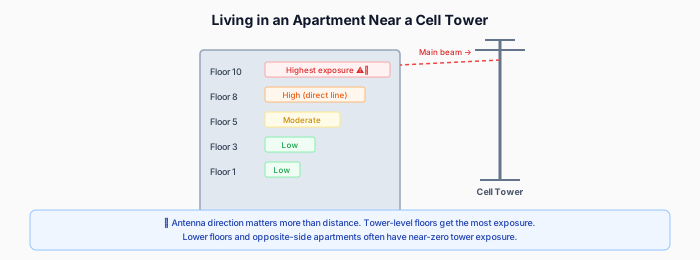
Here’s the most counterintuitive finding in cell tower research: if there’s an antenna on YOUR building’s roof, you’re probably safer than the building across the street.
Why? Cell antennas don’t broadcast straight down like a flashlight. They radiate outward and slightly downward in a cone pattern. The building’s own structure — concrete, steel rebar, roofing materials — acts as a shield for everyone below.
Multiple measurement studies (Ahlbom et al., 2004; ARPANSA guidance) confirm:
- Apartments directly below rooftop antennas typically measure lower RF than apartments at the same height in neighboring buildings
- The peak exposure zone is 50-200 meters away, at antenna elevation — exactly where adjacent buildings sit
- Top-floor units do see slightly elevated readings, but almost always within international guidelines
The real question isn’t “is there an antenna on my building?” It’s “is there an antenna on the building across the street, pointed at my bedroom window?”
Your Floor Matters More Than You Think
The floor you live on changes your exposure profile significantly. Here’s the pattern, backed by field measurements:
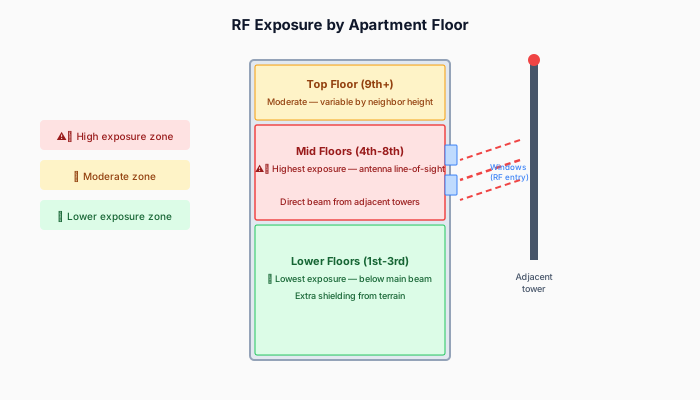
Ground & Lower Floors (1st-3rd)
RF exposure: Generally lowest ✅
You’re below the main beam of most antennas. Ground-floor units get additional shielding from the earth itself plus whatever’s between you and the tower. The exception: 5G small cells mounted on streetlights at 15-25 feet — those point right at lower floors.
Best for: Maximum distance from rooftop antennas, natural terrain shielding
Mid Floors (4th-8th)
RF exposure: Potentially highest ⚠️
This is the danger zone for towers on adjacent buildings. You’re at the same elevation as most antenna arrays, which means direct line of sight — the worst-case scenario for RF exposure. The direction your windows face is everything here.
Key question: Which way does your unit face? A south-facing apartment with a tower to the north may have zero direct exposure through any window.
Top Floors (9th+)
RF exposure: Moderate to variable 🔶
Close to your own building’s roof antenna (if present), but actually shielded by the ceiling/roof structure. For towers on adjacent buildings, you might be above the main beam, which is good — or right in it, depending on relative heights.

Check your EMF exposure
See cell towers, power lines, and substations near any US address.
Search Your AddressThe Window Problem (and Fix)
Here’s something apartment hunters never think about: glass is basically transparent to RF.
A concrete wall blocks 90-99% of cell signal. The window three feet away? It lets almost everything through. Standard single-pane glass attenuates RF by roughly 2-3 dB — that’s maybe 30-50% reduction. Not much.
This means the layout of your apartment matters enormously:
| Apartment Feature | Impact |
|---|---|
| Windows facing the tower | ⚠️ Primary RF entry point |
| Solid wall facing the tower | ✅ 90-99% natural shielding |
| Low-E glass windows | ✅ Metallic coating blocks 10-15 dB extra |
| Double-pane windows | ✅ Better than single, not as good as walls |
| Open balcony facing tower | ❌ Zero shielding |
The renter-friendly fix: RF shielding curtains ($50-200/window). They look like normal blackout curtains, block 95-99% of RF when drawn, and you take them with you when you move. No landlord permission needed.
How to block EMF from a cell tower — full shielding guide →
Before You Sign: The 5-Minute Check
Do this for every apartment you’re seriously considering. Takes 5 minutes, saves months of regret.
1. Search the Address
Plug the address into EMF Radar before you even tour. You’ll see every FCC-registered tower nearby, exact distances, and an overall exposure score. If the score is low, you can stop worrying.
2. Look Up (and Around)
On the tour, do a 360° scan:
- Your building’s roof — antennas are usually visible from street level
- Adjacent rooftops — especially buildings at the same height or taller
- Streetlights and utility poles — 5G small cells are increasingly disguised on these
- Check Google Maps satellite view — rooftop equipment is usually visible from above
3. Ask the Landlord Directly
“Does the building have a cell tower lease?”
This is a legitimate question. Cell tower lease rates pay landlords $1,000-$5,000+/month. If there’s a lease, the antenna isn’t going anywhere — those contracts run 10-25 years.
Some jurisdictions require disclosure. Many don’t. But landlords who lie about it create legal liability for themselves, so most will answer honestly.
4. Check Unit Orientation
If there IS a tower nearby, ask:
- Which direction do the bedrooms face? You spend 7-8 hours per night there. A bedroom facing away from the tower is ideal.
- What floor is available? If you have unit choices in the same building, pick based on the floor analysis above.
Renter-Friendly Ways to Reduce Exposure

You can’t renovate a rental, but you’ve got options:
The Free Stuff
- Rearrange your bedroom — bed against an interior wall, not the tower-facing wall. Costs nothing, meaningfully reduces nighttime exposure.
- Close tower-facing windows — open windows are zero shielding. Even glass helps a little.
- Move your WiFi router — this is a secret most people miss. Your own router at 10 feet often produces more RF than a tower at 500 feet. Move it to the living room, not the bedroom.
- Airplane mode at night — your phone on the nightstand is a bigger RF source than you think.
The $50-300 Range
- RF shielding curtains — the best renter investment. Blocks 95-99% through windows when drawn. Doubles as blackout curtains for better sleep. No modifications needed.
- An RF meter — a decent one runs $150-300 and tells you exactly where your hot spots are, room by room. Measure before spending money on shielding. Many people discover their actual levels are much lower than they feared.
What NOT to Spend Money On
- “EMF harmonizer” stickers or pendants — these are scams. The FTC has fined companies for marketing them. Physics doesn’t work that way.
- Orgonite, crystals, salt lamps — zero measurable RF reduction. If they help you sleep via placebo, fine, but that’s not shielding.
Your Legal Rights (Short Version)
Federal level: The FCC’s position is that if tower emissions are within their limits, there’s no regulatory basis for complaint. Those limits haven’t been updated since 1996, which is a legitimate criticism, but it’s the current legal reality.
Local level: Some cities require tenant notification when new antennas are installed. Check your local ordinances — this varies widely.
Lease leverage: If you discover a tower after signing and want out, you’ll generally need to show the landlord failed to disclose a material fact where required by law. It’s much easier to screen before signing.
Rent negotiation: There’s no formal precedent for tower-related rent discounts, but if you’re aware of it, others will be too. It’s a reasonable basis for negotiation — backed by the same property value research that applies to home purchases.
The Bottom Line
Most apartments near cell towers are perfectly livable. The key decisions are:
- Which floor — lower is generally better
- Which direction your bedroom faces — away from the tower
- Whether to add shielding curtains — cheap insurance for tower-facing windows
Search your address on EMF Radar first. If your score is moderate or low, you probably don’t need to change anything. If it’s high, the renter-friendly options above will cut your exposure dramatically without touching the landlord’s property.
Related Reading
- Do Cell Towers Affect Property Values? — the financial side for buyers and sellers
- How to Block EMF from a Cell Tower — full shielding guide with costs
- What Is a Safe Distance from a Cell Tower? — the distance research
- EMF and Sleep Quality — why bedroom exposure matters most
- Best EMF Meters — measure before you stress
- 5G Towers: Health Risks — the small cell angle
FAQ
Is it safe to live in a building with a cell tower on the roof?
Generally yes. Units below a rooftop antenna have lower RF exposure than neighboring buildings because antennas broadcast outward, not downward. Building materials provide significant shielding. Top-floor units may see slightly elevated levels. Measure with an RF meter for certainty.
Which floor is safest near a cell tower?
For towers on adjacent buildings: lower floors, below the main beam. For rooftop antennas on your building: also lower floors, due to distance and structural shielding. Mid-floors at antenna height are the worst case.
Can I ask my landlord to remove a cell tower?
You can ask. They’ll almost certainly say no. Tower leases run 10-25 years and generate $1,000-$5,000+/month. Your best strategy is choosing the right unit within the building (floor, orientation) and adding renter-friendly shielding.
How do I measure RF levels in my apartment?
An RF meter ($150-300) gives you room-by-room readings in about 10 minutes. Measure at each window, at each wall, and at different times of day. Compare your readings to the Swiss precautionary limit of 0.1 mW/m² — if you’re under that, you’re in a conservative safety range.
Related Reading
- How to Reduce EMF in Your Apartment: A Renter’s Guide — complete room-by-room EMF reduction strategies for renters, covering WiFi, smart meters, wiring, and shielding