How to Block EMF from a Cell Tower: A Practical Shielding Guide
There’s a tower near your home and you want to do something about it. We get it. But before you start lining walls with foil or dropping $800 on a bed canopy — let’s be strategic about this. The difference between effective shielding and wasted money comes down to understanding where the signal enters and targeting that, not wrapping your entire house in metal.
The principle: You don’t need to shield your entire home. RF from a cell tower comes from one direction. Shield that side — specifically the windows on that side — and you’ve solved 80-90% of the problem for 10% of the cost.

Rule #1: Measure Before You Spend
The number of people who buy $400 worth of shielding paint before checking their actual exposure levels is wild. Don’t be that person.
What you need: An RF meter. A good one runs $150-300 and will pay for itself immediately by telling you:
- Your actual exposure level (spoiler: it’s often lower than you fear)
- Which rooms have the highest RF
- Which wall/window the signal enters through
- Whether your WiFi router is a bigger source than the tower (it often is)
Walk every room. Hold the meter at each window, then step to the interior walls. Focus on bedrooms — that’s where you log 7-8 hours per night.
Check your address on EMF Radar first → See what towers are nearby, their distances, and your overall score before even buying a meter.
What the Numbers Mean
| Your Reading | What It Means | Action |
|---|---|---|
| < 0.01 mW/m² | Very low. Most rural/suburban homes. | Nothing needed. |
| 0.01-0.1 mW/m² | Low-moderate. Within Swiss precautionary limits. | Bedroom curtains if you want to optimize sleep. |
| 0.1-1.0 mW/m² | Elevated. Above precautionary limits, well below FCC limits. | Window film + curtains on tower side. |
| > 1.0 mW/m² | High. Still below FCC limits but worth addressing. | Full tower-side shielding: film, paint, curtains. |
The Shielding Toolkit, Ranked
Starting with the highest ROI and working down. Every option includes real costs and measured dB reduction — not marketing claims.
1. RF Window Film — Best First Move
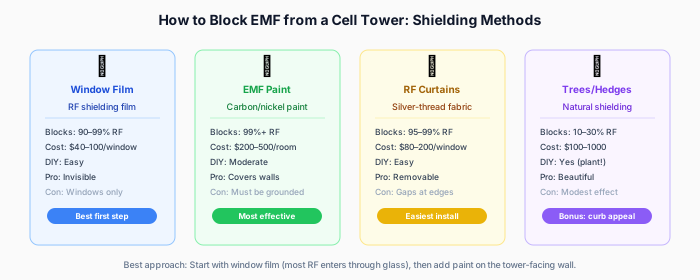
What: Metallic film applied to glass, like automotive tint but optimized for RF frequencies.
Why windows first: Here’s the physics that most people miss. A brick or concrete wall already blocks 10-20 dB of RF — that’s 90-99% reduction. But the window right next to it? Glass blocks maybe 2-3 dB. Your windows are the weak link, and they’re usually the cheapest thing to fix.
| Metric | Detail |
|---|---|
| Cost | $3-8/sq ft installed. ~$50-80 per bedroom window. |
| Attenuation | 20-30 dB (99-99.9% RF reduction through the window) |
| Installation | DIY in 30 minutes per window. Same process as privacy tint. |
| Light transmission | 40-70% depending on product. Room is slightly darker. |
| Renter-friendly? | Semi — removable films exist but may leave residue. |
Products worth looking at:
- Signal Defense Window Film — purpose-built for RF, well-documented attenuation specs
- Metallic privacy/reflective tints from 3M or LLumar — cheaper, still effective for RF
- Check if your building already has Low-E glass — its metallic oxide layer blocks 10-15 dB naturally
The trade-off: Window film blocks signal in both directions. Your cell reception near that window will drop. If you need strong indoor coverage, leave one window unshielded or switch to WiFi calling.
Deep dive: RF Shielding Film for Windows — product comparisons, installation photos, and before/after measurements.
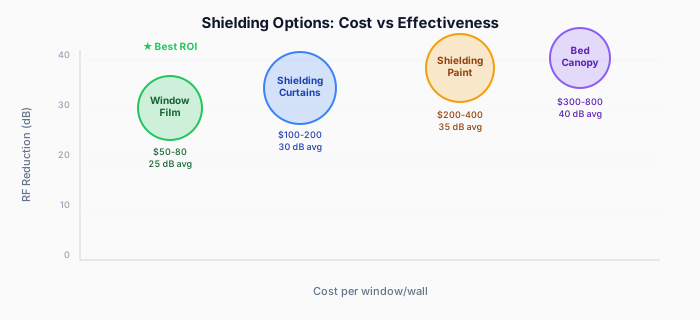
2. RF Shielding Curtains — The Renter’s Best Friend
What: Fabric woven with silver or copper threads. Looks like blackout curtains. Blocks RF when drawn.
| Metric | Detail |
|---|---|
| Cost | $50-200 per window depending on size and brand |
| Attenuation | 20-40 dB when hung properly with full edge coverage |
| Installation | Standard curtain rod. 10 minutes. |
| Appearance | Indistinguishable from normal blackout curtains |
| Renter-friendly? | 100% yes — take them when you move |
Why they’re great: They double as blackout curtains for better sleep. If your main concern is nighttime RF exposure in the bedroom, curtains give you 24/7 flexible control. Draw them at night, open them during the day.
The catch: Only work when drawn. For 24/7 protection on a specific window, film is better. For bedroom-only nighttime protection, curtains are perfect.
Where to buy: Swiss Shield makes the most tested products. Amazon has cheaper options — look for ones that list specific dB attenuation, not just marketing claims.
3. EMF Shielding Paint — The Nuclear Option for Walls
What: Carbon-based conductive paint. Applied like primer, painted over with regular paint. Creates a Faraday cage effect on the wall.
| Metric | Detail |
|---|---|
| Cost | $200-400/room (DIY). $500-1000 with professional application. |
| Attenuation | 30-40 dB per coat. Two coats for maximum shielding. |
| Coverage | ~20 sq ft per liter |
| Appearance | Goes on black, gets painted over with normal paint |
| Renter-friendly? | ❌ No — permanent modification |
When it makes sense: Your RF meter shows elevated readings at a specific wall (not a window), and that wall faces the tower. One wall of shielding paint is $50-100 in materials. That’s worth it if the wall is the entry point.
Critical detail: The paint must be grounded to an electrical ground point for full effectiveness. It’s not hard — you run a grounding strip from the painted surface to the ground terminal of a nearby outlet — but skip this step and you’ve got expensive black primer.
Full application guide: EMF Shielding Paint: Does It Work? — step-by-step with grounding instructions and measured results.
4. Landscaping — Nature’s Long Game
What: Dense trees and hedges between your home and the tower.
| Metric | Detail |
|---|---|
| Cost | $0 (existing trees) to $500-2,000 (new plantings) |
| Attenuation | 5-15 dB depending on density and species |
| Timeline | Immediate (mature transplants) to 3-5 years (saplings) |
| Bonus | Blocks the VIEW of the tower — addressing the #1 property value impact |
Why this matters beyond RF: The research on cell towers and property values is clear — visibility drives the financial discount more than anything else. A tree line that hides the tower solves both the RF concern AND the property value concern simultaneously.
Best species for year-round coverage:
- Leyland Cypress — fast-growing, dense, evergreen. 15-20 feet in 5 years.
- Green Giant Arborvitae — similar growth rate, slightly hardier.
- Holly — dense foliage, works as a hedge or standalone.
The deciduous problem: Maple, oak, etc. lose their leaves in winter. Five months of zero coverage. Use evergreens for RF shielding.
5. The Bedroom Sleep Setup — Maximum Protection Where It Counts
Your bedroom is where shielding investment pays off most. You’re there 7-8 hours per night, every night. If RF has any effect on sleep quality, this is where it shows up.
The $200 bedroom protocol:
- ✅ RF shielding curtains on tower-facing windows ($100-150)
- ✅ Bed against interior wall — not the tower-facing wall ($0)
- ✅ Phone on airplane mode at night, or in another room ($0)
- ✅ WiFi router in another room — your router at 10 feet likely produces more RF than the tower at 500 feet ($0)
- ✅ Re-measure with your meter to confirm the improvement ($0)
If your meter still shows elevated readings after steps 1-4, consider adding window film ($50-80) or a Faraday bed canopy ($300-800) for maximum nighttime shielding.
Check your EMF exposure
See cell towers, power lines, and substations near any US address.
Search Your AddressWhat Definitely Doesn’t Work
We have to address this because the EMF product space is rife with pseudoscience and outright scams.
EMF Stickers, Pendants, and “Harmonizers”
These products claim to “neutralize,” “harmonize,” or “restructure” EMF. They don’t do anything measurable. The FTC has taken enforcement action against companies selling them. You can’t neutralize an electromagnetic wave with a sticker any more than you can stop the ocean with a Post-it note.
Deep dive: EMF Protection Products: What Actually Works — our honest review of what’s real and what’s snake oil.
Aluminum Foil on Walls
Technically conductive? Yes. Practical? No. It creates gaps at every seam, looks terrible, and it’s a fire hazard near electrical outlets. If you’re going to the trouble of covering a wall, spend $50-100 on actual shielding paint. It’s designed for the job, looks normal after painting over, and provides consistent attenuation.
“Whole House” Faraday Cages
Unless you’re spending $10,000+ and willing to sacrifice all wireless connectivity inside your home, full-house Faraday caging is overkill. RF from a tower comes from one direction. Shield that side — the windows specifically — and you’ve captured 80-90% of the benefit at a fraction of the cost.
The Practical Order of Operations
Based on typical tower-proximity situations:
Week 1: Know your enemy ($0-300)
- Search your address on EMF Radar
- Buy an RF meter
- Map your home room by room, wall by wall
Week 2: Quick wins ($0-200)
- Shielding curtains for bedroom windows facing the tower
- Move bed to interior wall
- Relocate WiFi router away from bedroom
- Re-measure to confirm improvement
Month 1: If needed ($100-500)
- Window film on remaining tower-facing windows
- Shielding paint on tower-facing wall (if meter still shows elevated readings through wall, not just windows)
- Re-measure again
The long play ($200-2,000)
- Plant evergreen trees/hedges for permanent RF + visual screening
- Protects property value too
Re-measure after every step. You’ll almost certainly find that window curtains/film alone solve 80%+ of the problem. Most people don’t need to go further.
Related Reading

- What Is a Safe Distance from a Cell Tower? — the distance research in detail
- Do Cell Towers Affect Property Values? — the financial impact
- Living in an Apartment Near a Cell Tower — renter-specific guide
- RF Shielding Film for Windows — product deep-dive
- EMF Shielding Paint Guide — application and grounding
- Best EMF Meters for Home Buyers — measuring your actual exposure
- Faraday Cage for Your Bedroom — the nuclear sleep option
- EMF Protection Products Review — what works vs. scams
FAQ
Can you actually block cell tower radiation?
Yes. Conductive materials (metallic films, carbon paint, metal-threaded fabrics) block RF effectively. Window film alone reduces transmission through glass by 99%+ (20-30 dB). The key is shielding the tower-facing side of your home, not the whole structure.
How much does it cost to shield a house from a cell tower?
Targeted shielding (tower-facing windows + bedroom optimization) costs $200-500 for most homes. Shielding curtains: $50-200/window. Window film: $50-80/window. Paint: $200-400/wall. Full-house shielding runs $5,000-15,000 and is rarely necessary.
Will EMF shielding block my WiFi and cell signal?
On the shielded side, yes — that’s the point. Your WiFi router should be inside the shielded area where it won’t compete with outside interference. Cell signal enters through unshielded walls/windows. If indoor coverage drops, use WiFi calling or a femtocell.
Is shielding better than moving farther from the tower?
Moving is the most effective “shielding” — doubling your distance quarters your exposure at zero cost. But if moving isn’t realistic, targeted shielding achieves comparable indoor protection for the rooms you care about.
Do EMF protection stickers and pendants work?
No. They have zero measurable effect on RF levels. The FTC has fined companies for making unsubstantiated claims about these products. See our full product review.