Setting up a low-EMF nursery is mostly a furniture-arrangement problem, not a shopping problem. Where the crib sits relative to your home’s electrical equipment, where the baby monitor mounts, and which side of the room the sound machine plugs into matter more than anything in your registry — and every one of those decisions is free.
Let’s be clear about the science up front: no study has established that everyday wireless devices or household wiring harm infants. What the research does show is that babies absorb radiofrequency energy differently than adults and are in their most rapid window of neurological development — which is why many parents (and several European health agencies) apply simple precaution where it’s cheap. In a nursery, precaution is almost entirely about distance and placement. This guide walks the room in order: the crib, the monitor, the small stuff, and what’s just outside the window.
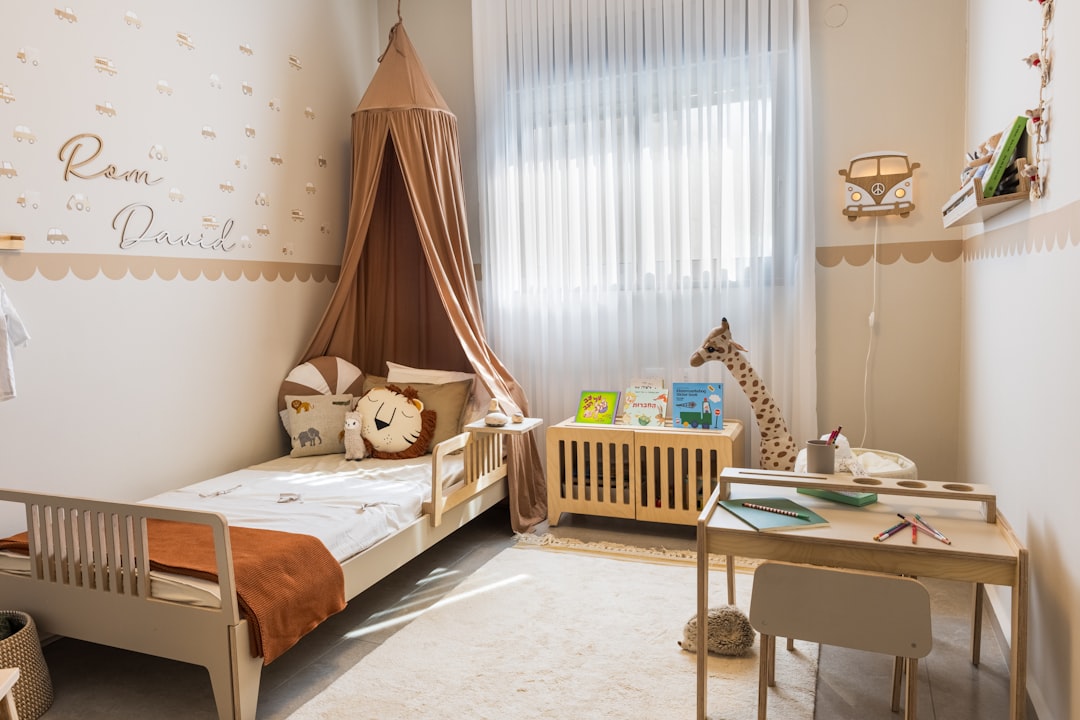 The pattern behind every recommendation in this guide: radio-equipped devices live on the far side of the room, not at the crib rail.
Why the Nursery Gets Extra Care
We’ve covered the underlying science in EMF and babies: what new parents need to know, so here’s the short version: a baby’s thinner skull and smaller head mean higher tissue absorption from the same RF source, and their nervous system is wiring itself at a pace that never repeats.
None of that proves harm. It’s why precaution that feels excessive for your own bedroom feels reasonable for a nursery — especially when the cost is deciding which wall the crib goes on before you’ve assembled it.
Two principles do almost all of the work:
- Distance beats everything. RF power density falls with the square of distance — moving a source from 1 foot to 3 feet away cuts exposure at the crib by roughly 9x. Magnetic fields from compact sources like appliance motors fall off faster still.
- Duty cycle matters. A device that transmits only when needed (a sound-activated monitor) delivers far less cumulative exposure than one streaming continuously all night.
Start With the Crib: Check the Walls First
The crib is where your baby spends 12 to 16 hours a day, so its placement is the single highest-leverage decision in the room. Before you think about any device, think about what’s on the other side of each wall.
Low-frequency magnetic fields — the kind produced by electrical equipment and appliance motors — pass through drywall, brick, and shielding paint alike. The good news: in most homes they drop toward background levels within a few feet of the source. The catch: a crib pushed against the wrong wall can sit inside that few-foot zone all night.
Walls to be cautious about:
- The wall behind your electrical service panel (breaker box), whether it’s in the garage, a closet, or the basement below
- Exterior walls where the utility meter mounts — in apartments and townhomes, meter banks serving multiple units can sit together on one wall
- Walls shared with large appliances — refrigerator, washer/dryer, HVAC air handler, or a heat pump just outside
- In multi-unit buildings, your neighbor’s side — their kitchen, panel, or entertainment wall may back directly onto your nursery
The fix is rarely dramatic: choose an interior wall with nothing suspicious behind it, or simply pull the crib 3+ feet away from a wall you’re unsure about — a few feet of separation does most of what’s possible.
If you want certainty instead of rules of thumb, a basic gaussmeter will tell you in five minutes which wall is quietest — our home EMF testing guide shows exactly how to take those readings.
Why do magnetic fields get this attention? Decades of epidemiology have reported a statistical association between sustained elevated residential magnetic fields and childhood leukemia — an association, not proven causation, with no identified mechanism and mixed recent results, as we cover honestly in our power lines and childhood leukemia review. You don’t need to resolve that debate to act on it: when avoiding the exposure costs nothing but crib placement, most parents just avoid it.
Check your EMF exposure
See cell towers, power lines, and substations near any US address.
Search Your AddressThe Baby Monitor: Choose Well, Then Place Well
The monitor is usually the strongest intentional RF transmitter in the nursery, and it’s also the most fixable. Two decisions matter — what you buy, and where you put it.
Technology, ranked by emission (condensed from our full low-EMF baby monitor buyer’s guide):
| Monitor type | RF from the nursery unit | Notes |
|---|---|---|
| Wired PoE camera (ethernet) | Near zero | Video travels through the cable; requires running a cable |
| DECT audio with VOX mode | Very low, intermittent | Transmits only when baby makes noise |
| DECT/FHSS video (no WiFi) | Moderate | Point-to-point to a parent unit, no internet |
| WiFi smart monitor | Highest | Continuous streaming to your router and often the cloud |
Placement rules that apply to any monitor:
- Never on the crib rail. Mount the camera or mic at least 3 feet from the crib — ideally 6+ feet, on the opposite wall. You lose nothing but a close-up.
- Turn on VOX / ECO / sound-activated mode if the monitor has it. During quiet sleep — which is most of the night — the unit stops transmitting.
- Drop to audio-only overnight on video monitors. Video needs vastly more data throughput than audio, and you’ll hear a crying baby before you’d ever check a screen.
What about wearables? Vitals monitors like the Owlet Dream Sock work differently: a low-power Bluetooth sensor on the baby’s foot talks to a base station, and the base station — not the sock — carries the WiFi connection. If a pulse-oximetry monitor gives your family real peace of mind — or your pediatrician has suggested one — use it. The EMF-smart move is simply to put the base station across the room rather than on the crib rail, since it’s the stronger radio; the sock itself is a genuinely low-power transmitter. Full breakdown in our Owlet Dream Sock EMF review.
Sound Machines: The Radio You Forgot About
Modern sound machines are smart devices. The popular Hatch Rest (2nd gen) carries both WiFi and Bluetooth radios — WiFi is required for setup and app control, though saved routines keep running if WiFi later drops. That doesn’t make it dangerous; it makes it placeable.
Your options, from lowest EMF up:
- A fan-based mechanical machine (the classic Dohm style) — a motor and a fan, no radios at all
- A basic digital machine with physical buttons and no app — check the box for the words “WiFi” or “Bluetooth”; if they’re absent, there’s no transmitter
- A smart machine placed across the room — configure it once, then let it live 6+ feet from the crib
Conveniently, hearing guidance points the same direction: pediatric advice on infant white noise is to keep the machine well away from the crib at moderate volume, because these devices can be surprisingly loud up close. The low-EMF placement and the hearing-safe placement are the same placement. See our Hatch sound machine EMF breakdown for measurements and settings.
Night Lights: The Easiest Win in the Room
A plain plug-in LED night light contains no radio. It draws a watt or two from the outlet and emits nothing meaningful beyond a few inches. If you buy the simple version, this category is solved.
The complications are all in the “smart” versions — color-changing, app-controlled lights maintain a WiFi or Bluetooth connection all night. If you love the features, treat a smart light like the sound machine: across the room, not at the head of the crib.
Two small extras while you’re at it:
- Pick warm/amber tones over bright blue-white. A sleep-hygiene point rather than an EMF one — dim, warm light is gentler on melatonin for everyone in the room, you included at 3 AM.
- Keep all cords 3+ feet from the crib. This is standard safe-sleep guidance (cords are a strangulation hazard), and it conveniently keeps every plugged-in device out of the crib’s immediate zone too.
The Rest of the Room — and Just Outside It
With the big three placed, sweep the remainder:
- The router doesn’t belong in or beside the nursery. If it currently sits on the other side of a nursery wall, moving it to a central spot away from bedrooms is one of the highest-value changes in the whole house. Most routers can also be scheduled off overnight, zeroing home WiFi during sleep hours entirely.
- Phones charge outside the nursery, not on the crib rail or nursing-chair armrest. If yours must stay in the room, use airplane mode while feeding or rocking.
- Prefer “dumb” humidifiers, air purifiers, and diffusers. A humidifier doesn’t need an app; most smart versions work fine with WiFi never set up.
- Skip the smart speaker in the nursery. It’s an always-on microphone and WiFi client; a sound machine covers the actual need.
- Look out the window. Nursery EMF isn’t only about what’s inside. A cell tower on the next block or transmission lines behind the fence change the room’s baseline more than any gadget in it. Check your address on the EMF Radar map to see documented towers and power infrastructure near your home — 30 seconds, and you’ll know whether the outside picture is even worth thinking about.
The One-Evening Checklist
| Step | Cost |
|---|---|
| Crib on an interior wall; nothing suspect (panel, meters, large appliance) behind it | $0 |
| 3+ feet between crib and any wall you can’t verify | $0 |
| Monitor mounted 6+ feet from crib, VOX/audio-only overnight | $0 |
| Wearable-monitor base station across the room | $0 |
| Sound machine across the room, moderate volume | $0 |
| Plain LED night light, warm tone; cords 3+ feet from crib | ~$10 |
| Router relocated away from bedroom walls; scheduled off overnight | $0 |
| Phones charge outside the room | $0 |
| Address checked on the map for towers and power lines | $0 |
Total spend: about the price of a night light. The layout does the work.
What We’re Not Saying
We are not saying your WiFi monitor is hurting your baby. Regulatory limits everywhere sit far above what these devices produce, and studies of everyday exposure levels in children have mostly found no measurable effects. Precaution earns its keep when it’s cheap, and everything above is cheap.
What we’d steer you away from is the fear-driven end of this market: shielding paint for nursery walls, EMF-blocking crib liners, and especially shielding canopies draped over cribs — never do this. Loose fabric over or inside a crib is a genuine suffocation and entrapment hazard under universal safe-sleep guidance — the one “EMF product” category that carries a real, documented risk. Placement first, purchases rarely, nothing in the crib ever.
Frequently Asked Questions
Where should I put the crib to reduce EMF?
On an interior wall with no electrical panel, utility meter, or large appliance on the other side, and at least 3 feet from any wall you can’t verify. Magnetic fields from household equipment pass through walls but fall off quickly with distance, so a few feet of separation removes most of the exposure. A basic gaussmeter reading along each wall settles it definitively.
Do baby monitors emit a lot of EMF?
It depends almost entirely on the technology. WiFi video monitors stream continuously and emit the most; DECT audio monitors with sound-activated (VOX) mode transmit only when your baby makes noise; wired ethernet cameras emit essentially none from the nursery. Whatever you own, mounting it 6+ feet from the crib cuts exposure dramatically.
Is the Hatch sound machine high EMF?
The Hatch Rest (2nd gen) contains WiFi and Bluetooth radios, so it does transmit — but its saved routines run even without a live WiFi connection, and its output is modest compared to a streaming video monitor. Placed across the room, it contributes very little at the crib. A fan-based mechanical sound machine is the zero-radio alternative.
Should I turn off WiFi at night in a house with a baby?
It’s a reasonable, zero-cost precaution if your router sits near bedrooms, and scheduling makes it automatic — though moving the router away from sleeping areas accomplishes most of the same reduction. No research establishes that overnight home WiFi harms infants; this is precaution, not treatment of a known hazard.
Is it safe for a crib to be near an electrical outlet?
An unused outlet, or one powering a small device, produces very little field beyond a few inches, so this is a minor concern compared to what’s behind the wall. The firmer rule is safe-sleep, not EMF: keep all cords at least 3 feet from the crib, and use outlet covers once your baby can reach.