Power Lines and Childhood Leukemia: A Comprehensive Review of the Evidence
Quick Answer: Research shows a statistical association between living near power lines (exposure above 0.3-0.4 microtesla) and approximately doubled childhood leukemia risk, which led IARC to classify ELF magnetic fields as “possibly carcinogenic.” However, no biological mechanism has been identified, recent studies show mixed results, and the absolute risk increase is small—affecting perhaps 1-4% of childhood leukemia cases if the association is causal.
Key Facts at a Glance
| Question | Answer |
|---|---|
| What is the observed risk increase? | Approximately 2x higher leukemia risk for children exposed to magnetic fields above 0.3-0.4 microtesla (3-4 milligauss) |
| What is IARC’s classification? | Group 2B: “possibly carcinogenic to humans”—the same category that once included coffee |
| Is there a proven mechanism? | No. Despite 40+ years of research, no biological mechanism explains how ELF fields could cause cancer |
| What percentage of children have high exposure? | Only 1-2% of children in developed countries are exposed above the 0.3-0.4 µT threshold |
| What is the baseline childhood leukemia risk? | About 4-5 cases per 100,000 children per year |
| What do recent studies show? | Mixed results—a 2021 pooled analysis found no increased risk, while a 2023 Italian study found elevated risk near power lines |
Of all the health questions surrounding power lines, childhood leukemia is the most studied. It is the specific concern that prompted IARC’s Group 2B classification of ELF magnetic fields in 2002, and it remains the focus of new pooled analyses and epidemiological work today.
This article is a deep dive into that specific question — the key studies, the statistical association, the missing biological mechanism, and what the latest evidence means for parents living near high-voltage lines.


The Finding That Started Everything
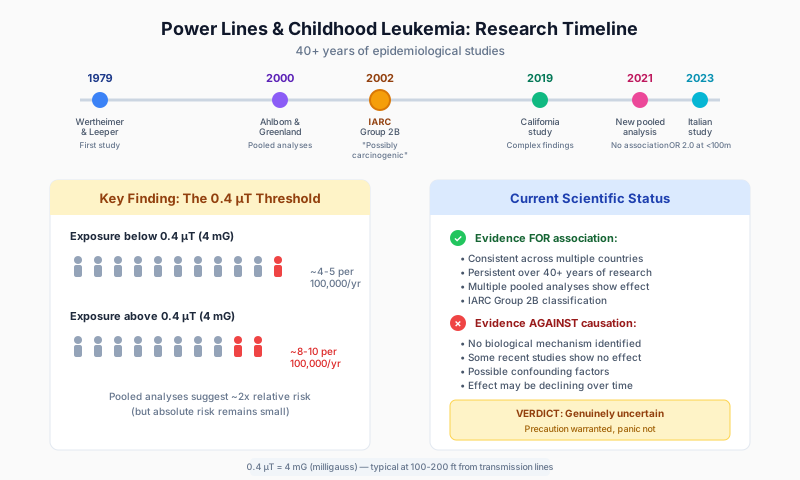
The 1979 Wertheimer-Leeper study first identified a potential link between power lines and childhood cancer. Epidemiologists Nancy Wertheimer and Ed Leeper published a study in the American Journal of Epidemiology that found children who had died from cancer were more likely to have lived in homes near high-current electrical configurations. The association was strongest for leukemia.
This paper launched decades of research. Some studies supported the association; others didn’t. But the question refused to go away.
Check your EMF exposure
See cell towers, power lines, and substations near any US address.
Search Your AddressThe IARC Classification
The World Health Organization classified ELF magnetic fields as “possibly carcinogenic” in 2002. The International Agency for Research on Cancer (IARC) evaluated the evidence and assigned extremely low frequency (ELF) magnetic fields to Group 2B.
This wasn’t based on speculation. According to PubMed, the classification drew on pooled analyses showing a statistical association between magnetic field exposure above 0.3-0.4 microtesla (µT)—equivalent to 3-4 milligauss (mG)—and approximately doubled childhood leukemia risk.
To be clear about what Group 2B means:
- It’s the same category that once included coffee and pickled vegetables
- It indicates “limited evidence” in humans and “less than sufficient evidence” in animals
- It does NOT mean “proven to cause cancer”
- It DOES mean the association is considered real enough to warrant ongoing research and precaution
What the Pooled Analyses Found
Pooled analyses combining multiple studies provide the strongest evidence for an association. Key findings:
Ahlbom et al. (2000) pooled nine studies with over 3,000 cases. For exposures ≥0.4 µT, they found a relative risk of 2.0 (95% CI: 1.3-3.3)—meaning roughly double the leukemia risk.
Greenland et al. (2000) pooled 15 studies and found similar results: odds ratio of 1.7 (95% CI: 1.2-2.3) for exposures ≥0.3 µT.
Kheifets et al. (2010) updated the pooled analysis with newer studies and found the association persisted, though with wider confidence intervals.
These pooled analyses are considered the most reliable evidence because they combine large numbers of cases and use consistent methodology across studies.
The Most Recent Research

Recent studies have produced contradictory findings, with some showing elevated risk and others finding none. According to PubMed:
2023 Italian Study: A case-control study in Northern Italy (182 cases, 726 controls) found that children living within 100 meters of high-voltage power lines had approximately double the leukemia risk (OR 2.0, 95% CI 0.8-5.0) compared to children living 400+ meters away. The study controlled for potential confounders including traffic pollution and proximity to fuel stations. DOI
2021 Pooled Analysis: A new pooled analysis combining four recent studies (24,994 cases, 30,769 controls) found no increased risk at exposures ≥0.4 µT (OR 1.01). The authors noted a “decline in risk over time” and suggested this could reflect methodological improvements, random chance, or a “true finding of disappearing effect.” DOI
2019 California Power Line Study: This large study found something intriguing: neither close proximity alone nor high magnetic fields alone were associated with elevated risk. Rather, elevated risk was confined to children who were both very close to high-voltage lines (<50m) and had high calculated fields (≥0.4 µT)—odds ratio 4.06 (95% CI 1.16-14.3). The authors suggested this argues against magnetic fields as the sole explanation. DOI
The Central Puzzle: No Known Mechanism
No biological mechanism has been identified that explains how ELF magnetic fields could cause cancer. Here’s what makes this issue so frustrating for scientists: despite the persistent statistical association, the physics doesn’t support a causal pathway.
Unlike ionizing radiation (X-rays, gamma rays), ELF magnetic fields:
- Don’t have enough energy to break chemical bonds
- Don’t directly damage DNA
- Can’t cause the kind of cellular damage typically associated with cancer
This doesn’t mean the association is false—but it does mean we’re missing something. Possible explanations that researchers have explored:
Oxidative Stress: Some studies suggest ELF fields may increase reactive oxygen species (ROS) in cells, which can indirectly damage DNA. This remains an active area of research.
Melatonin Disruption: Magnetic fields might suppress melatonin production, which has anti-cancer properties. Evidence is mixed.
Epigenetic Effects: Fields might alter gene expression without damaging DNA directly. This is plausible but not well-established.
Corona Ions: High-voltage lines produce charged particles (corona ions) that might carry pollutants into the body. This could explain why the California study found effects only near high-voltage lines.
Something Else Entirely: The association might be real but caused by another factor correlated with power line proximity—something we haven’t identified yet.
What Skeptics Point Out
Several valid scientific objections challenge the power line-leukemia association. It’s important to present the case for skepticism honestly:
Inconsistent Results: Not all studies find an association. Some large, well-designed studies have found no effect.
No Dose-Response: If magnetic fields caused leukemia, we’d expect more exposure to mean more risk. But the association appears mostly as a threshold effect above 0.3-0.4 µT, not a linear increase.
Biological Implausibility: The lack of a clear mechanism is a significant problem. Science generally requires both statistical association AND biological plausibility before concluding causation.
Potential Confounders: Power lines run through certain neighborhoods—often lower-income areas with more traffic, pollution, and other potential risk factors. Despite efforts to control for these, residual confounding is possible.
Publication Bias: Studies finding associations may be more likely to get published than null results, potentially inflating the apparent effect.
According to PubMed, a 2012 review by a former WHO official noted that while IARC classified ELF fields as possibly carcinogenic, the WHO’s overall assessment found that “laboratory studies and other research results did not support the association,” and they could not confirm health consequences from low-level magnetic field exposure. DOI
Putting the Risk in Perspective
The absolute risk increase from power line exposure, even if real, remains small in practical terms. Even if we accept the statistical association at face value, what does it mean?
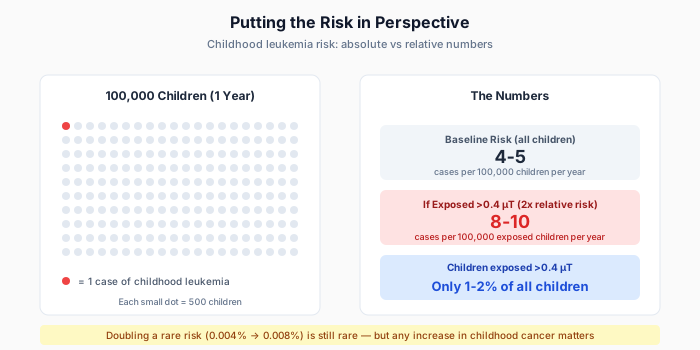
Childhood leukemia is rare. The baseline risk is about 4-5 cases per 100,000 children per year.
Few children have high exposure. Only about 1-2% of children in developed countries are exposed to magnetic fields above 0.3-0.4 µT at home.
Doubling a small risk is still small. If exposure above 0.4 µT doubles the risk, that means going from ~4 cases per 100,000 to ~8 cases per 100,000 among highly exposed children.
Estimated attributable cases: Based on these numbers, researchers have estimated that ELF magnetic field exposure might account for 1-4% of childhood leukemia cases in high-exposure populations—if the association is causal.
This isn’t meant to minimize parental concern. Any increase in childhood cancer risk matters. But context helps with decision-making.
What Should Parents Do?
Parents should take reasonable precautions without making drastic life changes based on uncertain science. Given the scientific uncertainty, here’s a reasonable approach:
If You’re House Hunting
- Use power line proximity as one factor among many—not a dealbreaker by itself
- For transmission lines (high-voltage), 200+ feet provides meaningful distance
- Check EMF Radar’s ELF score to assess specific addresses
- Consider measuring if a property is within 300 feet of transmission lines
If You Already Live Near Power Lines
- Don’t panic. The absolute risk, even if the association is real, is small.
- Arrange bedrooms away from the power line side of the house if practical
- Focus on factors with clearer evidence: don’t smoke, maintain healthy weight, etc.
- If concerned, measure your actual exposure—it may be lower than expected
If You’re Deeply Concerned
- Hire a Building Biology consultant to assess your home
- Consider whether the anxiety itself is affecting your family’s quality of life
- Recognize that perfect EMF avoidance is impossible in modern society—and may not be necessary
The Precautionary Principle
Many countries have adopted precautionary measures (including policies around schools) despite scientific uncertainty about power lines and leukemia. These reflect the judgment that, given the stakes (children’s health), taking reasonable precautions makes sense even without certainty:
- Switzerland sets exposure limits 100x lower than ICNIRP for new buildings near power lines
- Several European countries discourage building schools near high-voltage lines
- Building Biology guidelines recommend keeping sleeping areas below 1 mG
These measures don’t assume the association is proven—they reflect the judgment that, given the stakes (children’s health), taking reasonable precautions makes sense even without certainty.
Frequently Asked Questions
Do power lines cause childhood leukemia?
The evidence is inconclusive. Statistical studies show an association between high magnetic field exposure (above 0.3-0.4 microtesla) and approximately doubled childhood leukemia risk, but no biological mechanism has been identified, and recent studies show mixed results. IARC classifies ELF fields as “possibly carcinogenic”—meaning the association warrants attention but is not proven causal.
What is a safe distance from power lines for children?
There is no officially established “safe” distance because the science remains uncertain. However, for high-voltage transmission lines, 200+ feet (60+ meters) typically provides meaningful reduction in magnetic field exposure. Actual exposure depends on the line’s voltage, current load, and configuration, so measuring is more accurate than relying on distance alone.
How do I measure magnetic field exposure in my home?
Use a gaussmeter (also called a magnetometer) to measure magnetic fields in milligauss (mG) or microtesla (µT). Focus on areas where children spend extended time, especially bedrooms. The threshold of concern in studies is 0.3-0.4 µT (3-4 mG). Measurements should be taken at different times since power line fields vary with electrical load.
Why did IARC classify ELF magnetic fields as “possibly carcinogenic”?
IARC assigned the Group 2B classification in 2002 based on pooled epidemiological studies showing a consistent statistical association between magnetic field exposure and childhood leukemia. Group 2B indicates “limited evidence” in humans—the association is real enough to warrant concern but not strong enough to establish causation. This is the same category that once included coffee.
Should I move if I live near power lines?
Moving is generally unnecessary based on current evidence. The absolute risk increase, even if the association is causal, is small—potentially affecting 1-4% of childhood leukemia cases among highly exposed populations. Practical steps like arranging children’s bedrooms away from the power line side of the house can reduce exposure without relocating.
Are distribution lines (neighborhood power lines) as concerning as transmission lines?
Distribution lines generally produce much lower magnetic fields than high-voltage transmission lines. The studies showing associations typically involve exposures above 0.3-0.4 µT, which is more commonly found near transmission lines or very close to distribution lines. Measuring your actual exposure is more informative than assuming risk based on line type.
The Bottom Line
The power line / childhood leukemia question remains genuinely unresolved after 40+ years of research:
What we know:
- Multiple pooled analyses have found a statistical association between magnetic fields >0.3-0.4 µT and roughly doubled childhood leukemia risk
- This association is persistent across different countries, study designs, and time periods
- No biological mechanism has been established
- Recent large studies have shown mixed results, with some finding no association
What it means:
- The association is real enough that IARC classifies ELF fields as “possibly carcinogenic”
- It’s uncertain enough that regulatory bodies haven’t set strict exposure limits
- The absolute risk, even if real, is small (affecting perhaps 1-4% of cases)
- Reasonable precaution—especially for children’s sleeping areas—is warranted
The precautionary principle suggests keeping children’s long-term exposure low when practical, without upending your life over it. Check your exposure with EMF Radar, measure if you’re concerned, and make informed decisions based on your specific situation.
Related Reading
- Power Lines Near My House: Should I Be Worried?
- EMF and Dementia: Does Electromagnetic Radiation Affect Brain Aging? — what the research says about EMF exposure and adult neurodegeneration
- How to Measure EMF in Your Home
- EMF and Sleep: What the Research Shows
Last updated: January 2026. This article synthesizes publicly available research from PubMed and is not medical advice. For personalized guidance, consult with your healthcare provider.
Sources:
- Malagoli C, et al. (2023). “Residential exposure to magnetic fields from high-voltage power lines and risk of childhood leukemia.” Environmental Research. DOI
- Crespi CM, et al. (2019). “Childhood leukemia risk in the California Power Line Study.” Environmental Research. DOI
- Amoon AT, et al. (2021). “Pooled analysis of recent studies of magnetic fields and childhood leukemia.” Environmental Research. DOI
- Repacholi M. (2012). “Concern that ‘EMF’ magnetic fields from power lines cause cancer.” Science of the Total Environment. DOI