
EMF Exposure and Children: A Complete Parent’s Guide for 2026
Quick Answer: Children may be more susceptible to EMF effects due to thinner skulls, developing brains, and longer lifetime exposure ahead. While no study has proven harm at normal environmental levels, the precautionary principle makes sense — especially for device use habits. The biggest exposure source for most kids isn’t cell towers or WiFi, it’s the phone or tablet they hold against their body.
Key Facts at a Glance
| Question | Answer |
|---|---|
| Are children more vulnerable to EMF? | Possibly — thinner skulls, higher water content in tissue, and developing nervous systems may increase susceptibility. No proven harm at ambient levels. |
| Is WiFi in schools dangerous? | WiFi access points emit very low power (0.1-1 watt). Measured levels in classrooms are typically 10,000x below safety limits. |
| Should I worry about cell towers near school? | Distance matters more than presence. Most schools aren’t within concerning proximity. Use EMF Radar to check specific schools. |
| What’s the biggest EMF source for kids? | Their own devices — phones, tablets, laptops — especially when held against the body. |
| What age should kids get phones? | AAP recommends limiting screen time; WHO recommends no screens under 2. For EMF specifically, speaker mode and texting reduce head exposure 90%+. |
| What practical steps should I take? | Distance is your best friend. Speaker mode, devices off the body, WiFi off at night, wired connections when practical. |
As a parent, you want to protect your children from every possible harm. The rise of 5G, WiFi-saturated classrooms, and kids carrying phones from younger ages has many parents asking hard questions about electromagnetic field (EMF) exposure.
This guide cuts through both the fear-mongering and the dismissiveness to give you an honest, science-based framework for making decisions about your family’s EMF exposure.


Why Children Might Be Different

Children are not small adults. Several physiological differences are relevant to EMF exposure:
Thinner Skulls
A child’s skull is thinner and less dense than an adult’s. Research by Gandhi et al. (1996) and De Salles et al. (2006) using computational models showed that RF energy from a cell phone can penetrate proportionally deeper into a child’s brain.
- 5-year-old: RF absorption may extend roughly twice as deep as in an adult
- 10-year-old: Intermediate between a 5-year-old and adult
- These models are theoretical — they show potential for greater absorption, not demonstrated harm
Higher Tissue Water Content
Children’s brain tissue contains more water than adults’, and water is more efficient at absorbing RF energy. This means the same external RF field may deposit slightly more energy in a child’s tissue.
Developing Nervous System
The brain undergoes critical development through adolescence, including:
- Myelination (insulating nerve fibers) — continues into the mid-20s
- Synaptic pruning — peaks in adolescence
- Blood-brain barrier maturation
Whether RF exposure at environmental levels could affect these processes is theorized but not established. The concern is plausible enough that several national health agencies recommend precaution for children specifically.
Cumulative Lifetime Exposure
A child born today will have 70-80+ years of RF exposure from ambient sources. No previous generation has had this level of lifetime exposure starting from birth. This is genuinely uncharted territory, and it’s the strongest argument for reasonable precaution — even if current evidence doesn’t show harm.
Check your EMF exposure
See cell towers, power lines, and substations near any US address.
Search Your AddressThe Main Sources of EMF Exposure for Kids
Understanding where exposure actually comes from helps you prioritize the right things.
1. Personal Devices (Highest Exposure)
This is almost certainly your child’s #1 source of RF-EMF exposure:
- Phone held to head: SAR of 0.5-1.6 W/kg (at FCC limit) — the highest RF exposure most people experience
- Tablet on lap: Lower SAR than phone to head, but sustained exposure to the torso
- Laptop on lap: RF from WiFi + heat exposure
- Smartwatch: Low power, but continuously worn against skin
The key insight: A phone call held against a child’s head produces more RF exposure in that tissue than standing next to a cell tower for an entire day. Ambient environmental RF (towers, WiFi) is dwarfed by close-contact device use.
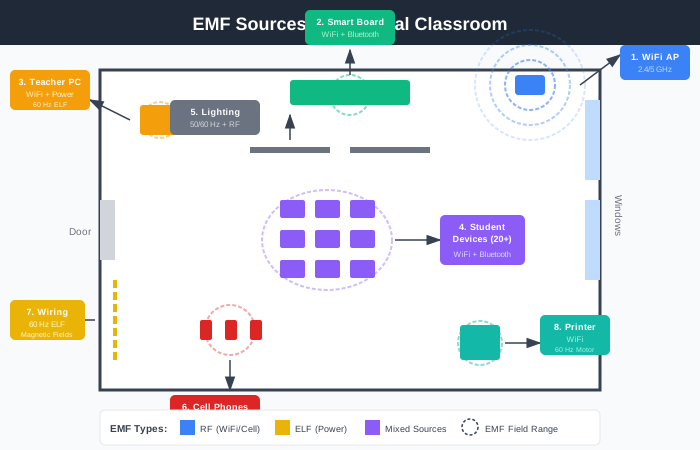
2. WiFi in Schools and Home
WiFi routers and access points typically operate at:
- 2.4 GHz and/or 5 GHz
- Power: 0.1-1 watt (home routers) to 1-4 watts (commercial access points)
Classroom measurements: Multiple studies (including by ARPANSA Australia, French ANSES, and the UK Health Protection Agency) have measured WiFi levels in schools:
- Typical exposure: 0.0001-0.01 mW/cm² — thousands of times below safety limits
- A student sitting 1 meter from a WiFi access point receives less RF exposure than from their own phone held at arm’s length
- WiFi is intermittent — access points only transmit when actively sending data, not continuously
Perspective: Your home WiFi router exposes your child to less RF than a baby monitor, which exposes them to less than a cell phone.
3. Cell Towers Near Schools
This is the most emotionally charged source, but often the least significant in terms of actual exposure:
- Cell towers near schools operate at the same power as towers everywhere
- Distance from tower to classrooms is typically 200+ feet minimum
- Measured RF levels at schools near towers: consistently below 1% of safety limits
- Building walls attenuate (reduce) RF by 50-90%
When to actually investigate:
- Tower is mounted directly on the school building (some schools lease rooftop space to carriers)
- Multiple towers within 200 feet of classrooms
- You notice unusual antenna installations very close to play areas
Check your school: EMF Radar’s schools tool shows nearby cell towers for schools across the US, with estimated exposure scores.
4. Smart Home Devices
The modern home is full of RF emitters:
- Smart speakers (Alexa, Google Home)
- Smart TVs
- Baby monitors
- Security cameras
- Smart thermostats, lights, plugs
- Bluetooth devices
Each individually emits very low power (typically 0.01-0.1 watts). Collectively, they contribute to ambient RF levels in the home, but measured total exposure typically remains far below safety limits.
5. Power Lines and Substations (ELF-EMF)
Extremely low frequency (ELF) electromagnetic fields from power lines are a separate category from RF:
- Frequency: 60 Hz (US) / 50 Hz (Europe) — millions of times lower than cell frequencies
- Source: high-voltage power lines, transformers, substations
- The IARC classified ELF magnetic fields as “possibly carcinogenic” (Group 2B) based on epidemiological associations with childhood leukemia at exposures above 3-4 milligauss
- This association has been observed but not confirmed as causal — confounding factors remain
What this means for housing decisions: If you’re choosing between two otherwise equal homes and one is directly under high-voltage power lines (not standard distribution lines), the other home is a reasonable precautionary choice. For typical neighborhood power lines, measured magnetic field levels at normal distances (50+ feet) are generally below levels of concern.
What Do Health Authorities Actually Recommend?
World Health Organization (WHO)
- Classifies RF as “possibly carcinogenic” (Group 2B) — same as pickled vegetables, aloe vera
- States: “To date, no adverse health effects have been established as being caused by mobile phone use”
- Recommends: “Reducing exposure through hands-free use and texting” as a precautionary measure for children
American Academy of Pediatrics (AAP)
- Has called for the FCC to reassess safety standards, particularly for children
- Recommends children limit cell phone use, especially calls held to the head
- Emphasizes speaker mode and hands-free options
- Has not recommended removing WiFi from schools or avoiding areas near cell towers
French ANSES (National Agency for Food, Environmental and Occupational Health & Safety)
- The most precautionary mainstream agency
- Recommends limiting children’s use of mobile phones
- Recommended against WiFi in nursery schools (ages 0-3) — but based on general precaution, not demonstrated harm
- Has not found WiFi in elementary/secondary schools to be a measurable health risk
ICNIRP (International Commission on Non-Ionizing Radiation Protection)
- Updated guidelines in 2020 are designed to protect all population groups, including children
- Includes safety factors (50x below harmful levels) that account for potential increased sensitivity
- Does not recommend separate, stricter limits for children specifically
The Common Thread
Every major health authority says the same thing, more or less:
- Current evidence doesn’t establish harm from normal RF exposure
- Children may be more susceptible
- Reducing unnecessary close-contact device exposure is sensible precaution
- Ambient environmental RF (towers, WiFi) is not at concerning levels
Practical Steps by Age Group

Infants and Toddlers (0-3)
Priority: Minimize close-contact device exposure
- No phones or tablets as toys — the chewing distance is maximum RF absorption
- Keep baby monitors 3+ feet from the crib — most modern monitors work fine at this distance
- Consider a low-EMF baby monitor — our buyer’s guide covers wired, DECT, and audio-only options
- WiFi router placement: Not in the nursery; elsewhere in the house is fine
- Don’t stress about ambient RF — your home’s WiFi, neighbor’s WiFi, and distant towers produce negligible exposure compared to any device held against the body
Young Children (3-8)
Priority: Build good device habits early
- Tablet use: On a table, not in the lap. This creates distance from the body.
- Speaker mode always for any voice/video calls
- Airplane mode for offline games — if the device doesn’t need WiFi, turn it off. Reduces RF to near zero.
- Limit screen time (AAP recommends 1 hour/day for 2-5 year olds) — this incidentally limits EMF exposure
- Check your child’s school on EMF Radar — know what’s nearby, but don’t panic
Tweens (8-12)
Priority: Prepare for phone ownership
- If they get a phone: Start with speaker mode and texting as defaults. These habits, formed now, persist.
- No sleeping with the phone — charging station in common area overnight
- Introduce the concept: “Your phone sends out radio waves. They’re strongest right against your body. Keep some distance.”
- Laptop hygiene: On a desk, not on the lap for extended periods (both for RF and posture)
- Wired headphones for music and calls — AirPods/Bluetooth earbuds are very low power but wired is lower
Teenagers (13-18)
Priority: Realistic harm reduction
You’re not confiscating their phone. Focus on high-impact, easy habits:
- Speaker mode or wired headphones for calls (the single highest-impact behavior change)
- Phone not in the front pocket when possible — back pocket, bag, or jacket
- Phone not under the pillow at night — charge across the room
- WiFi over cellular when available — phones transmit at lower power on WiFi because the access point is closer
- Awareness, not fear — “The science isn’t definitive, but easy precautions make sense. Here’s why.”
Common Scenarios and What to Do
“There’s a Cell Tower Near My Child’s School”
First, check the facts:
- Go to EMF Radar and search for the school
- Note the distance to the nearest tower(s)
- Check the tower type (macro tower, small cell, rooftop)
If the tower is 500+ feet away: Exposure at the school is negligible. The building walls alone reduce RF by 50-90%. Your child gets more RF from their tablet.
If the tower is on the school building: This is worth investigating. Ask the school administration:
- Where exactly are the antennas?
- Are any antennas pointed at or near classrooms/play areas?
- Has RF measurement been done?
Even rooftop antennas typically point outward and upward, so the floors below receive minimal exposure. But it’s reasonable to request measurements.
If you’re concerned regardless: An RF meter (TriField TF2, ~$188) lets you measure actual levels in your child’s classroom. Bring data to conversations with the school — it’s more persuasive than worry.
“Should I Opt My Child Out of School WiFi?”
This is unlikely to make a meaningful difference because:
- The WiFi access points transmit regardless of whether your child’s device is connected
- Other students’ devices are transmitting
- The exposure levels are already thousands of times below safety limits
However, if your child uses a school-issued device:
- Ensure it’s on a desk, not in the lap
- Airplane mode when not actively using network features (if the school allows)
“We Live Near Power Lines”
For ELF magnetic fields from power lines:
- Standard distribution lines (neighborhood poles): Magnetic fields drop to background levels within 50-100 feet — learn more about power lines near houses
- High-voltage transmission lines (tall metal towers): Fields can be elevated up to 300+ feet
- Measure with an ELF meter — anything consistently below 2 milligauss is at background levels
If you’re house-hunting and EMF is a concern, check the address on EMF Radar for a comprehensive view of nearby towers, power lines, and substations.
“My Child Complains of Headaches Near Devices”
This deserves attention, but context matters:
- Screen fatigue (eye strain, posture) causes far more headaches in children than RF
- Blue light exposure and too-close viewing distances are common culprits
- Electrosensitivity (EHS) in children is not well-studied; in adult studies, blinded trials haven’t confirmed the ability to detect RF presence
- Take it seriously: Reduce screen time, ensure proper viewing distance (20+ inches), and see if symptoms resolve before attributing to EMF
The Fear Factor: Keeping Perspective

Parenting in the information age means constant exposure to alarming headlines. Some perspective on EMF risk relative to other childhood risks:
Well-established risks you probably already manage:
- Car accidents (leading cause of childhood death)
- Drowning
- Falls
- Poisoning
- Screen addiction and mental health impacts
Risks with some scientific support:
- Excessive screen time effects on development and sleep
- Sedentary lifestyle
- Blue light effects on circadian rhythm
Risks that are theorized but unproven:
- Ambient RF effects on children at current environmental levels
- WiFi effects on developing brains
- Long-term cumulative RF exposure from infrastructure
This hierarchy matters. If you’re spending significant energy worrying about the cell tower near school while your child spends 6 hours a day on screens (the average for US teenagers), the priorities may be inverted.
That said: Unproven doesn’t mean impossible. The precautionary principle — making easy, low-cost changes to reduce a possible risk — is entirely rational. The key is keeping precaution proportionate to the evidence.
Building an EMF-Aware Home (Without Going Overboard)
High-Impact, Low-Effort Changes
- Phone charging station in common area — keeps phones out of bedrooms at night
- WiFi router central, not in bedrooms — reduces nighttime exposure to the lowest levels
- Speaker mode default for calls — teach everyone in the family
- Devices on desks, not laps — simple rule, big reduction in body-contact exposure
- Wired internet where convenient — desktop computers, gaming consoles, smart TVs can all use Ethernet
Moderate Effort
- WiFi scheduler — most routers can turn WiFi off on a schedule (e.g., 11 PM to 6 AM)
- Reduce smart home device count — do you really need a smart plug for every lamp? Each one adds to ambient RF.
- Wired headphones for kids who listen to music/watch videos extensively
Going Further (If You Choose)
- EMF meter — measure your actual home environment instead of guessing
- Low-EMF bedroom — wired alarm clock, no devices, router scheduled off at night
- Shielding — window films, paints (only for rooms facing very close cell infrastructure; overkill for most homes)
What’s Not Worth It
- “EMF blocking” phone cases that claim to block radiation while still letting the phone work. Physics doesn’t support this — if the case blocked the signal, the phone would increase its transmit power to compensate, potentially increasing your exposure.
- Anti-radiation stickers or chips — no legitimate testing supports their claims
- Removing WiFi entirely — the inconvenience is disproportionate to the already-negligible risk for most families
Talking to Other Parents
If you’re the parent who brings up EMF at a school meeting, here’s how to be taken seriously:
- Lead with questions, not conclusions — “Has the school measured RF levels in classrooms?” works better than “WiFi is irradiating our children”
- Bring data — an RF meter reading from the classroom is worth more than 100 articles
- Focus on reasonable asks — router placement away from desks, measurement studies, and keeping cell infrastructure off school buildings are reasonable. Removing all WiFi is not practical.
- Acknowledge uncertainty honestly — “The science isn’t settled, so reasonable precaution makes sense” is a stronger position than “WiFi causes cancer”
- Reference credible sources — AAP, WHO, ICNIRP, not wellness influencers or conspiracy sites
Key Takeaways
- Device use matters more than ambient RF — your child’s phone against their head is 100x more exposure than the cell tower down the street
- Distance is your best tool — even a few inches dramatically reduces exposure
- Good habits now last a lifetime — speaker mode, devices on desks, phones out of bedrooms
- Measure, don’t assume — actual RF levels are almost always lower than feared
- Precaution is rational, panic is not — make easy changes, don’t upend your life
- Check your environment — use EMF Radar to know what’s near your home and school
Resources
- Check cell towers near your child’s school
- Search your home address for nearby towers
- EMF Exposure While Pregnant
- Best EMF Meters for Home Buyers
- Are 5G Small Cells Dangerous?
- How to Read an EMF Meter
Related Articles
- EMF and Autism: What the Science Actually Shows
- EMF and ADHD: Can EMF Affect Your Child’s Attention?
- EMF Exposure in Schools: WiFi and Cell Tower Risks
- How to Reduce EMF Exposure at Home: A Practical Guide
- EMF and Female Fertility: Preconception Planning Guide
- Power Lines Linked to Alzheimer’s in 3.5 Million-Person Study
Related Reading
- EMF Exposure in Schools: WiFi and Cell Tower Risks
- Are 5G Small Cells Dangerous? What the Science Says in 2026
- Cell Towers on Schools: Lawsuits, Legal Rights, and What Parents Can Actually Do
- EMF and Human Health: What the Science Actually Says
Want to check your exposure? Search your address on EMF Radar to see cell towers, power lines, and substations nearby. For a professional assessment, find a certified EMF consultant in your area.