How to Measure EMF in Your Home: A Complete Guide
Quick Answer: To measure EMF in your home, you need two types of meters: an RF meter for wireless signals (WiFi, cell towers, smart meters) and an ELF/gaussmeter for power-frequency fields (wiring, appliances, power lines). The Safe and Sound Pro II ($350-500) is recommended for RF, and the Trifield TF2 ($30-50) works well for ELF. Measure at the center of each room, near known sources, and especially in bedrooms where you spend 8 hours sleeping.
Key Facts at a Glance
| Question | Answer |
|---|---|
| What equipment do I need? | An RF meter for wireless signals and an ELF/gaussmeter for magnetic fields from wiring |
| How much do EMF meters cost? | Budget options start at $30-50 for ELF and $150-200 for RF; recommended mid-range is $350-500 |
| Where should I measure first? | Bedrooms (EMF affects sleep), then home office, then living areas |
| What is a safe RF level? | Building biology: below 10 µW/m² for sleeping areas. How to interpret readings → |
| What is a safe magnetic field level? | Below 1 mG for sleeping areas; precautionary guidelines based on research findings |
| When should I hire a professional? | When you suspect wiring issues, need pre-purchase evaluation, or find confusing results |
You’ve heard about EMF exposure, maybe checked your address on EMF Radar, and now you want to know exactly what’s happening in your own space. Good instinct—actual measurements beat estimates every time.
This guide will walk you through the equipment you need, how to use it properly, and how to interpret what you find. By the end, you’ll be able to conduct a thorough EMF assessment of any home.

First: Understand What You’re Measuring
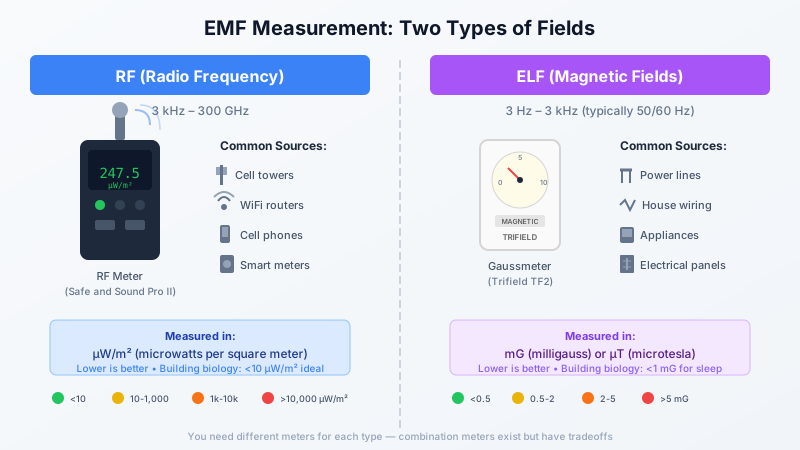
EMF measurement requires understanding two distinct field types that need different meters. “EMF” covers two very different types of fields that require different meters:
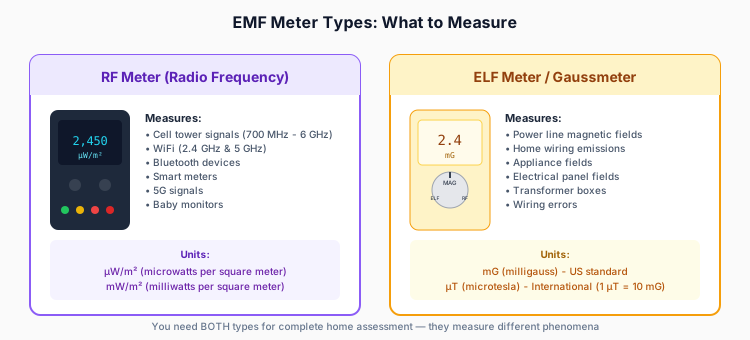
RF (Radio Frequency) — 3 kHz to 300 GHz Sources: Cell towers, WiFi routers, cell phones, Bluetooth devices, smart meters, microwaves Measured in: µW/m² (microwatts per square meter) or mW/m² (milliwatts per square meter)
ELF (Extremely Low Frequency) — 3 Hz to 3 kHz Sources: Power lines, electrical wiring, appliances, transformers Measured in: mG (milligauss) or µT (microtesla) for magnetic fields; V/m for electric fields
You can’t measure RF with an ELF meter or vice versa. Some combination meters do both, but entry-level options typically specialize in one or the other.
Check your EMF exposure
See cell towers, power lines, and substations near any US address.
Search Your AddressEquipment: What You Actually Need
The right EMF meter depends on what you’re measuring and your budget. Dedicated meters outperform combination units for accuracy.
For RF Measurement
Budget Option (~$150-200): Acoustimeter AM-11 or Safe and Sound Classic
- Good for detecting WiFi, cell signals, smart meters
- Simple traffic-light display (green/yellow/red) plus numeric readout
- Limited frequency range compared to pro meters — see our complete meter comparison
Mid-Range (~$350-500): Safe and Sound Pro II
- Wider frequency range (200 MHz - 8 GHz)
- Covers 5G mid-band frequencies
- Peak and average readings
- Audio feedback helps locate sources
Professional (~$800-2000+): GigaHertz Solutions HF35C or HFW35C
- Laboratory-grade accuracy
- Directional antenna for source identification
- Covers frequencies up to 6 GHz (HFW35C to 27 GHz for 5G mmWave)
- Required for professional assessments
Our recommendation for homeowners: The Safe and Sound Pro II hits the sweet spot—accurate enough to trust, covers modern frequencies including 5G, and won’t bankrupt you.
For ELF Measurement (Magnetic Fields)
Budget Option (~$30-50): Trifield TF2, Latnex MG-300
- Measures magnetic fields from wiring and appliances
- Basic accuracy, good for finding obvious problems
- Some also measure electric fields and RF (with limitations)
Mid-Range (~$150-250): AlphaLabs UHS2
- Higher accuracy gaussmeter
- Better for measuring low-level fields (under 1 mG)
- Professional-quality magnetic field readings
Professional (~$400-1000+): Gigahertz Solutions ME3951A
- Separate magnetic and electric field modes
- True RMS measurements
- Frequency-weighted readings matching biological standards
Our recommendation for homeowners: The Trifield TF2 is fine for most purposes. If you’re specifically concerned about power line exposure or want higher precision, step up to the AlphaLabs UHS2.
Combination Meters
The Trifield TF2 and similar “3-in-1” meters measure RF, magnetic, and electric fields. Convenient, but understand the tradeoffs:
- RF accuracy is lower than dedicated RF meters
- Frequency range is limited
- Fine for screening, not for definitive assessment
If budget allows, dedicated meters for each type give better results.
How to Measure: Step-by-Step Protocol
A systematic measurement protocol ensures accurate, reproducible results. Follow these steps for reliable EMF assessment.
Before You Start
- Charge your meters. Low battery affects readings.
- Remove personal electronics. Your phone, smartwatch, and wireless earbuds all emit RF. Put them in another room or airplane mode.
- Plan your survey. Sketch a floor plan and mark where you’ll take readings.
- Note the time. RF levels vary with cell network traffic; ELF varies with electrical load.
RF Measurement Protocol
Step 1: Establish Baseline Start in the center of each room, away from walls and devices. Hold the meter at chest height, oriented according to manufacturer instructions. Record the ambient reading.
Step 2: Check Near Known Sources Measure 1 foot from:
- WiFi router (both 2.4 GHz and 5 GHz bands)
- Smart meters
- Cordless phone base stations
- Smart home hubs
- Baby monitors
Record peak and average readings where available.
Step 3: Check Exterior Walls and Windows If you’re near cell towers, RF often enters through windows. Measure at each exterior-facing window at:
- Window center
- 3 feet back into the room
- With blinds/curtains open vs. closed (some materials reduce RF)
Step 4: Measure Bedrooms Carefully For sleep spaces, measure:
- At pillow height
- At the head of the bed (wall side if against a wall)
- At nightstand level (where phones often charge)
Step 5: Scan for Surprises Walk slowly through the home with the meter in “peak hold” or maximum mode. Listen if your meter has audio—it’ll chirp when detecting signals. Common surprise sources:
- Neighbor’s WiFi (especially in apartments)
- Hidden smart devices (smart TVs often transmit even when “off”)
- Solar inverters
- Security systems
Room-Specific Measurement Tips
Bedroom (Highest Priority — you spend 7-9 hours here nightly):
- Measure RF at pillow level, facing the nearest window
- Measure magnetic and electric fields at pillow level and mattress surface
- Check for cords behind the headboard creating electric fields
- Target levels for sleeping areas: RF < 0.1 mW/m², Magnetic < 2 mG, Electric < 10 V/m
Living Room / Home Office:
- Measure at your typical sitting position
- Multiple monitors can produce elevated magnetic fields within 1 foot
- Check power strips under desks — move them away from your legs/feet
Kitchen:
- Measure magnetic fields near the refrigerator (especially if it backs to a bedroom wall)
- Check near the electrical panel if kitchen-adjacent
- Kitchen appliance exposure is brief — the bigger concern is always-on appliances near rooms where you spend extended time
Near Windows (External Sources):
- Measure RF at each window facing cell towers — check EMF Radar to know which direction towers are
- Compare window readings to 3 feet back into the room to see wall attenuation
- If elevated, RF shielding window film can reduce incoming tower radiation by 95%+
Recording Your Results
| Location | Distance from Source | Peak (µW/m²) | Average (µW/m²) | Notes |
|---|---|---|---|---|
| Living room center | Ambient | 45 | 12 | Neighbor WiFi visible |
| Kitchen, near smart meter | 3 ft | 2,500 | 800 | Peaks during transmit cycle |
| Master bedroom, pillow | Ambient | 8 | 3 | Router in next room |
ELF/Magnetic Field Measurement Protocol
Step 1: Check Overall Home Background Measure in the center of each room, away from appliances and wiring. In a typical home, background should be 0.2-1.0 mG. Higher than 2 mG away from obvious sources suggests a wiring issue.
Step 2: Measure Near Suspected Sources
- Along walls shared with electrical panels (maintain 3+ feet for sleeping)
- Near refrigerators, HVAC equipment, washers/dryers
- Where you feel vibration (motors create fields)
- Near power strips and extension cords under load
Step 3: Check Bedrooms Thoroughly Map the bed area:
- Head of bed (both sides)
- Center of mattress
- Foot of bed
- Under the bed (some people have electronics stored there)
Watch for:
- Elevated readings on one side (possible wiring behind wall)
- Readings that change when you turn circuits on/off
- Clock radios and charging stations near pillows
Step 4: Test for Wiring Errors Wiring issues (neutral-ground bonds, improper grounds) can create elevated whole-house magnetic fields. Signs to look for:
- Readings above 1 mG throughout the home
- Fields that don’t correspond to obvious sources
- Readings that change when neighbor’s load changes (indicates shared neutral issues)
If you suspect wiring problems, hire an electrician familiar with EMF issues—this is beyond DIY territory.
Step 5: Measure Near Power Lines (If Applicable) If transmission or distribution lines are near your property:
- Measure at the property line closest to the lines
- Measure at exterior walls facing the lines
- Measure inside rooms facing the lines
- Take readings at different times (power flow varies)
Common Measurement Mistakes
Holding the Meter Wrong
Your body absorbs RF and can distort readings. Hold the meter at arm’s length by the handle or bottom edge. For magnetic field measurements, position your body behind or beside the meter, not in front of it.
Measuring Near Metal
Metal objects reflect and concentrate RF, creating artificially high or low readings. Take measurements in the middle of rooms, away from filing cabinets, metal shelving, and appliances.
Expecting Stable RF Numbers
RF readings jump around constantly — this is normal, not a broken meter. Cell towers adjust power, WiFi bursts data, and phones transmit intermittently. Watch the reading for 30–60 seconds and note the average and peak values.
Measuring Appliances at Contact Distance Only
A hair dryer reads 200 mG at the handle — alarming! But you only use it for 5 minutes, and the field drops to near zero at arm’s length. Always measure at the distance where you’ll actually be during use.
Comparing RF and Magnetic Field Numbers
5 mW/m² of RF and 5 mG of magnetic field are measured in completely different units from completely different sources. Interpret each field type independently against its own reference ranges.
Not Measuring at Multiple Times of Day
Cell tower traffic peaks during weekday business hours and evenings. Magnetic fields may change based on which circuits are active. Multiple measurements at different times reveal patterns that single snapshots miss.
Interpreting Your Results
Understanding what your EMF readings mean requires comparing them to established reference levels. Building biology standards are precautionary and more conservative than regulatory limits.
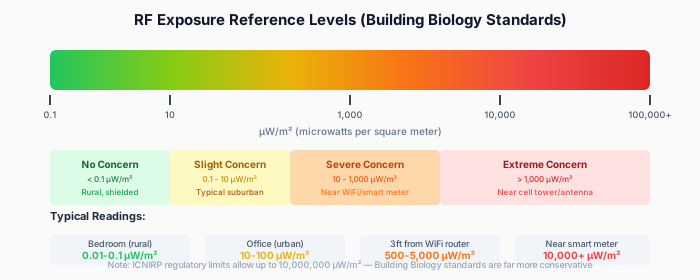
RF Reference Levels
| Reading (µW/m²) | Building Biology Assessment | Context |
|---|---|---|
| < 0.1 | No concern | Very low, typical of rural areas |
| 0.1 - 10 | Slight concern | Normal urban background |
| 10 - 1,000 | Severe concern | Near WiFi routers, smart meters |
| > 1,000 | Extreme concern | Close to cell antennas, inside RF beam |
Note: Regulatory limits (ICNIRP) allow up to 10,000,000 µW/m² (10 W/m²), based on preventing tissue heating. Building biology standards are precautionary and far more conservative.
For context, EMF Radar’s RF scoring roughly corresponds to:
- Score 0-15: Typically < 10 µW/m²
- Score 16-30: Typically 10-100 µW/m²
- Score 31-50: Typically 100-1,000 µW/m²
- Score 51-70: Typically 1,000-5,000 µW/m²
- Score 71+: Often > 5,000 µW/m²
Magnetic Field Reference Levels
| Reading (mG) | Building Biology Assessment | Context |
|---|---|---|
| < 0.2 | No concern | Ideal for sleeping areas |
| 0.2 - 1 | Slight concern | Typical home background |
| 1 - 5 | Severe concern | Elevated, investigate sources |
| > 5 | Extreme concern | Near sources or wiring issues |
The childhood leukemia research found elevated risk above 3-4 mG. Precautionary guidelines suggest keeping sleeping areas below 1 mG.
EMF Radar’s ELF scoring roughly corresponds to:
- Score 0-15: Typically < 1 mG at property
- Score 16-30: Typically 1-3 mG
- Score 31-50: Typically 3-10 mG
- Score 51+: Typically > 10 mG or very close to infrastructure
Common Findings and What They Mean
“My whole house reads 2+ mG magnetic everywhere” Likely a wiring issue. Could be improper neutral-ground bonds, shared neutrals, or knob-and-tube wiring. Have an EMF-aware electrician investigate.
“RF spikes to 50,000+ µW/m² near my smart meter” Normal for smart meters during transmission bursts. If this is near a bedroom, the meter’s placement is the issue. You may be able to request relocation.
“One bedroom wall reads 5x higher than the rest” Check what’s on the other side—electrical panel, refrigerator, or wiring running through that wall. Rearrange the bed to move the head away from that wall.
“RF is low everywhere except near windows facing the cell tower” Expected. Low-E windows reduce RF significantly. Standard glass doesn’t. For concerned homeowners, RF-blocking window film is an option.
What To Do With Your Data
Taking action on your EMF measurements requires prioritizing by time spent in each location. Focus on areas where you spend the most hours.
Step 1: Compare to EMF Radar Scores
Check your address on EMF Radar and compare your measured values to our RF and ELF scores. If they’re aligned, you’ve confirmed the assessment. If they differ significantly, your local situation may have factors our model doesn’t capture (like a nearby WiFi mesh or unusual wiring).
Step 2: Prioritize by Time Spent
Focus reduction efforts on:
- Bedrooms (8 hours/night)
- Home office/desk (if you work from home)
- Living areas (where you spend waking hours)
A high reading in a closet you never enter doesn’t matter. A moderate reading where you sleep matters a lot.
Step 3: Take Simple Actions First
- Move the WiFi router away from bedrooms
- Turn off WiFi at night (use a timer)
- Relocate beds away from high-field walls
- Increase distance from smart meters (or request relocation)
- Replace cordless phones with corded alternatives
Step 4: Measure Again
After making changes, re-measure to confirm improvement. EMF reduction is empirical—verify, don’t assume.
When to Hire a Professional
Professional EMF assessment is recommended when DIY measurements reveal complex issues or when documentation is needed. Consider hiring a Building Biology consultant or EMF professional if:
- You suspect wiring issues causing elevated whole-house fields
- You’re highly sensitive and need thorough assessment
- You’re buying a home and want pre-purchase evaluation
- Your readings are confusing or inconsistent
- You need documentation for a real estate transaction
Professional assessments typically cost $300-800 depending on home size and scope. Find certified consultants through the Building Biology Institute or the International Institute for Building-Biology & Ecology.
Summary: Your Measurement Checklist
Equipment
- RF meter (Safe and Sound Pro II recommended)
- ELF/gaussmeter (Trifield TF2 or better)
- Notebook and pen, or spreadsheet on a non-WiFi device
- Floor plan sketch
Preparation
- Remove/disable personal wireless devices
- Charge meters fully
- Note time of day and any unusual electrical activity
Measurement
- RF: Center of each room, near sources, exterior walls/windows, bedrooms
- ELF: Center of each room, near electrical sources, beds, perimeter walls
- Record peak and average where applicable
- Note any anomalies for follow-up
Analysis
- Compare to reference levels above
- Cross-check with EMF Radar scores
- Identify highest-priority areas
- Plan reduction steps
- Re-measure after changes
Good data leads to good decisions. Now you have the tools to get it.
Frequently Asked Questions
What is the best EMF meter for home use?
The Safe and Sound Pro II ($350-500) is the best RF meter for homeowners because it covers modern frequencies including 5G, provides both peak and average readings, and offers reliable accuracy without professional-level cost. For magnetic fields, the Trifield TF2 ($30-50) is sufficient for most home assessments.
How often should I measure EMF in my home?
Measure EMF levels whenever you make changes to your home electronics, rearrange furniture in bedrooms, or notice new cell towers or electrical infrastructure nearby. Annual baseline measurements help track changes over time. Re-measure immediately after any mitigation efforts to verify effectiveness.
What EMF level is considered safe for sleeping?
Building biology guidelines recommend RF levels below 10 µW/m² and magnetic field levels below 1 mG for sleeping areas. These precautionary standards are far more conservative than regulatory limits, which focus only on preventing tissue heating rather than long-term exposure effects.
Can I use my smartphone as an EMF meter?
Smartphone EMF apps cannot accurately measure electromagnetic fields. Phones lack the calibrated sensors and antenna systems required for reliable EMF measurement. These apps may detect some magnetic field variations but should not be used for health-related EMF assessment. Invest in a dedicated meter for accurate results.
Why are my EMF readings different at different times of day?
RF levels fluctuate with cell network traffic, which peaks during commute hours and evenings. Magnetic field levels vary with electrical load in your home and neighborhood. Power line fields are typically higher during peak usage periods. Take measurements at multiple times to understand the full range of exposure in your home.
Do EMF meters need calibration?
Quality EMF meters come factory-calibrated and maintain accuracy for years under normal use. Professional-grade meters should be recalibrated annually if used for paid assessments. For home use, follow manufacturer guidelines and replace meters if readings become erratic or inconsistent with known sources.
The Bottom Line
Measuring EMF in your home requires two types of meters: an RF meter for wireless signals and an ELF meter for magnetic fields from wiring and appliances. Start with bedrooms where you spend 8 hours sleeping, then measure other high-occupancy areas. Compare your readings to building biology reference levels: below 10 µW/m² for RF and below 1 mG for magnetic fields in sleeping areas. Focus reduction efforts on the spaces where you spend the most time, take simple actions like moving WiFi routers and relocating beds away from high-field walls, then re-measure to verify improvement. If you find whole-house elevated magnetic fields or confusing results, hire a Building Biology professional for thorough assessment.
Related Reading
- What Is a Safe Distance From a Cell Tower?
- Power Lines Near My House: Should I Be Worried?
- How to Reduce EMF Exposure at Home
Last updated: January 2026. Equipment recommendations reflect current market availability and may change as new products release.