
The 49ers EMF Controversy: Power Substations, Injuries, and What We Know
Quick Answer: A viral social media post claiming the San Francisco 49ers’ extraordinary injury rate is linked to electromagnetic field (EMF) exposure from a nearby power substation has sparked widespread debate. While the 49ers led the NFL in injuries during the 2024 season, scientific consensus holds that extremely low frequency (ELF) fields from substations do not cause soft tissue damage. However, some researchers say the theory cannot be entirely dismissed, and the team has pledged to investigate.
The San Francisco 49ers entered the 2024 NFL season as Super Bowl contenders. They finished 6-11, decimated by injuries that sidelined nearly every star player on the roster. When a wellness entrepreneur posted a theory blaming the team’s misfortune on the power substation adjacent to their practice facility, it went viral—reaching over 22 million views and prompting uncomfortable questions about electromagnetic fields, athlete health, and what we truly know about long-term exposure.
This is the story of how a fringe theory became a national conversation, and what the science actually tells us.

Key Facts at a Glance
| Category | Details |
|---|---|
| 2024 Injury Impact | 141.2 Adjusted Games Lost (worst in NFL); 20 players on reserve lists; $95M+ in contract value sidelined |
| 2023 Comparison | 34.5 Adjusted Games Lost (4th best in NFL) |
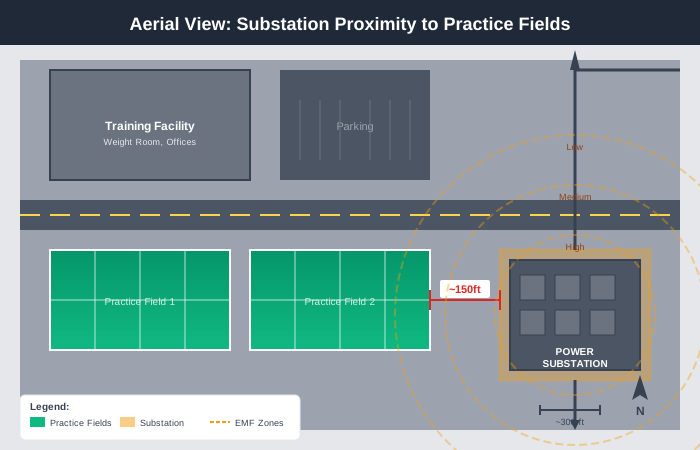
| Substation Distance | Approximately 100 yards from practice fields |
| Substation Timeline | 49ers practicing in Santa Clara since 1988; substation expanded in 2014 |
| Viral Post Views | 22+ million on X (formerly Twitter) |
| EMF Reading Claimed | 8.5+ milligauss at practice field boundary |
| ICNIRP Public Limit | 2,000 milligauss (for 50/60 Hz fields) |
| Expert Consensus | Divided—most say no established link; some say more research needed |
What Happened: The Viral Post That Started It All

On January 6, 2026, Peter Cowan, a wellness entrepreneur and self-described EMF consultant with roughly 6,000 followers, posted a thread on X that would soon reach an audience of millions. His claim was straightforward but provocative: the 49ers’ epidemic of soft tissue injuries might be caused by chronic exposure to low-frequency electromagnetic fields emanating from Silicon Valley Power’s Mission Substation, located just across the street from the team’s practice facility.
Cowan had visited the site on December 1, 2025, armed with a gaussmeter. Standing at the northeast corner of the Marie P. DeBartolo Sports Center practice fields, approximately 100 yards from the substation, he recorded readings of 8.5+ milligauss.
His posts garnered over 22 million views, 35,000 likes, and 5,800 reposts. The theory had escaped the wellness community and entered the sports mainstream.
Check your EMF exposure
See cell towers, power lines, and substations near any US address.
Search Your AddressThe Injury Data: A Statistical Anomaly
The 49ers’ 2024 injury situation was not merely bad—it was historically catastrophic. According to Football Outsiders’ Adjusted Games Lost metric, which measures the cumulative impact of injuries on a team, San Francisco finished dead last in the NFL with 141.2 AGL. For context, the previous season they ranked fourth-best with just 34.5.
The running back position was hit particularly hard, recording 32.2 AGL—the second-highest single-position total in NFL history. Christian McCaffrey, the reigning Offensive Player of the Year, missed most of the season with bilateral Achilles tendonitis before a PCL tear ended his campaign entirely after just four games.
The list of casualties reads like a Pro Bowl roster:
- Nick Bosa: Torn ACL (his second, with the latest occurring in September 2025)
- Fred Warner: Fractured and dislocated ankle
- George Kittle: Torn Achilles tendon during playoff game
- Brandon Aiyuk: Torn ACL in 2024
- Jordan Mason & Isaac Guerendo: Both injured after filling in for McCaffrey
According to OverTheCap, the 49ers had $95 million in adjusted annual contract value sitting on reserve lists—nearly $20 million more than any other team.
What Power Substations Actually Emit
Power substations like Silicon Valley Power’s Mission Substation generate extremely low frequency (ELF) electromagnetic fields as a byproduct of transmitting electricity. These fields operate in the 50-60 Hz range and consist of both electric and magnetic components.
The Mission Substation is the largest in Silicon Valley Power’s system—a 60kV facility with three 50MVA transformer banks. It was expanded in 2014 specifically to support Levi’s Stadium’s power demands.
Here is what the science tells us about ELF exposure:
Typical exposure levels:
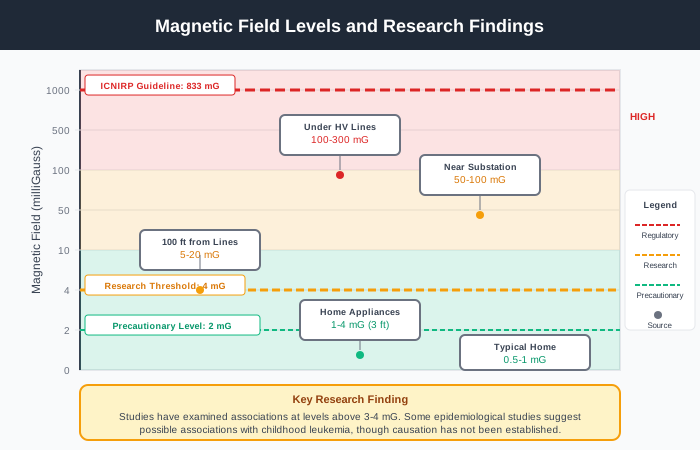
- Directly beneath high-voltage transmission lines: 10-100+ milligauss
- At substation boundaries: 10-20 milligauss (decreasing rapidly with distance)
- Average household exposure: 1-10 milligauss
- 1-2 meters from a substation: Often lower than household levels
Regulatory limits:
- ICNIRP general public limit: 2,000 milligauss (200 microtesla)
- IEEE recommended limit: 9,100 milligauss
The 8.5 milligauss reading Cowan recorded falls well below regulatory thresholds—approximately 0.4% of the ICNIRP limit. However, some EMF researchers advocate for precautionary limits as low as 0.5-1.0 milligauss, particularly in sleeping areas, based on epidemiological studies suggesting possible associations with childhood leukemia.
Expert Opinions: A Divided Field

The scientific response to Cowan’s theory has ranged from dismissive to cautiously open-minded.
The Skeptics
Frank de Vocht, professor of epidemiology and public health at Bristol Medical School in England and a leading EMF researcher, offered perhaps the most direct assessment in an interview with The Washington Post. He called the theory “nonsense.”
Christopher Collins, professor of radiology at New York University, struggled to identify any plausible mechanism. He noted that the closest phenomenon—dizziness experienced in MRI machines—requires magnetic fields vastly stronger than anything near a substation.
Jerrold Bushberg, radiology professor at UC Davis and chair of the National Council on Radiation Protection and Measurements, told Front Office Sports that “there is no firmly established evidence” that low-level EMF exposures have biological impacts on tissue integrity.
A Bay Area physician interviewed by ABC7 characterized the claims as “baseless,” noting that ELF fields lack sufficient energy to break molecular bonds, damage DNA, or produce thermal effects on tissue.
The Cautious Voices
Frank Barnes, distinguished professor emeritus at the University of Colorado Boulder, offers a more nuanced perspective. Barnes has studied EMFs for over six decades and co-edited the foundational “Handbook of Biological Effects of Electromagnetic Fields.”
His assessment: “Can’t rule it out, but you can’t rule it in, either.”
While Barnes considers the theory “unlikely,” he acknowledged a theoretical worst-case scenario where EMFs could alter oxidative stress levels in players, potentially leading to overcompensation during workouts. He emphasized the probability was “pretty darn low” but suggested the only way to know for certain would be to take actual measurements.
Joel Moskowitz, a UC Berkeley researcher serving on the International Commission on the Biological Effects of Electromagnetic Fields, offered qualified support. He stated there is “some credence to this theory,” though he acknowledged it is “not the most likely risk factor” for the injuries.
Barnes also highlighted a frustrating research gap: “The utility companies, and particularly the communications companies, don’t want to see anything, so there has been essentially no money for research on the effects of magnetic fields on the biology.”
What Science Says About ELF and Tissue Health
The relationship between ELF-EMF and biological tissue is more complex than either dismissive or alarmist takes suggest. Published research reveals a fascinating paradox: the same frequencies some fear may cause harm are actively used in therapeutic applications.
Therapeutic applications of ELF-EMF include:
- Bone healing: Pulsed electromagnetic field (PEMF) therapy is FDA-approved for treating non-union fractures, accelerating osteoblast proliferation
- Wound repair: Studies show ELF-EMF can modulate inflammation, accelerate re-epithelialization, and promote collagen formation
- Soft tissue recovery: Research indicates potential benefits for reducing inflammation markers and enhancing angiogenesis

A 2021 review in the International Journal of Molecular Sciences found that ELF-EMF therapy demonstrates three primary beneficial effects on wound healing: anti-inflammatory effects through cytokine modulation, neo-angiogenic effects through increased endothelial cell activity, and re-epithelialization through collagen stimulation.
However, these therapeutic applications use carefully controlled frequencies, intensities, and exposure durations—very different from chronic environmental exposure.
What we do not know:
The research on long-term, low-level chronic exposure remains inconclusive. ELF-EMFs were classified as “possibly carcinogenic” (Group 2B) by the International Agency for Research on Cancer in 2002, based on limited epidemiological evidence suggesting associations with childhood leukemia. However, no causal mechanism has been established.
Critically, no published research directly links ELF-EMF exposure to soft tissue degradation, tendon weakness, or increased athletic injury rates. The mechanism Cowan proposed—that low-frequency fields “degrade collagen, weaken tendons, and cause soft-tissue damage”—lacks support in the peer-reviewed literature.
The Locker Room Response
The theory did not remain confined to social media. It penetrated the 49ers’ locker room itself.
Former guard Jon Feliciano, who spent two seasons with the team before retiring after missing all of 2024 with a knee injury, confirmed the substation had been a topic of conversation among players. Following Cowan’s viral post, Feliciano stated in an Instagram video that while he would not do interviews about it, EMF exposure was “definitely a conversation” during his time with the team.
When tight end George Kittle tore his Achilles during a playoff game against Philadelphia, receiver Kendrick Bourne alluded to the theory, joking that “that power plant” was responsible.
Current players have expressed more serious interest. Defensive end Nick Bosa, who has now torn his ACL twice, told reporters: “I might pull up with a meter one day. It’s getting a little suspicious at this point. There might be something going on.”
The Washington Post surveyed approximately two dozen NFL agents, roughly one-third of whom reported hearing concerns from their clients about the power plant theory.
What the 49ers Are Doing
General manager John Lynch announced the team would investigate all possible factors contributing to the injury epidemic—including the substation theory.
“Because it deals with allegedly the health and safety of our players, I think you have to look into everything,” Lynch stated.
The investigation represents an acknowledgment that even theories with limited scientific support warrant examination when player welfare is at stake. Whether the team will conduct independent EMF measurements, commission third-party studies, or simply review existing research remains unclear.
Frank Barnes, the Colorado researcher, noted that shielding an entire outdoor practice field from EMF would be impractical. However, he suggested that if elevated readings were found in indoor facilities like the locker room, mitigation measures such as field-canceling generators or soft iron shielding could be implemented.
Lessons for Facilities Near Substations
The 49ers controversy offers broader lessons for sports facilities, workplaces, and residential developments situated near electrical infrastructure.
For facility planners:
- Commission baseline EMF measurements before construction
- Document readings at various distances and times (EMF levels fluctuate with power demand)
- Consider buffer zones for areas where people spend extended periods
For existing facilities:
- If concerns arise, obtain professional EMF assessments rather than relying on consumer-grade meters
- Compare readings to both regulatory limits and precautionary guidelines
- Document the chronology of any health concerns relative to infrastructure changes
For researchers:
- The 49ers case highlights the need for more funding toward long-term EMF exposure studies
- Athletic populations may offer valuable data given their consistent location and detailed health monitoring
- Comparison studies between teams with varying proximity to electrical infrastructure could prove illuminating
Related Reading
Frequently Asked Questions
What is EMF, and how does it differ from radiation?
Electromagnetic fields exist on a spectrum ranging from extremely low frequency (ELF) fields generated by power lines and appliances to high-frequency ionizing radiation like X-rays. ELF-EMFs from power substations operate at 50-60 Hz—far below the frequencies capable of ionizing atoms or breaking chemical bonds. They are classified as non-ionizing radiation, fundamentally different from the harmful radiation associated with nuclear materials or excessive X-ray exposure.
Have the 49ers always had injury problems at this location?
The 49ers have practiced in Santa Clara since 1988, and the substation has been present in some form since then. However, the substation was significantly expanded in 2014 when Levi’s Stadium opened. The team’s injury rates have fluctuated considerably over the years—they ranked fourth-best in the NFL for Adjusted Games Lost in 2023, just one year before finishing last. This variability complicates any direct correlation with substation proximity.
Are the EMF readings at the 49ers facility above safe limits?
The 8.5 milligauss reading reported by Peter Cowan is well below regulatory limits set by international bodies. The ICNIRP recommends a public exposure limit of 2,000 milligauss for 50/60 Hz magnetic fields—roughly 235 times higher than the recorded reading. However, some researchers advocate for more conservative precautionary limits, and the readings have not been independently verified or contextualized with measurements at varying distances and times.
Could shielding protect players from potential EMF exposure?
According to EMF researcher Frank Barnes, shielding an entire outdoor practice field would be impractical. However, indoor facilities could potentially be protected using field-canceling technology or soft iron materials. Barnes emphasized that such measures would only be warranted if professional measurements confirmed elevated readings in those specific areas.
What do other NFL teams do about EMF exposure?
No publicly available information suggests other NFL teams have conducted EMF assessments of their facilities or implemented specific mitigation measures. The 49ers case may prompt increased awareness across the league, particularly for teams whose facilities are near electrical infrastructure. The topic has not previously been part of standard facility evaluation protocols.
Is there any precedent for EMF concerns in professional sports?
The 49ers situation appears to be unprecedented in terms of public attention. While occupational EMF exposure has been studied in various industries, professional sports facilities have not been a focus of EMF research. This case may catalyze new investigations into whether athletes—who spend extended periods training in fixed locations—warrant specific consideration in EMF exposure guidelines.
Related Reading
- Living Near a Power Substation: EMF Exposure and What to Know — What the research says about EMF levels near substations and homes
- Do Power Lines Cause Cancer? Decades of Research Reviewed — The long-running debate about ELF magnetic fields and health
- Power Lines Near Your House: Understanding the Real Risk — Distance, field strength, and what matters for people living near power infrastructure
- How to Measure EMF in Your Home — How to take your own readings with consumer EMF meters
- EMF and Cancer Research — A broader review of the human and animal study evidence
- Check EMF levels near any location → — Use our free interactive map to see cell towers and power line infrastructure near you
The Bottom Line
The 49ers EMF controversy sits at the intersection of genuine scientific uncertainty, viral speculation, and a team’s very real injury crisis. The facts are these: San Francisco suffered historically bad injury luck in 2024, a power substation does sit adjacent to their practice facility, and the scientific community cannot definitively prove a negative.
However, the weight of evidence strongly suggests the substation is not responsible for the team’s injuries. EMF levels appear to fall well within established safety guidelines. No peer-reviewed research links ELF exposure to soft tissue degradation. And the team practiced at this location for decades—including many healthy seasons—before the current injury epidemic.
What the controversy does illuminate is a genuine gap in our scientific understanding of chronic low-level EMF exposure, a gap that utility companies have shown little interest in funding research to close. It also demonstrates how quickly unverified theories can capture public attention when they offer simple explanations for complex problems.
The 49ers have committed to investigating all possibilities. That is the appropriate response—not because the EMF theory is likely correct, but because dismissing player concerns outright would erode trust. In the meantime, the more mundane explanations for the team’s injury woes—training methods, playing style, field surfaces, recovery protocols, and simple statistical variance—deserve equal scrutiny.
Sometimes a bad injury year is just a bad injury year. But in the age of viral theories and legitimate questions about what science does not yet know, the 49ers’ willingness to look into everything may be the most sensible play of all.