Cell Tower Radiation vs Phone Radiation: Which Exposure Is Greater?
Quick Answer: Your phone exposes you to significantly more RF radiation than a nearby cell tower. A phone pressed against your head delivers RF energy directly to your tissue at close range, while cell tower signals travel hundreds of meters and weaken dramatically with distance. However, cell tower exposure is continuous — you’re absorbing it 24/7 — while phone exposure is intermittent. Both matter, and the real question is total cumulative exposure.
Key Comparison at a Glance
| Factor | Cell Phone | Cell Tower |
|---|---|---|
| Typical power output | 0.1–2 watts | 10–100 watts per antenna |
| Distance from you | 0–2 cm (against head) | 100–2,000+ meters |
| Your RF exposure | Higher (close range) | Lower (inverse square law) |
| Duration | Intermittent (calls, browsing) | Continuous (24/7) |
| SAR regulation | Yes (1.6 W/kg limit in US) | Yes (FCC MPE limits) |
| You control it? | Yes | No |
Understanding the Inverse Square Law
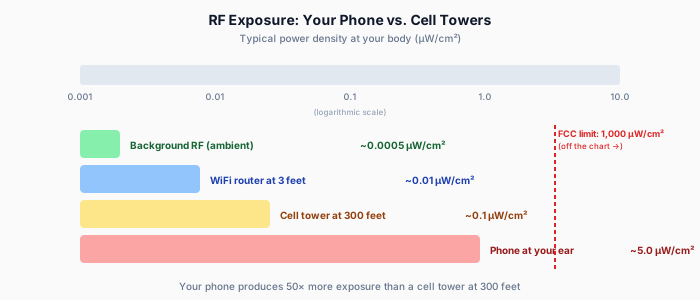
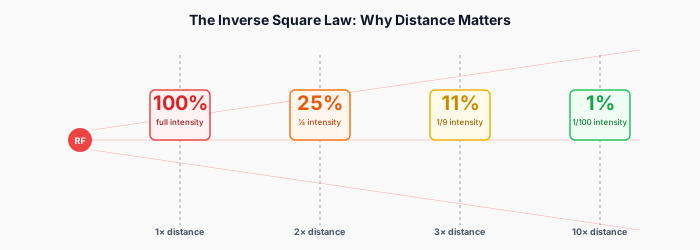
The most important concept in this comparison is the inverse square law: RF power density decreases with the square of the distance from the source.
A cell tower might transmit at 50 watts — far more than your phone’s 1–2 watts. But by the time those signals reach you at 300 meters away, the power density has dropped by a factor of roughly 90,000 compared to holding a phone against your head.
Here’s how this works in practice:
| Distance from Source | Relative Power Density |
|---|---|
| 1 cm (phone at ear) | 1x (baseline) |
| 30 cm (phone on speaker) | 0.001x (1/900th) |
| 1 meter | 0.0001x |
| 100 meters (nearby tower) | 0.00000001x |
| 300 meters (typical tower) | ~0.000000001x |
This is why a 50-watt tower at 300 meters delivers far less RF energy to your body than a 1-watt phone touching your skin.
Check your EMF exposure
See cell towers, power lines, and substations near any US address.
Search Your AddressPhone Radiation: The Closer Threat
How Phone RF Exposure Works
When you hold your phone to your ear during a call, the antenna (typically near the top or bottom edge) is pressed directly against your skull. At this range, your head absorbs a measurable fraction of the transmitted RF energy.
This is measured as Specific Absorption Rate (SAR) — the rate at which your body absorbs RF energy, measured in watts per kilogram (W/kg).
US FCC SAR limits:
- 1.6 W/kg averaged over 1 gram of tissue (head and body)
EU/ICNIRP SAR limits:
- 2.0 W/kg averaged over 10 grams of tissue
Most modern smartphones test between 0.2 and 1.5 W/kg at maximum power. However, SAR testing is done under worst-case conditions — maximum transmit power, phone pressed against a test head. Real-world exposure varies significantly.
When Your Phone Emits the Most
Your phone doesn’t transmit at full power all the time. It dynamically adjusts based on signal strength:
- Weak signal (1 bar): Phone ramps up to maximum power to maintain connection — highest RF exposure
- Strong signal (full bars): Phone transmits at minimum necessary power — lowest RF exposure
- Phone call: Continuous transmission throughout the call
- Streaming video: Frequent short bursts of data transmission
- Standby: Periodic check-ins with the tower, very low exposure
- Airplane mode: No RF transmission at all
Key insight: Your phone exposes you to more radiation when you have weak signal. If you live far from a cell tower, you get less tower radiation but more phone radiation because your device has to work harder to reach the distant tower.
Real-World Phone Exposure Scenarios
| Scenario | Relative Exposure | Duration |
|---|---|---|
| Voice call (phone at ear) | Very High | Minutes per call |
| Video call (phone at arm’s length) | Moderate | Minutes |
| Browsing/social media (hand) | Low-Moderate | Hours per day |
| Phone in pocket (standby) | Very Low | All day |
| Phone on nightstand (standby) | Negligible | 8 hours |
| Phone in airplane mode | Zero | Variable |
Cell Tower Radiation: The Constant Background
How Tower RF Exposure Works
Cell towers broadcast signals continuously, regardless of whether anyone nearby is using a phone. The antennas on a macro tower typically transmit at 10–100 watts per channel, and a single tower may have dozens of channels across multiple carriers and frequencies.
However, the antennas are directional (not omnidirectional), and the main beam is angled slightly downward from the horizontal to cover ground-level users. If you’re directly beneath a tower, you’re actually in a relatively low-exposure zone because the main beam passes over you.
Tower Exposure by Distance
Using real-world measurements from published studies:
| Distance from Tower | Typical Power Density | Relative to FCC Limit |
|---|---|---|
| 50 meters | 0.1–1.0 mW/m² | 0.01–0.1% of limit |
| 100 meters | 0.01–0.5 mW/m² | 0.001–0.05% of limit |
| 200 meters | 0.005–0.1 mW/m² | Well below limit |
| 500 meters | 0.001–0.01 mW/m² | Negligible |
| 1,000+ meters | < 0.001 mW/m² | Background level |
Even at 50 meters from a tower — uncomfortably close by most standards — the measured RF power density is typically less than 0.1% of the FCC safety limit.
Compare this to a phone call: your head absorbs energy at rates approaching the SAR limit (1.6 W/kg), which is vastly more RF energy than the milliwatts per square meter reaching you from a distant tower.
The 24/7 Factor
The counterargument for tower exposure is duration. While your phone exposure is intermittent (you’re not on calls 24 hours a day), cell tower exposure never stops. You’re absorbing low-level RF radiation from towers every moment you’re in range — while sleeping, working, exercising.
Some researchers argue that chronic low-level exposure could have biological effects that acute higher-level exposure doesn’t, through mechanisms like:
- Disruption of cellular calcium signaling
- Effects on melatonin production
- Oxidative stress at the cellular level
- Blood-brain barrier permeability changes
The 2018 NTP (National Toxicology Program) study and the Ramazzini Institute study both found health effects in animals exposed to low-level RF fields over their lifetimes — at levels comparable to living near a cell tower, not using a phone.
These studies remain debated, but they highlight why chronic tower exposure deserves attention even though instantaneous power levels are low.
Cumulative Daily Exposure: A Realistic Estimate


Let’s estimate total daily RF exposure for a typical person:
Phone Exposure
- 30 minutes of voice calls at ear: High exposure (~0.5–1.5 W/kg SAR)
- 3 hours of browsing/social at hand distance: Moderate exposure
- 18 hours standby in pocket or nearby: Very low exposure
Tower Exposure (living 200m from nearest tower)
- 24 hours continuous exposure at ~0.05 mW/m²: Very low but constant
Combined Assessment
For most people, phone usage accounts for 80–95% of their total RF exposure, especially during voice calls. Tower exposure accounts for the remaining 5–20%, primarily as a chronic background contribution.
However, this ratio changes if you:
- Rarely use your phone → Tower exposure becomes proportionally larger
- Live very close to a tower (< 100m) → Tower exposure increases significantly
- Live in a dense urban area → Multiple towers compound the background level
- Use your phone heavily (hours of calls daily) → Phone dominates even more
What the Research Says
Studies Focusing on Phone Use
-
INTERPHONE Study (2010): The largest case-control study on phone use and brain tumors. Found no overall increase in risk, but suggested a possible elevated risk for the heaviest users (30+ minutes per day for 10+ years) on the side of the head where the phone was held.
-
Swedish Hardell Group Studies (2006–2013): Found increased risk of glioma and acoustic neuroma with long-term phone use (10+ years), particularly on the ipsilateral (same) side.
-
IARC Classification (2011): The WHO’s International Agency for Research on Cancer classified RF electromagnetic fields as Group 2B — “possibly carcinogenic to humans” based primarily on phone use evidence.
Studies Focusing on Tower Proximity
-
Eger et al. (2004): Found cancer incidence was 3x higher among residents living within 400 meters of a cell tower compared to those living farther away, over a 10-year period in Naila, Germany.
-
Wolf & Wolf (2004): Reported 4.15x higher cancer incidence rate among residents within 350 meters of a cell tower in Netanya, Israel, compared to the broader population.
-
Dode et al. (2011): Study of 7,191 cancer deaths in Belo Horizonte, Brazil found a strong correlation between proximity to cell tower clusters and cancer mortality, with highest risk within 500 meters.
-
NTP Study (2018): Found “clear evidence” of heart tumors and “some evidence” of brain tumors in rats exposed to whole-body RF radiation at levels comparable to living near a cell tower.
The Bottom Line
Both phone and tower exposure have associated health concerns in the scientific literature. Neither is “safe” in the absolute sense, and neither is proven to be definitively harmful at typical exposure levels. The prudent approach is to minimize both.
How to Reduce Your Exposure from Each Source
Reducing Phone Exposure
- Use speakerphone or wired earbuds — Moving the phone 30 cm from your head reduces exposure by ~99%
- Text instead of calling — Phone at arm’s length during texting produces much less exposure
- Don’t hold the phone against your body — Use a bag, desk, or table
- Avoid calls in weak signal areas — Your phone transmits at maximum power in low-signal zones
- Limit call duration — Shorter calls = less cumulative exposure
- Use airplane mode at night — Eliminates all RF emission while sleeping
Reducing Tower Exposure
- Know your tower proximity — Check your address on EMF Radar to see nearby towers
- Choose housing wisely — When buying or renting, check for towers within 400 meters
- Use RF shielding — Window film and shielding paint can reduce tower RF entering your home
- Sleep in the room farthest from towers — Maximize distance during your longest exposure period
- Advocate for setback distances — Support local regulations requiring minimum distances between towers and residences
The Real Answer: Manage Both
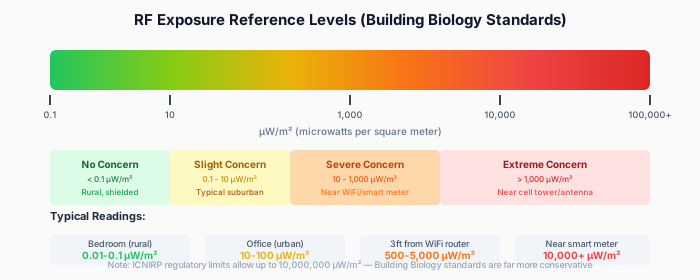
Framing this as “tower vs phone” misses the bigger picture. Your total RF exposure is the sum of all sources — phone, towers, WiFi routers, smart meters, Bluetooth devices, and more.
The most impactful steps you can take:
- Distance your phone from your body (biggest single reduction for most people)
- Check your tower exposure at home — search your address on EMF Radar to see what’s nearby
- Address the source you can’t control — If you live close to a tower, consider RF shielding
- Reduce the source you can control — Limit phone call time and use speakerphone
Neither source is inherently “worse” — they’re different types of exposure (acute vs. chronic) that both contribute to your overall electromagnetic environment. The goal isn’t to eliminate one; it’s to minimize both.
Check Your Tower Exposure
Curious about the cell towers near your home? EMF Radar shows you every tower, power line, and substation near any US address — free.
Understanding your local tower environment is the first step toward managing your total RF exposure. Combined with smart phone habits, you can significantly reduce your daily electromagnetic burden.
Frequently Asked Questions
Is living near a cell tower worse than using a phone?
In terms of instantaneous RF exposure, using a phone at your ear is far more intense. But tower exposure is continuous — 24/7, including while you sleep. Both contribute to your overall exposure, and the healthiest approach is to minimize both.
How far from a cell tower is considered safe?
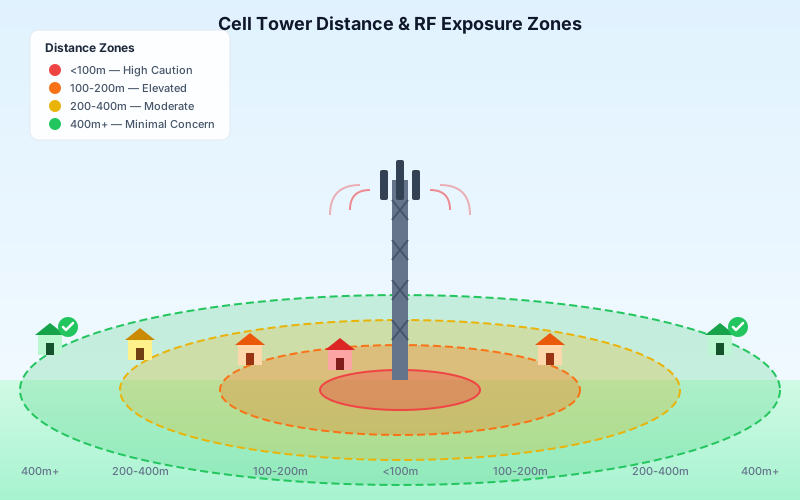
Most precautionary guidelines recommend at least 400 meters (1,300 feet) from a macro cell tower. At this distance, RF power density is negligible. Use EMF Radar to check your specific address and see how many towers are within this radius.
Does my phone emit more radiation when I’m far from a tower?
Yes. Your phone increases its transmit power when the signal is weak, which happens when you’re far from a tower or inside buildings with poor reception. Ironically, living far from towers can increase your phone’s RF output during calls.
Can I measure both phone and tower radiation?
Yes. An RF meter like the TriField TF2 or Safe and Sound Pro II can measure ambient tower radiation in your environment. For phone SAR values, check your phone’s settings or the manufacturer’s specifications.
Should I be more worried about 5G towers?
5G small cells operate at lower power than macro towers (typically 2–10 watts vs. 10–100 watts) but are placed much closer to where people live and work — often on streetlights and building facades. The proximity can partially offset the lower power, making it worth checking your exposure from both types.
Related Reading
- Are 5G Towers Dangerous? What the Research Shows (2026)
- What Is a Safe Distance to Live From a Cell Tower?
- What Does a 5G Tower Look Like? Visual Guide
- Apartment Near a Cell Tower: What Renters Must Know
Concerned about EMF in your environment? Check your address on EMF Radar to see nearby cell towers and power lines, or find a certified EMF consultant for professional testing.