Faraday Cage for Your Bedroom: EMF Bed Canopy Guide 2026
Quick Answer: EMF bed canopies work — a quality silver-threaded canopy can reduce RF exposure by 95–99% (20–40 dB attenuation) inside the sleeping area. Whether you need one depends on your baseline exposure. If you live near cell towers or have strong WiFi signals in your bedroom, a canopy is one of the most effective shielding solutions available. If your bedroom is already low-EMF, a canopy is overkill. Measure first, then decide.
Key Questions
| Question | Answer |
|---|---|
| Do EMF bed canopies actually work? | Yes. Quality canopies block 95–99%+ of RF radiation. Lab and independent tests confirm this. |
| How much do they cost? | $200–$800+ depending on size, material, and grounding capabilities. |
| What about low-frequency EMF (power lines, wiring)? | Canopies block RF (cell towers, WiFi, 5G) but NOT low-frequency magnetic fields from wiring and appliances. |
| Do I need to ground the canopy? | Grounding helps for electric field shielding but isn’t required for RF blocking. Some canopies include grounding kits. |
| Can I just turn off WiFi at night? | Yes, and it’s free. But it won’t block signals from neighbors, cell towers, or external sources. |
| What about shielding paint instead? | Paint shields entire walls (better for external sources), but requires renovation work. Canopies are removable and easier. |

What Is a Faraday Cage?

A Faraday cage is an enclosure made of conductive material that blocks electromagnetic radiation. Named after Michael Faraday, who built the first one in 1836, the principle is simple: when electromagnetic waves hit a conductive mesh, the free electrons in the metal redistribute to cancel the incoming field.
You encounter Faraday cages daily without realizing it:
- Microwave ovens — the mesh screen in the door is a Faraday cage that keeps microwaves inside
- Airplane fuselage — acts as a partial Faraday cage (which is why WiFi needs an internal system)
- MRI rooms — shielded to keep external RF from interfering with imaging
- Your car — partially shields you from external RF (which is why phone signal can drop in parking garages)
An EMF bed canopy is a Faraday cage shaped like a mosquito net — draped over your bed to create a shielded sleeping environment.
Check your EMF exposure
See cell towers, power lines, and substations near any US address.
Search Your AddressWhy the Bedroom Matters Most
You spend roughly 1/3 of your life sleeping. During sleep:
- You’re stationary for 6–9 hours, meaning cumulative exposure at your sleeping position matters more than anywhere else
- Your body is in recovery mode — cellular repair, immune function, hormone regulation
- Your phone (if on the nightstand) is constantly communicating with towers
- You can’t move away from a source mid-sleep like you would while awake
Several studies have investigated RF exposure and sleep quality:
- A 2019 study in the International Journal of Environmental Research and Public Health found that participants living within 300m of cell tower base stations reported significantly more sleep disturbances than those farther away.
- A 2020 Swiss study found measurable (though small) effects on brain electrical activity during sleep when participants were exposed to moderate RF fields.
- A 2022 systematic review in Environmental Research concluded that “there is some evidence that RF-EMF exposure may affect sleep quality, though the clinical significance is unclear.”
Whether RF exposure causally disrupts sleep remains debated. But the bedroom is the one room where shielding provides the longest continuous benefit, making it the highest-impact area to address.
How EMF Bed Canopies Work
The Material
Quality EMF canopies are woven from a blend of cotton or polyester with conductive fibers — usually silver, copper, or stainless steel threads. The conductive fibers create a continuous mesh that reflects and absorbs RF radiation.
Common materials:
| Material | Typical Attenuation | Pros | Cons |
|---|---|---|---|
| Silver-threaded fabric | 30–60 dB (99.9–99.9999%) | Highest shielding, soft, antibacterial | Most expensive, darkens over time with oxidation |
| Copper-nickel fabric | 20–40 dB (99–99.99%) | Good shielding, durable | Stiffer, heavier, can irritate sensitive skin |
| Stainless steel mesh | 20–35 dB (99–99.97%) | Very durable, affordable | Rougher texture, less breathable |
| Silver-coated nylon | 25–45 dB (99.7–99.997%) | Good balance of softness and shielding | Silver coating can degrade with washing |
Understanding decibels (dB) of attenuation:
- 10 dB = 90% reduction (1/10 of signal passes through)
- 20 dB = 99% reduction (1/100 passes through)
- 30 dB = 99.9% reduction (1/1,000 passes through)
- 40 dB = 99.99% reduction (1/10,000 passes through)
For reference, reducing your bedroom RF exposure from typical urban levels (~100–1,000 µW/m²) by 20 dB would bring it down to 1–10 µW/m², which is below the building biology guideline of “no concern” (<10 µW/m²).
The Shape
Most canopies come in three designs:
Box/Rectangular (Best for most people) Hangs from a ceiling frame or hooks, creating a rectangular tent over the bed. Provides the most interior space and airflow. Works for any bed size.
Pyramidal/Pointed Hangs from a single ceiling point and drapes down to the bed corners. Takes less hardware to install but has less headroom. Can feel more enclosed.
Baldachin/Four-poster Attaches to a four-poster bed frame or a freestanding frame around the bed. The most elegant look, but requires a compatible bed or additional frame purchase.
What They Block (and Don’t Block)
✅ Effectively blocked:
- Cell tower signals (3G, 4G, 5G — all bands)
- WiFi (2.4 GHz and 5 GHz)
- Bluetooth
- Smart meter signals
- Neighbor’s WiFi
- 5G mmWave
- Any RF from approximately 100 MHz to 40+ GHz
❌ NOT blocked:
- Low-frequency magnetic fields from power lines, house wiring, and transformers. These require different shielding (mu-metal or special alloys), and are rarely addressed by fabric canopies.
- Low-frequency electric fields from house wiring. Grounded canopies can reduce these, but ungrounded canopies cannot.
- Extremely low frequency (ELF) emissions from appliances near the bed (alarm clocks, chargers, power strips)
This distinction matters. If your main concern is a cell tower visible from your bedroom window, a canopy will help enormously. If your concern is the power lines running directly above your roof, a canopy alone won’t address it.
Do You Actually Need One?

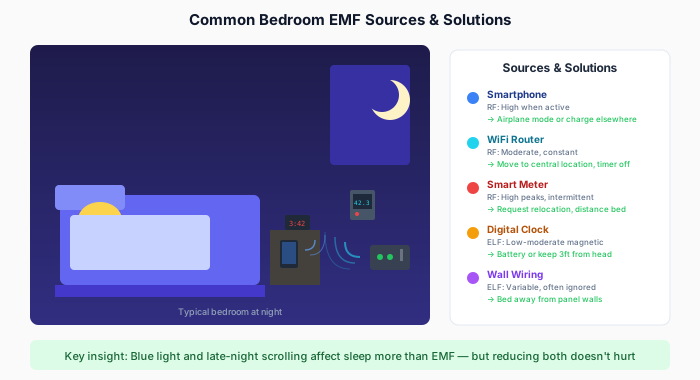
Before spending $300–$800 on a canopy, determine whether your bedroom has an EMF problem worth solving.
Step 1: Measure Your Bedroom
Borrow or buy an RF meter (the TriField TF2 at ~$180 or Acoustimeter AM-11 at ~$400 are popular choices for home use) — see our guide to reading EMF meters. Measure RF power density at your pillow position with all your devices in their normal state.
Building biology guidelines (SBM-2015) for sleeping areas:
| RF Power Density | Classification |
|---|---|
| < 0.1 µW/m² | No concern |
| 0.1–10 µW/m² | Slight concern |
| 10–1,000 µW/m² | Severe concern |
| > 1,000 µW/m² | Extreme concern |
These are precautionary guidelines from the Institute of Building Biology, not government safety limits (which are 10,000,000 µW/m² for ICNIRP). They represent a “better safe than sorry” approach.
Step 2: Check What’s Nearby
Use EMF Radar to see what RF sources are near your home:
- Cell towers within 500 feet are the biggest concern
- Multiple towers in line-of-sight to your bedroom window
- 5G small cells on the utility pole outside
Step 3: Try Free Fixes First
Before buying a canopy, try these zero-cost improvements:
- Put your phone in airplane mode at night — eliminates your biggest personal exposure source
- Move your WiFi router out of the bedroom — ideally to the opposite end of your home
- Turn off WiFi at night using a timer plug (~$10) — eliminates your home WiFi entirely during sleep
- Unplug or move anything with a wireless signal from the bedroom (smart speakers, baby monitors, wireless chargers)
If your RF levels are high because of your own devices, these free steps may solve the problem without any shielding. Re-measure after making changes.
Step 4: Decide on Shielding
If after eliminating your own sources, RF is still elevated (due to external cell towers, neighbor WiFi, etc.), then shielding makes sense. A bed canopy is the most practical option because:
- No renovation required
- Can take it with you when you move
- Protects only the area where you spend the most time
- Easier than shielding an entire room
Buying Guide: What to Look For
Key Specifications
Attenuation rating: Look for independent lab test results, not just manufacturer claims. A quality canopy should provide at least 20 dB (99%) attenuation at common cellular frequencies (700 MHz–3.5 GHz). Better canopies achieve 30–40 dB.

Frequency range tested: Some canopies are tested only at one frequency. Since you’re dealing with multiple signal types (4G at 700–2600 MHz, WiFi at 2.4/5 GHz, 5G at 3.5 GHz or higher), look for attenuation data across a range.
Fabric weight and breathability: You’ll be sleeping inside this. Heavier fabric = better shielding but less airflow. Look for fabric in the 40–80 g/m² range for a good balance.
Closure system: The canopy needs to fully enclose the bed with overlapping or closeable openings for entry. Any gap is a signal leakage path. The best designs have generous overlap flaps.
Floor coverage: RF can enter from below. Some canopies include a floor mat or are designed to tuck under the mattress. Without floor coverage, shielding effectiveness drops significantly — a canopy with an open bottom is more like 70–80% effective rather than 99%.
Grounding option: If you also want electric field shielding, look for canopies with a grounding wire/clip that connects to the ground pin of an outlet.
Recommended Canopies
Budget: Swiss Shield Naturell Canopy ($250–$350)
- Attenuation: ~25 dB at 1 GHz, ~20 dB at 5 GHz
- Cotton/silver blend, breathable
- Good for moderate shielding needs
- Available in multiple sizes
Mid-Range: Blocsilver Canopy ($350–$550)
- Attenuation: ~35 dB at 1 GHz, ~30 dB at 5 GHz
- Silver-threaded polyester, very effective
- Floor mat available separately
- Includes grounding option
Premium: YShield Silver-Tulle Canopy ($500–$800)
- Attenuation: ~40 dB at 1 GHz, ~35 dB at 5 GHz
- Pure silver mesh, near-total RF elimination
- Very lightweight and breathable despite high shielding
- Lab-tested across full frequency range
- Best for high-exposure environments (tower within 200 feet)
Installation Tips
-
Ceiling hooks or frame: Most canopies use 4–6 ceiling hooks or a rectangular frame suspended by hooks. Get hooks rated for the weight (most canopies are 3–8 lbs).
-
Full enclosure: Ensure the canopy reaches the floor on all sides with extra fabric to eliminate gaps. Tuck fabric under the mattress or weight edges with clips.
-
Entry point: Position the opening where you get in/out of bed. Use clothespin-style clips to secure the flap closed after entering.
-
Verify with meter: After installation, measure inside vs. outside the canopy. You should see a dramatic difference. If not, check for gaps.
-
Grounding (optional): Connect the grounding wire to the ground pin of a properly wired outlet. Test the outlet first with a $10 outlet tester to confirm the ground actually works.
DIY Faraday Cage Options
If you’re handy and want to save money, you can build bedroom shielding yourself.
Option 1: EMF Shielding Fabric + Bed Frame
Buy shielding fabric by the yard (Swiss Shield, Blocsilver, or similar — $30–$80/yard) and sew or clip it to a frame around your bed. You need roughly 20–30 yards for a queen bed enclosure.
Pros: Customizable, can match your bedroom aesthetic Cons: Sewing with metallic fabric is tricky, seams are potential leak points
Option 2: EMF Shielding Paint + Window Film
For a more permanent room-level solution:
- Paint walls with carbon/graphite-based EMF shielding paint (like YShield HSF54)
- Apply RF window film to bedroom windows
- Ground the paint to an electrical ground
This creates a shielded room rather than just a shielded bed. See our EMF shielding paint guide for details.
Pros: Protects the entire room, invisible once painted over Cons: Requires painting (or repainting), permanent, need to address windows separately
Option 3: Aluminum Foil (Emergency/Temporary)
Aluminum foil provides decent RF shielding (~20 dB) and can be used for quick testing. Tape foil to a window facing a cell tower to verify that shielding makes a measurable difference before investing in proper materials.
Pros: Costs almost nothing, good for testing concepts Cons: Looks terrible, tears easily, not practical long-term
Common Mistakes

1. Leaving gaps at the bottom A canopy that doesn’t reach the floor or tuck under the mattress leaks significantly. RF will enter through any opening. Think of it like a tent in the rain — a single gap lets water in.
2. Not measuring before and after You need baseline measurements to know if the canopy is working and whether you had a problem to begin with. Flying blind with expensive shielding is like buying medicine without a diagnosis.
3. Using your phone inside the canopy If you bring your phone inside the canopy (not in airplane mode), it may actually increase your exposure. The phone, unable to reach the tower through the shielding, will boost its transmit power to maximum — and you’re now in an enclosed space with it. Always put your phone in airplane mode or leave it outside the canopy.
4. Ignoring non-RF sources If your sleep issues are caused by the charging cable under your pillow or the electric blanket, an RF canopy won’t help. Address electric field sources separately.
5. Not washing correctly Silver-threaded fabrics degrade with harsh detergents and hot water. Follow manufacturer instructions — usually cold water, mild detergent, no bleach, air dry. Washing incorrectly can reduce shielding effectiveness over time.
6. Expecting it to fix everything EMF shielding is one factor in sleep quality. If you’re also dealing with light pollution, noise, caffeine, screen time before bed, or stress, a canopy alone won’t transform your sleep. It’s one piece of a sleep hygiene puzzle.
Frequently Asked Questions
Q: Can I use a regular mosquito net as an EMF shield? No. Standard mosquito nets are made of non-conductive materials (polyester, cotton, nylon) and provide zero EMF shielding. You need fabric with conductive metal fibers woven in.
Q: Will a canopy block my alarm/phone from waking me up? If your phone is inside the canopy and in airplane mode, your alarm will still work (alarms are local, not network-dependent). If your phone is outside the canopy, the sound will pass through the fabric — it blocks RF, not sound.
Q: How long do canopies last? Quality silver-threaded canopies last 5–10+ years with proper care. Shielding effectiveness may decrease slightly over time as silver oxidizes, but the reduction is typically minimal (a few dB over several years).
Q: Do I need to shield the whole house? No. The bedroom is the highest-priority room because of the duration and nature of exposure during sleep. Shield one room well rather than trying to shield everything poorly.
Q: Is it safe to sleep in a grounded canopy during a thunderstorm? Yes. The grounding wire carries negligible current and is connected to your home’s ground system, which is designed to handle lightning through the main grounding rod. A canopy’s grounding is no different from any other grounded appliance.
Q: Can I ground the canopy to a water pipe? Technically yes if the pipe is metal and connects to ground, but this isn’t recommended. Use the ground pin of a properly wired electrical outlet for a reliable connection.
The Bottom Line
An EMF bed canopy is one of the most effective, reversible, and practical ways to reduce RF exposure where it matters most — during sleep. But it’s not something everyone needs.
Buy a canopy if:
- You live within 500 feet of cell towers with line-of-sight to your bedroom
- RF measurements at your pillow exceed 10 µW/m² after removing your own devices
- You’ve already tried free fixes to reduce EMF exposure (airplane mode, turning off WiFi) and levels are still elevated
- You want peace of mind and are willing to invest in measurable shielding
Skip the canopy if:
- Your bedroom RF levels are already low (<10 µW/m²)
- Your main concern is power line magnetic fields (canopies don’t help)
- You haven’t measured yet — measure first, spend later
Before you buy anything: Check your address on EMF Radar to see what cell towers and antennas are near your bedroom. That’s your starting point.
Related Articles
- EMF and Sleep: Do Cell Towers Disrupt Sleep Quality?
- EMF Shielding Paint: Does It Work? Complete 2026 Guide
- How to Block EMF from a Cell Tower: Shielding Guide
- How to Reduce EMF Exposure at Home: A Practical Guide
Related Reading
- Does EMF Affect Your Sleep? What 30+ Studies Found
- The Complete Guide to a Low-EMF Bedroom: Sleep Better by Reducing Electromagnetic Exposure
- EMF and Sleep Apnea: Can Electromagnetic Fields Worsen Sleep-Disordered Breathing?
- How to EMF-Proof Your Home: A Room-by-Room Guide
Concerned about EMF in your home? Check your address on EMF Radar to see nearby cell towers and power lines, or find a certified EMF consultant for a professional home assessment.