Microwave Oven EMF: Safe Distance, Radiation Levels, and What You Need to Know
Quick Answer: Microwave ovens emit both RF radiation (2.45 GHz, the same frequency they use to heat food) and ELF magnetic fields (from the magnetron and transformer). A properly functioning microwave leaks very little RF — the FDA limit is 5 mW/cm² at 2 inches from the surface, and most ovens measure well below that. At 2 feet away, RF leakage drops to near-background levels. The ELF magnetic field from the transformer is typically 25–200 mG at 1 foot and drops to under 2 mG at 4–5 feet. Practical safe distance: stand 3–4 feet away while it’s running. That reduces both RF and magnetic field exposure to negligible levels.
Key Facts at a Glance
| Question | Answer |
|---|---|
| FDA RF leakage limit | 5 mW/cm² at 2 inches from surface (over the oven’s lifetime) |
| Typical RF leakage (new oven) | 0.1–0.5 mW/cm² at 2 inches — well below the limit |
| Magnetic field at 1 foot | 25–200 mG depending on wattage and model |
| Magnetic field at 3 feet | 2–10 mG |
| Magnetic field at 5 feet | < 2 mG (near background) |
| Safe distance for minimal exposure | 3–4 feet during operation |
| Does the door seal matter? | Yes — damaged seals or dirty gaskets increase RF leakage. Clean regularly |
| Can microwaves cause cancer? | The microwave radiation used is non-ionizing — it cannot damage DNA. No evidence links microwave oven use to cancer |
| Is microwaved food radioactive? | No. Microwaves heat food through molecular vibration. No radiation remains in the food |
The microwave oven is the most common source of high-intensity RF radiation in most homes — and also one of the best-shielded. That Faraday cage built into every microwave door isn’t decorative; it’s blocking roughly 99.9% of the energy that’s heating your food.
But “99.9%” isn’t “100%,” and the transformer and magnetron inside produce significant magnetic fields regardless of shielding. Here’s what you’re actually exposed to, and what distance eliminates it.

How a Microwave Oven Produces EMF
RF Radiation (2.45 GHz)
The magnetron tube generates high-powered microwave radiation at 2.45 GHz — a frequency specifically chosen because it’s efficiently absorbed by water molecules in food. A typical home microwave generates 600–1,200 watts of RF power.
The oven is designed as a Faraday cage — a metal enclosure that contains the RF energy inside. The door has a fine metal mesh with holes smaller than the wavelength (~12 cm), which blocks the microwaves while letting you see inside. The mesh, door seal, and metal body contain the vast majority of the energy.
What leaks out:
- Some RF escapes through the door seal, especially around the edges and hinges
- The amount depends on seal condition, oven age, and manufacturing quality
- The FDA mandates that leakage never exceeds 5 mW/cm² at 5 cm (2 inches) from the surface
ELF Magnetic Fields
The magnetron is powered by a high-voltage transformer (typically 2,000–4,000 volts). This transformer, along with the associated wiring, produces significant ELF magnetic fields — the same type generated by other transformers, motors, and power lines.
Unlike RF, magnetic fields are not blocked by the Faraday cage. They pass through the metal enclosure just as they pass through walls. This is actually the larger EMF consideration with microwaves — not the RF leakage.
ELF Electric Fields
The high-voltage circuit also produces electric fields, but these are largely contained by the metal enclosure and drop off rapidly. They’re generally not a significant exposure concern at typical standing distances.
Check your EMF exposure
See cell towers, power lines, and substations near any US address.
Search Your AddressMeasured Levels at Various Distances
RF Leakage (2.45 GHz)
Measured with calibrated RF power density meters:
| Distance from Oven | Typical New Oven | Typical 5+ Year Oven | FDA Limit |
|---|---|---|---|
| 2 inches (5 cm) | 0.1–0.5 mW/cm² | 0.3–2.0 mW/cm² | 5 mW/cm² |
| 6 inches (15 cm) | 0.02–0.1 mW/cm² | 0.05–0.5 mW/cm² | — |
| 1 foot (30 cm) | 0.005–0.05 mW/cm² | 0.01–0.1 mW/cm² | — |
| 2 feet (60 cm) | 0.001–0.01 mW/cm² | 0.002–0.02 mW/cm² | — |
| 3 feet (1 m) | < 0.005 mW/cm² | < 0.01 mW/cm² | — |
| 5 feet (1.5 m) | Near background | Near background | — |
The inverse square law at work: RF power density decreases proportionally to the square of the distance. Move twice as far away, and you get roughly 1/4 the exposure. At 3 feet, even a relatively leaky older oven produces negligible exposure.
Where leakage is highest: Around the door seal, particularly the corners and the area near the door latch. If you can see light escaping through the door seal while the oven is running (in a dark room), the seal may need replacement.
ELF Magnetic Fields
Measured with a triaxial gaussmeter:
| Distance from Oven | 700W Oven | 1,000W Oven | 1,200W Oven |
|---|---|---|---|
| Surface contact | 200–400 mG | 300–600 mG | 400–800 mG |
| 6 inches (15 cm) | 40–100 mG | 60–150 mG | 80–200 mG |
| 1 foot (30 cm) | 15–40 mG | 25–60 mG | 30–80 mG |
| 2 feet (60 cm) | 5–15 mG | 8–20 mG | 10–25 mG |
| 3 feet (1 m) | 2–5 mG | 3–8 mG | 4–10 mG |
| 4 feet (1.2 m) | 1–3 mG | 1.5–4 mG | 2–5 mG |
| 5 feet (1.5 m) | 0.5–1.5 mG | 1–2 mG | 1–3 mG |
| 8 feet (2.4 m) | < 0.5 mG | < 1 mG | < 1 mG |
Key observations:
- Magnetic fields drop off approximately as the cube of the distance (faster than RF) because the transformer acts as a magnetic dipole
- The 3-foot mark is the practical “safe zone” where both RF and magnetic fields reach low levels
- Higher-wattage ovens produce proportionally higher fields
- The field is strongest on the back and bottom of the oven (near the transformer) rather than the front/door
Duration Context
Unlike many EMF sources, microwave exposure is brief and intermittent:
| Use Case | Typical Duration | Frequency |
|---|---|---|
| Reheating leftovers | 1–3 minutes | 1–2x daily |
| Making popcorn | 2–4 minutes | Weekly |
| Defrosting | 3–10 minutes | Weekly |
| Cooking a meal | 5–15 minutes | Occasional |
| Boiling water | 2–4 minutes | Daily |
Total daily exposure for most households: 3–10 minutes. Compare this to 8 hours sleeping near a panel box, or 40 hours per week at an office desk near electrical equipment. The intermittent nature of microwave use significantly reduces cumulative exposure.
Common Concerns Addressed
“Does microwaved food become radioactive?”
No. Microwaves heat food by causing water molecules to vibrate rapidly — friction from this vibration produces heat. This is the same principle as rubbing your hands together for warmth. No radiation stays in the food, no molecular structure is permanently altered beyond the normal effects of heating, and the food is not “irradiated” in any meaningful sense.
Fun fact: the “radiation” leaving your food after microwaving is infrared (heat) — the same radiation leaving any hot food regardless of how it was heated.
“Is standing in front of a running microwave dangerous?”
For a properly functioning microwave, no — even at close range. The FDA’s 5 mW/cm² limit at 2 inches includes a substantial safety margin, and real-world leakage is typically 10–50x below that limit. That said, there’s no reason to press your face against the door either. Standing 2–3 feet back is a simple habit that eliminates any meaningful exposure.
“My microwave is old — is it leaking?”
Possibly more than when it was new, but not necessarily dangerously. Seal wear, accumulated grime in the gasket, and door alignment changes can increase RF leakage over time. Signs that may indicate higher leakage:
- Visible damage to the door seal or mesh
- Food or grease buildup in the door gasket
- The door doesn’t close tightly or requires force to latch
- Paint peeling inside the cavity (doesn’t directly cause leakage but indicates age)
How to test: You can buy a microwave leakage detector for $15–$30 that will tell you if your oven exceeds the FDA limit, or use a general EMF meter for a broader assessment. Professional-grade meters cost more but aren’t necessary for home use.
Simple DIY test (rough indicator only): Place your cell phone inside the microwave (without turning it on). Close the door. Try calling the phone. If it rings, the shielding has significant gaps at cellular frequencies. Note: this isn’t a perfect test because cell phone frequencies (700–2,600 MHz) are different from microwave oven frequency (2,450 MHz), so a pass doesn’t guarantee no leakage and a fail doesn’t necessarily mean dangerous leakage.
“Should I replace my old microwave?”
If it’s working properly, latching correctly, and has no visible seal damage, age alone doesn’t mean it’s dangerous. But microwaves are relatively inexpensive ($50–$200), and a new one will have tighter seals, better energy efficiency, and modern safety features. If your microwave is 10+ years old and you’re concerned about EMF, replacing it is a reasonable, low-cost precaution.
“Are microwave ovens worse than cell towers?”
At the surface of the oven, absolutely — a microwave oven produces far more EMF than any cell tower at ground level. But you stand next to your microwave for minutes, while cell tower exposure is continuous 24/7. The comparison:
| Source | Peak Exposure | Duration | Total Daily Dose |
|---|---|---|---|
| Microwave oven at 1 foot | 25–80 mG (mag), 0.01–0.05 mW/cm² (RF) | 5–10 min/day | Low total due to brevity |
| Cell tower at 500 feet | 0.1–1 mG (mag), 0.0001–0.001 mW/cm² (RF) | 24 hours | Low total due to low intensity |
| WiFi router at 3 feet | 0.1–0.5 mG (mag), 0.001–0.01 mW/cm² (RF) | 16 hours | Low-moderate total |
All of these are well below safety limits. To understand how cell tower vs phone radiation compares, check your cell tower exposure on EMF Radar to see how your home’s external RF sources compare.
Practical Guidelines
The 3-Foot Rule
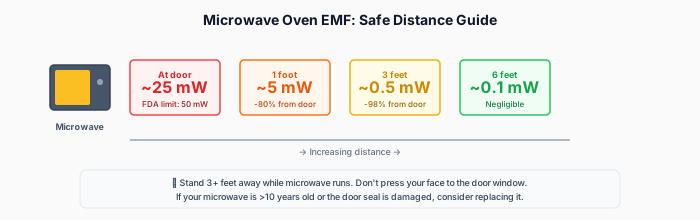
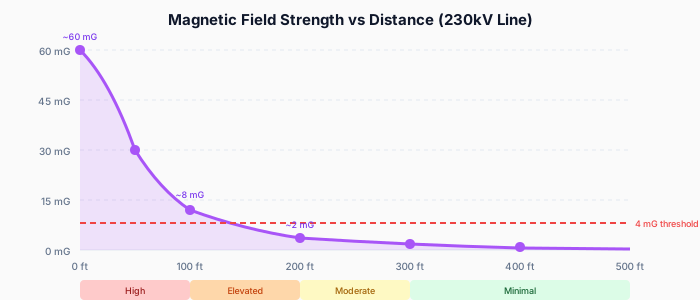
The simplest guideline: don’t stand within 3 feet of a running microwave. At that distance, both RF leakage and magnetic fields are at or near background levels, regardless of oven age or wattage. This isn’t a safety emergency — it’s just the point of diminishing returns where exposure becomes negligible.
Kitchen Layout Tips
If you’re concerned about microwave EMF and designing or reorganizing your kitchen:
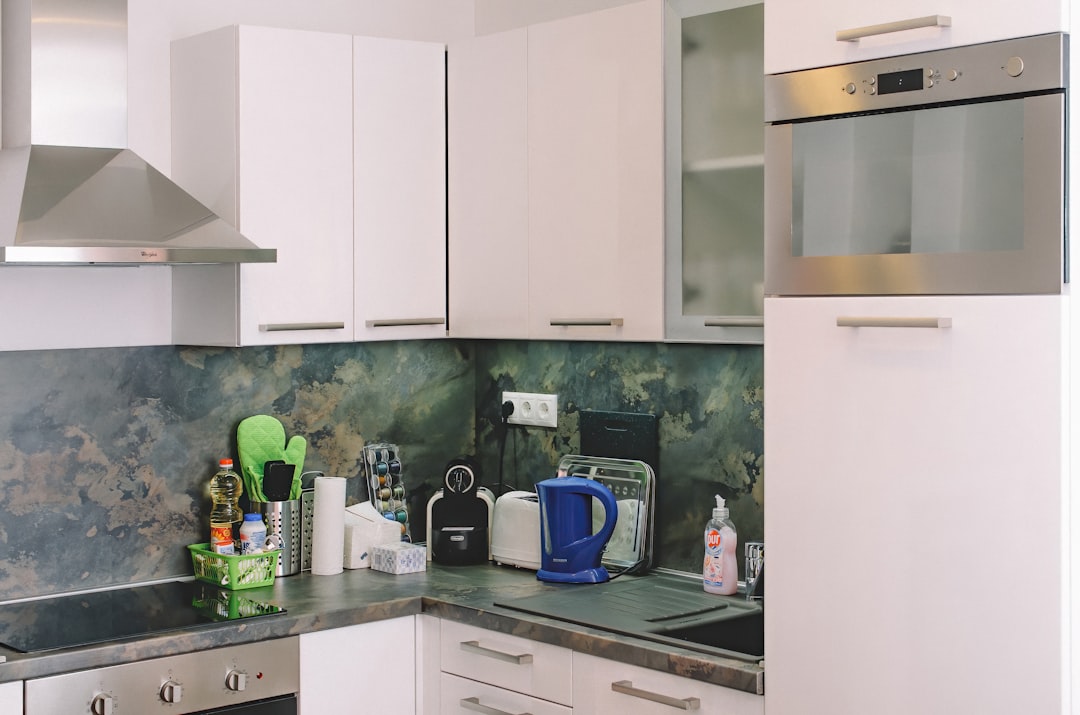
- Don’t place the microwave at head height next to where you stand to cook. Above the stove is a common but EMF-suboptimal location if you’re frequently cooking on the stovetop while the microwave runs.
- Counter placement at waist height, with your normal standing position 3+ feet away during operation, is ideal.
- Don’t place a microwave on the other side of a wall from a bed. Magnetic fields pass through walls, and while levels at 3+ feet are low, there’s no reason to add to nighttime exposure — see our guide on EMF and sleep quality.
- Built-in microwaves in islands or pantry walls are often better from an EMF perspective because they’re naturally farther from where you stand.
Maintenance for Lower Leakage
- Clean the door seal regularly. Food residue in the gasket prevents a tight seal.
- Don’t slam the door. Over time, this misaligns the seal.
- Inspect the mesh screen. Any visible holes, dents, or corrosion in the door mesh means the shielding is compromised.
- Check the door latch. The oven should not run if the door isn’t fully latched — the safety interlock prevents this, but worn latches can affect seal tightness.
- Replace if seal is damaged. A new microwave is $50–$200; a professional seal replacement is often more expensive and less effective.
For Parents
Children are shorter, putting their heads closer to counter-height microwaves. If you have young children:
- Teach them not to stand and watch the microwave from 6 inches away (a common kid behavior)
- Consider placing the microwave on a higher shelf where they naturally maintain more distance
- Use the kitchen timer rather than watching through the window
Microwave Ovens vs. Other Kitchen EMF Sources
Your microwave isn’t the only EMF source in the kitchen:
| Appliance | Magnetic Field at 1 Foot | Notes |
|---|---|---|
| Microwave oven | 25–80 mG | Only during operation (minutes/day) |
| Induction cooktop | 20–80 mG | During cooking, similar to microwave |
| Electric range/oven | 5–30 mG | Lower intensity, longer use |
| Dishwasher (running) | 10–30 mG | 1–2 hour cycles |
| Refrigerator (compressor) | 5–20 mG | Intermittent cycling |
| Blender/food processor | 15–50 mG | Very brief use |
| Coffee maker | 3–10 mG | During brewing |
| Toaster | 5–15 mG | During toasting |
The microwave produces among the highest fields, but for the shortest duration. Induction cooktops are similar in intensity and used for much longer periods — so if EMF is a concern, the cooktop may actually contribute more to your daily exposure than the microwave.
Summary
Microwave ovens produce significant EMF at close range, but the exposure drops rapidly with distance and is brief in duration. A properly functioning microwave leaking RF well below FDA limits, used for 5–10 minutes a day from 3+ feet away, produces negligible total EMF exposure.
The practical bottom line:
- Stand 3+ feet away during operation
- Keep the door seal clean
- Replace ovens with damaged seals or doors
- Don’t place a microwave adjacent to where you sleep (through a wall)
- Don’t stress about it — the numbers are small and the duration is short
Your microwave oven is likely the least concerning EMF source in your home on a daily-exposure basis. Your WiFi router, which runs 24/7, and your cell phone, which sits against your body, contribute far more to your cumulative daily exposure.
Related Articles
- How to Reduce EMF Exposure at Home: A Practical Guide
- How to Measure EMF in Your Home: A Complete Guide
- What Is EMF Radiation? The Complete Science Explained
Want to understand your full EMF picture? Search your address on EMF Radar to see nearby cell towers and RF exposure levels — the sources you can’t see or control are worth knowing about.
Related Reading
- Tesla EMF Levels: How Much Radiation Does a Tesla Produce?
- EMF Exposure While Pregnant: What the Research Says and How to Reduce Your Risk
- Baby Monitor EMF Radiation: Should Parents Be Concerned?
- Do WiFi Routers Cause Cancer? What Science Says in 2026
Concerned about EMF in your environment? Check your address on EMF Radar to see nearby cell towers and power lines, or find a certified EMF consultant for professional testing.