Tesla EMF Levels: How Much Radiation Does a Tesla Produce?
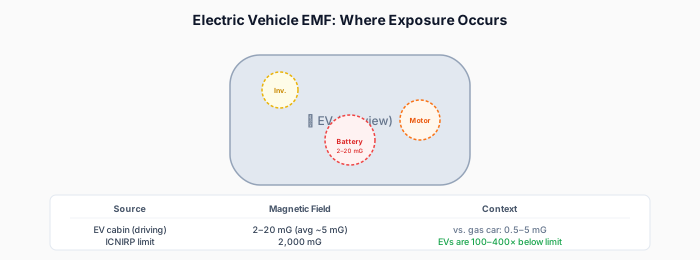
Quick Answer: Tesla vehicles produce magnetic field (ELF-EMF) levels of 2–20 milligauss (mG) at seat level during normal driving — highest during hard acceleration and near the floor where the battery sits. This is above the background level in your home (~1–2 mG) but well below international safety guidelines (2,000 mG / 200 µT per ICNIRP). RF emissions from Tesla’s cellular, WiFi, and Bluetooth systems are comparable to having a smartphone in your car. Independent testing consistently shows Tesla cabin EMF levels are within the same range as other EVs and, for magnetic fields, lower than riding on an electric train.
Key Facts at a Glance
| Question | Answer |
|---|---|
| Typical magnetic field at driver seat | 2–8 mG at seat height during steady driving; up to 15–20 mG during hard acceleration |
| Highest EMF location in a Tesla | Floor/footwell area directly above the battery — 20–50+ mG possible |
| How does this compare to ICNIRP limits? | 100–1,000x below the ICNIRP guideline of 200 µT (2,000 mG) |
| Tesla vs gas car magnetic fields | Tesla: 2–20 mG typical. Gas car: 0.5–5 mG typical. Both well below safety limits |
| Tesla vs other EVs | Similar. All EVs produce comparable cabin EMF. No evidence Tesla is better or worse |
| Does Autopilot/FSD add EMF? | Minimal — radar/camera processing adds negligible EMF at seat level |
| Should Tesla owners be concerned? | At current evidence, no. Cabin levels are far below any threshold shown to cause health effects |
Tesla is the most-discussed electric vehicle brand, and that extends to EMF concerns. Search “Tesla EMF” and you’ll find everything from detailed meter readings to alarming blog posts to dismissive manufacturer statements. This article cuts through the noise with measured data, proper context, and practical guidance.
Sources of EMF in a Tesla
Every Tesla produces EMF from multiple systems. Understanding the sources helps you interpret measurements:
1. Battery Pack (ELF Magnetic Fields)
The battery pack sits under the cabin floor and produces magnetic fields when current flows — during acceleration, regenerative braking, and climate control operation.
- Type: Extremely low frequency (ELF) magnetic fields, primarily 0–300 Hz
- Strength: Depends on current draw. Highest during hard acceleration (hundreds of amps), lowest at constant speed
- Location: Strongest at the floor level, decreasing rapidly with height (the seat provides 1–2 feet of distance)
- Behavior: Fluctuates with driving — hard acceleration produces peaks, coasting produces minimal fields
2. Drive Motor and Inverter (ELF Magnetic Fields)
The electric motor and power inverter produce both ELF magnetic fields and some higher-frequency switching noise:
- Location: Rear (or front and rear in dual-motor models)
- Impact on cabin: Shielded by the vehicle structure; contributes to rear seat and trunk area levels
- Frequency: Motor fields track motor RPM; inverter switching is typically 5–20 kHz
3. Onboard Charger (During Charging Only)
When plugged in, the onboard charger converts AC to DC for the battery:
- Only active during charging — not while driving
- Produces: ELF magnetic fields from power conversion
- Location: Typically front or side of vehicle
- Practical note: You’re usually not sitting in the car while charging
4. Wireless Systems (RF EMF)
Tesla vehicles have multiple RF transmitters:
- Cellular modem: 4G/5G connectivity for navigation, streaming, updates, remote access
- WiFi: For home network connection during updates
- Bluetooth: Phone key, audio streaming
- GPS: Receiver only (no transmission)
- Radar (some models): Forward-facing, used for Autopilot (removed in newer camera-only models)
- Ultra-wideband (UWB): Short-range, used for phone key proximity
These produce RF levels comparable to having a smartphone and Bluetooth speaker in your car — which you probably already have regardless of what you drive.
5. 12V System and Electronics
Like any modern car, the 12V system, touchscreen, seat heaters, and other electronics produce small ELF fields. These are comparable to any modern vehicle and are not Tesla-specific.
Check your EMF exposure
See cell towers, power lines, and substations near any US address.
Search Your AddressMeasured EMF Levels in Tesla Vehicles
Several independent testing efforts have measured cabin EMF in Teslas. Here’s a summary of published data:
Model 3 and Model Y (Most Common)
Magnetic fields (ELF) — measured with calibrated gaussmeter:
| Location | Steady 30 mph | Steady 60 mph | Hard Acceleration | Regenerative Braking |
|---|---|---|---|---|
| Driver headrest | 0.5–2 mG | 1–3 mG | 3–8 mG | 2–5 mG |
| Driver seat (hip level) | 2–5 mG | 3–7 mG | 5–15 mG | 4–10 mG |
| Driver footwell | 8–20 mG | 10–25 mG | 20–50 mG | 15–30 mG |
| Rear seat (center) | 3–8 mG | 5–12 mG | 8–20 mG | 5–15 mG |
| Rear footwell | 10–30 mG | 15–35 mG | 25–60 mG | 15–40 mG |
| Front center console | 2–5 mG | 3–6 mG | 5–12 mG | 3–8 mG |
Data compiled from: safelivingtechnologies.com, emfacademy.com, and several YouTube measurement videos using Trifield TF2 and Gigahertz Solutions ME3030B meters
Key observations:
- Footwell readings are 3–5x higher than seat-level readings due to proximity to the battery
- Acceleration peaks are brief (seconds) and don’t represent sustained exposure
- Steady-speed driving produces the most relevant sustained levels
- Seat-level readings (where your body actually is) are consistently in the 2–15 mG range
RF levels:
| Source | Typical Level at Driver Position |
|---|---|
| Cellular modem | 0.001–0.05 µW/cm² (comparable to a phone in your pocket) |
| Bluetooth | 0.0001–0.001 µW/cm² (very low power) |
| WiFi (when active) | 0.001–0.01 µW/cm² |
| Total RF in cabin | Well below FCC limit of 1,000 µW/cm² |
Model S and Model X
The larger battery and more powerful motors in the Model S and Model X can produce slightly higher readings, particularly in the rear footwell:
- Seat-level readings are similar to Model 3/Y (2–15 mG range)
- Footwell readings can be 10–20% higher due to the larger battery pack
- The greater cabin volume provides more distance from the floor to occupants
Comparison: Tesla vs Other EVs vs Gas Cars
| Vehicle | Driver Seat (mG) | Footwell (mG) | Notes |
|---|---|---|---|
| Tesla Model 3 | 2–8 | 10–30 | Skateboard battery platform |
| Tesla Model Y | 2–8 | 10–30 | Same platform as Model 3 |
| Chevy Bolt | 2–6 | 8–25 | Similar battery-under-floor design |
| Nissan Leaf | 2–7 | 10–28 | Battery under floor and rear seats |
| BMW i3 | 1–5 | 6–20 | Slightly lower due to carbon fiber cabin |
| Hyundai Ioniq 5 | 2–7 | 8–25 | 800V architecture, similar levels |
| Toyota Camry (gas) | 0.5–3 | 1–5 | Alternator and wiring, lower overall |
| Honda CR-V Hybrid | 1–5 | 5–15 | Hybrid battery under rear seat |
| Electric train (metro) | 5–50 | 10–100+ | Much higher sustained levels |
| Electric bus | 3–20 | 8–40 | Higher due to larger motors |
The takeaway: All EVs produce similar cabin EMF levels. Tesla isn’t an outlier — the physics of large lithium-ion batteries under the cabin floor is the same regardless of brand. Gas cars produce lower magnetic fields but still produce some from the alternator, ignition system, and wiring.
Context: What Do These Numbers Mean?
Regulatory Limits
| Standard | Magnetic Field Limit | Tesla Seat Level as % of Limit |
|---|---|---|
| ICNIRP (international) | 2,000 mG (200 µT) at 50 Hz | 0.1–0.75% |
| IEEE C95.1 (US) | 9,040 mG at 60 Hz | 0.02–0.17% |
| Swiss precautionary limit | 10 mG (for new installations) | 20–150% (exceeds during acceleration) |
Tesla cabin levels are well within ICNIRP and IEEE limits. They would exceed the Swiss precautionary installation limit — but that limit was designed for permanent installations like power lines, not brief in-vehicle exposure.
Everyday Comparisons
| Source | Typical Exposure |
|---|---|
| Tesla at seat level | 2–15 mG |
| 6 inches from hair dryer | 100–700 mG |
| 6 inches from microwave oven | 100–300 mG |
| 1 foot from electric range | 5–50 mG |
| Electric blanket | 5–30 mG |
| Office desk (multiple electronics) | 2–10 mG |
| Suburban home background | 0.5–2 mG |
| Under high-voltage power line | 10–70 mG |
Sitting in a Tesla produces magnetic field exposure comparable to working at a desk with a computer, monitor, and phone charger — and much less than using common household appliances at close range.
Duration Matters
A critical factor often missing from EMF discussions:
- Hair dryer: 100–700 mG but used for 5–10 minutes
- Tesla commute: 2–15 mG at seat level for 30–60 minutes
- Sleeping near a panel: 1–5 mG for 8 hours
Total exposure (field strength × time) matters more than peak readings. A Tesla commute involves low-to-moderate levels for moderate duration — not dramatically different from many other daily exposures.
Reducing EMF Exposure in Your Tesla
If you prefer to minimize exposure regardless of current safety guidelines:
Easy Changes (No Cost)
- Avoid floor contact: Don’t rest your feet directly on the floor for extended periods; use the footrest/dead pedal
- Limit acceleration bursts: Smooth driving produces lower magnetic fields than aggressive acceleration (and saves range)
- Use Chill mode: Reduces maximum acceleration, which reduces peak EMF
- Seat position: Maintain normal seating position — the distance between the battery and your body is your primary protection
- Phone placement: Keep your phone on the dash mount rather than in your lap — reduces the RF from your phone, which is actually higher than the car’s EMF at seat level
Moderate Changes
- Seat cushion/riser: A magnetic shielding pad under the seat cushion can reduce footwell exposure, though the practical benefit is small given seat-level readings are already low
- Disable unnecessary wireless: If you don’t use Bluetooth audio, disable it. Turn off WiFi when not at home.
- Child seats: For rear-facing car seats, consider placement that maximizes distance from the floor. The seat itself provides meaningful distance.
What NOT to Bother With
- “EMF blocking” car mats: Most products marketed for this purpose don’t actually shield magnetic fields (which require mu-metal or similar materials, not common fabric)
- Turning off the car’s cellular connection: This saves minimal RF exposure and disables safety features
- Avoiding EVs entirely: The EMF difference between an EV and a gas car is within the range of everyday variation from other sources
The Bigger Picture
If you’re driving a Tesla and concerned about EMF, it’s worth putting the exposure in perspective:
-
Your phone is your biggest personal RF source. The cellular modem in your phone, held against your body, produces orders of magnitude more RF exposure than the car’s systems — see our cell tower vs phone radiation comparison.
-
Your home probably has similar magnetic field levels from wiring, appliances, and electronics — measure your home’s EMF and check with EMF Radar to see what external sources (cell towers) are near your home.
-
The health research on ELF magnetic fields at the levels found in EVs doesn’t show clear harm. The IARC “possibly carcinogenic” classification for ELF-EMF was based on epidemiological studies of much higher exposures (power line workers, high-current electrical occupations), not the 2–15 mG range found in vehicles.
-
EVs eliminate other exposures — no exhaust fumes, reduced engine noise (noise is a health stressor), and no gasoline vapors. The net health equation of switching from gas to electric is likely positive.
Summary
Tesla vehicles produce measurable magnetic fields, primarily from the battery pack under the floor. At seat level where your body sits, readings are typically 2–15 mG during normal driving — well below international safety guidelines and comparable to sitting at a desk with electronics. Footwell readings are higher (10–50+ mG) due to proximity to the battery.
These levels are not unique to Tesla — all EVs with under-floor battery packs produce similar readings. They’re higher than a gas car but lower than many household appliances at close range, and far lower than occupational exposure limits.
If you want to minimize exposure, smooth driving and normal seating position are the most effective strategies. For a broader view of EMF sources and how to reduce your overall exposure, see our home guide. But based on current evidence, Tesla cabin EMF levels don’t appear to pose a health concern.
Related Articles
- Electric Car EMF: How Much Radiation Do EVs Produce?
- EMF in Your Car: Every Radiation Source and How to Reduce It
- How to Measure EMF in Your Home: A Complete Guide
- What Is EMF Radiation? The Complete Science Explained
- EMF Exposure Symptoms: What Does the Research Actually Say?
Curious about EMF exposure outside your car? Search your home address on EMF Radar to see nearby cell towers and estimated RF levels — a complete picture of your daily exposure starts with knowing what’s around you.
Related Reading
- Electric Car EMF: How Much Radiation Do EVs Produce?
- Microwave Oven EMF: Safe Distance and Radiation Levels
- Study Spotlight: Are Electric Vehicles Safe? Japan’s Most Comprehensive EMF Test Says Yes
- EMF Exposure While Pregnant: What the Research Says and How to Reduce Your Risk
Concerned about EMF? Check your address on EMF Radar to see nearby towers and power lines, or find a certified EMF consultant for professional testing.